Authentication
Complete Getting Started — Recommended Setup Sequence (steps 1–12 per Recommended setup order, then steps 13–15 in Listings, Bookings, and Tenants) and Onboarding a New Property — Step 7 before you request partner Bearer keys from [email protected]. Configure steps 11–12 (Integrations, Integration field capability, Tenant categories default for integrations) first — operators automating outside partner integrations use Management session after step 3 (Users). After credentials arrive, verify 200 on a Swagger GET /listings Try it out (this page) before production traffic. Guide pairing after go-live: Setup sequence after go-live (hub: API Reference — Setup sequence after go-live).
Start with Request Format and How It Works for Bearer headers, then Verifying your token in Swagger before your first live call. Next guides: Listings & Availability (first read) → Property & Unit Mapping → Creating Bookings; handle 401 / 403 with Error Handling. Operators automating outside partner integrations should read Management session instead. Habit-specific shortcuts live under Related below.
All Vivin integration API endpoints are protected by Bearer token authentication. Every request must include a valid API key in the Authorization header.
Request Format
Use the same Authorization: Bearer header on every integration prefix — inspect live schemas in Try requests in Swagger.
GET /your-integration/listings HTTP/1.1
Host: api.vivin.app
Authorization: Bearer YOUR_API_KEY
Content-Type: application/json
How It Works
Token scope is one integration platform — do not reuse keys across environments. Contrast operator Management session JWTs before wiring automation — operator-only routes such as AI usage return 401 with integration Bearer keys.
- The Vivin team provisions a unique secret token for your integration during onboarding.
- Include this token in every API request as a Bearer token in the
Authorizationheader. - The API validates the token against the registered secret for your integration platform.
- If valid, the request proceeds and the authenticated integration context is set (your platform identity and associated account).
Verifying your token in Swagger
Confirm 200 on a GET /listings Try it out before production traffic — then continue to Listings & Availability.
Your integration’s OpenAPI (Swagger) page on the API host uses the same Bearer scheme as programmatic calls. Open the URL Vivin gave you at onboarding, click Authorize, paste your API key (with or without the Bearer prefix, following the form hint), then expand an operation and use Try it out to confirm you get 200 responses instead of 401 before you wire a client.
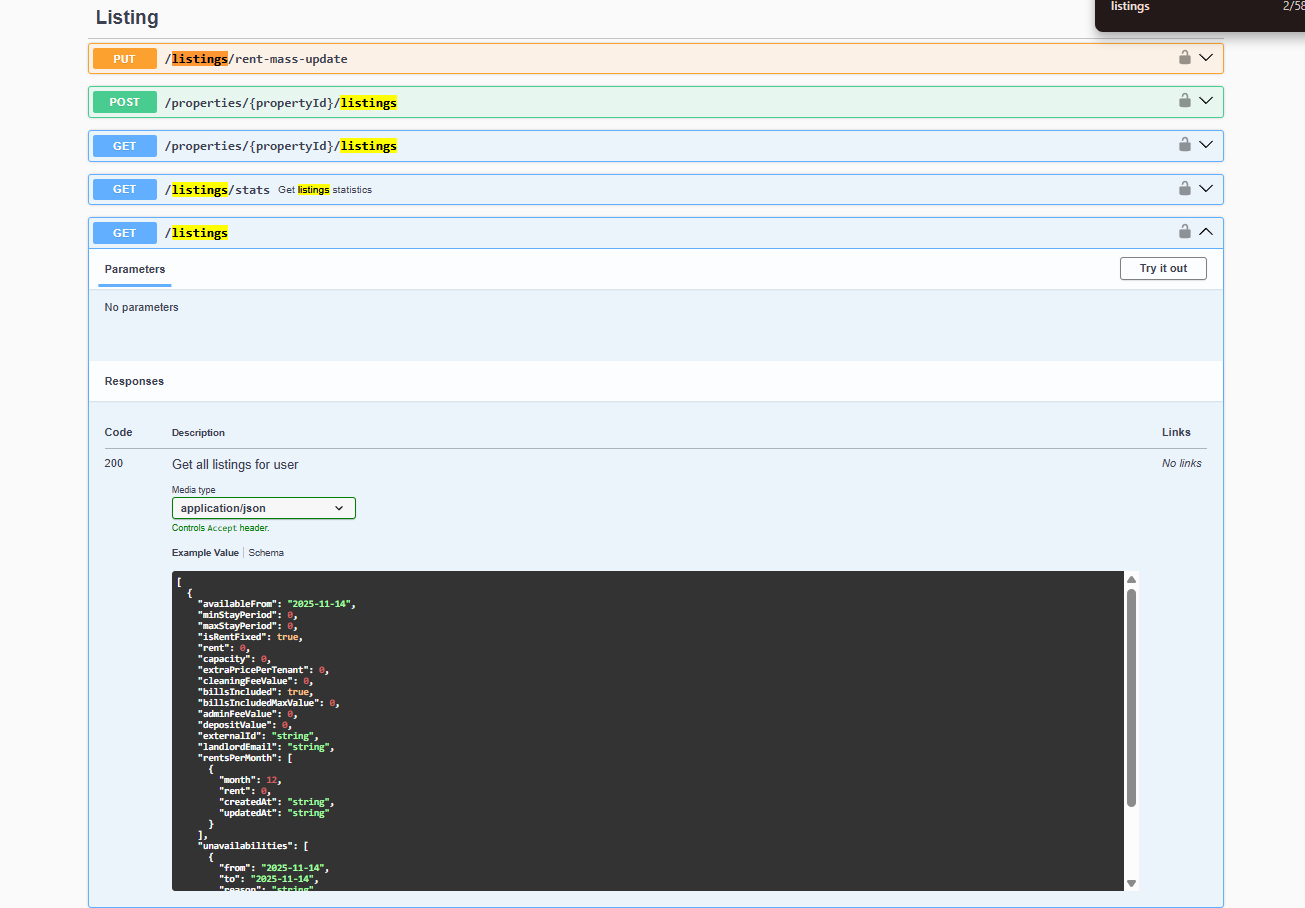
Step-by-step UI flow: Try requests in Swagger.
Token Properties
| Property | Details |
|---|---|
| Format | Opaque string (treat as a secret) |
| Lifetime | Does not expire unless rotated by Vivin |
| Scope | Tied to a single integration platform |
| Rate limits | Contact Vivin for details on rate-limiting policies |
Error Responses
Map 401 / 403 to Error Handling — Authentication Errors; inbound webhooks reuse the same secret per Webhooks & Notifications.
| HTTP Status | Meaning | Action |
|---|---|---|
401 Unauthorized | Token is missing, malformed, or invalid | Check that you are sending the correct token in the Authorization: Bearer <token> header |
403 Forbidden | Token is valid but does not have access to the requested resource | Confirm with Vivin that your token is scoped correctly |
Example: 401 Response
{
  "statusCode": 401,
  "message": "Unauthorized"
}
Security Best Practices
Rotate compromised keys via [email protected] — see Get Help & Support. Never paste integration Bearer tokens into Core /api Swagger (operator JWT only).
- Store your API key in environment variables or a secrets manager - never hardcode it in source code.
- Use HTTPS for all API calls. HTTP requests will be rejected.
- If you suspect your token has been compromised, contact Vivin immediately to rotate it.
- Do not share your token across different systems or environments.
Authentication section cross-reference
Use the endpoints and fields above. Related integrator pages are linked inline where useful.
Related
Related below links partner Bearer authorization to setup, companion API guides, operator workflows, and escalation paths.
Setup sequence after go-live
Complete Account Settings — Recommended setup order before partner traffic.
- Setup steps 1–10 — Complete operator workspace basics (Recommended setup order) before requesting partner Bearer keys; property managers automating outside the browser use Management session authentication after step 3 (Users)
- Setup steps 11–12 (Integrations, Integration field capability, Tenant categories default for integrations) — Channel credentials, calendar horizons, and payload field expectations before
[email protected]onboarding; operator context: Integrations & Distribution - Setup step 13 (Listings) — Property wizard,
externalIdmapping, and Channels tab before first partner listing reads or writes - Setup steps 14–15 (Bookings, Tenants) — Validate imported reservation shape and tenant segments after partner traffic
- After steps 13–15 — Onboarding a New Property — Step 7 go-live verification before escalating partner pull, webhook, or mapping defects
- After steps 11–12 — verify Bearer authorization in Try requests in Swagger with a
GET /listingsTry it out before production traffic; continue to Listings & Availability and Creating Bookings - Partner credential requests — Email
[email protected](distinct from in-app Vivin support tickets in Get Help & Support)
Documentation map & escalation
- Getting Started — Recommended Setup Sequence before partner HTTP traffic;
- API Reference hub — Hub pairing matrix across integration guides;
- Get Help & Support — Request credentials or token rotation via
[email protected](hub: Setup sequence after go-live) - FAQ & Troubleshooting — Credential and Swagger authorization questions (hub: Setup sequence after go-live)
- Glossary — Webhook — Callback signing model that reuses the same integration secret as Bearer reads
Companion API guides
Companion guides share Bearer authorization or error shapes with this page — start from API Reference hub.
- Listings & Availability — First read call after you authorize in Swagger
- Creating Bookings — Write operations that use the same Bearer token
- Error Handling —
401/403responses and when not to retry - Management session authentication — Operator Core API JWT (not integration Bearer keys)
- Webhooks & Notifications — Outbound event signing with the same integration secret
- Full listing feeds — Rich catalogue reads that use the same Bearer authorization
- iCal feeds — Calendar export module that shares the integration host but not JSON
GET /listings - Property & Unit Mapping — Configure
externalIdvalues before your first authenticated read call - Booking Lifecycle & Validations — Validation errors after authorized write calls
- Booking engine integration — Public booking-engine endpoints that use a different auth model
Upstream & downstream workflows
- Onboarding a New Property — Operator setup sequence before partner tokens can see live inventory
- Processing a New Booking — Operator confirmation workflow after partner imports use the same Bearer token
- Portfolio KPI review — Reconcile imported booking volume after your first authorized
POST /bookingstraffic - Notification triage — Clear payment alerts when authorized writes create booking events
- Managing a Check-out & Deposit Refund — Operator settlement after partner
POST /bookingsimports reach departure week
Operator UI & settings
- Settings > Integrations — Operator connection UI where platform credentials are provisioned alongside account setup
- Settings > Preferences — In-app notifications — Account-wide integration alerts when auth failures block channel sync troubleshooting
- Settings > Emails — Lifecycle templates and Communication Rules for partner-created bookings
- Property & listing details (booking engine) — Rich catalogue fields partners read after Bearer authorization on full feeds
- Create New — Inlife Import — Operator bulk migration before partner tokens see live mapped inventory
- Audit — Discounts tab — Cross-portfolio discount export after first authorized booking imports land in Bookings
Deeper concept reads
- Concepts > Integrations — Channel strategy before your first authorized listing pull
- Payment Allocation — Two-layer receipts, invoiced-floor rent edits, and credit note reject/revert warnings
- Booking Lifecycle — Computed Upcoming → Ongoing → Ended / Canceled status model, list filters, and Timeline
- Services Marketplace — Ancillary charges on tenant payment plans after authorized booking creation
- Tenant Portal — Booking-scoped tenant access after partner
POST /bookingscreates payment schedules - FAQ — Tenant contract signing blocked — No PDF yet, mandatory Your Details gates, category locks, or Lease purpose; portal signing vs paper upload on Contract Info
Deeper workflow reads
See Upstream & downstream workflows above for the same guides.
Operator habit hubs
Day-to-day operator habits (lockout catch-up, pending receipts, payment triage, handoffs, and related playbooks) live on the Common Workflows habit hub.
Deep-link anchors for habit hubs
Lockout catch-up after password recovery
Pending manual receipt approval
Reject/revert mistaken receipts
Portfolio segmentation by tenant category
Notification row-click navigation
Payment alert to receivables triage
Confirmation alert triage
Finance debt receivables triage
Handling a Late Payment collections
Finance Income status drill-down
Cash flow forecast drill-down
Key glossary terms
- Glossary — Invoiced floor (rent) — Rent edits blocked below exported invoice totals on live imported bookings
- Glossary — Deposit lifecycle status — Partner Bearer keys cannot mutate
depositStatus; deposit refund is operator UI after import - Glossary — End-of-Booking cost split — Charge Time → End of Booking splits daily overage across every occupied unit; still-staying roommates stay in the denominator
- Glossary — Change history — Operator-initiated edits on Listings setup and Bookings Changelog; create-time defaults excluded
- Glossary — Archived booking ledger visibility — Delete Booking hides manual/provider_platform rows on Finance → Transactions; vIBAN and credit card stay visible
- Glossary — Finance tenant category cache refresh — Recategorizing a tenant updates
booking.tenantCategoryIdimmediately; ledger tabs reflect it on reload, while Overview can lag up to ~10 minutes - Glossary — Full term list
Module documentation hubs
for screen-by-screen operator follow-up.
- Audit module — Manual blocks on mapped units that cause authorized availability reads to disagree with Sales (hub)
- Bookings module — Operator UI for reservations created via
POST /bookings(hub) - Dashboard module — Post-login Today, Total debt, Vacant Units, and forecast KPI snapshot with bell notification triage (hub)
- Analytics module — Month-range portfolio KPI charts (Overview, Revenue, Occupancy, ADR, RevPAR, Maintenance) with rankings and heatmaps (hub)
- Listings module — Property wizard, Channels tab, Archived inventory, and unit management (hub)
- Properties workspace — Legacy
/propertiesURL redirects into Listings (hub) - Booking engine details — Rich marketplace payload editor via the Full integration pill (hub)
- Finance module — Portfolio ledgers (Overview, Income, Contract Values, Transactions, Payouts, Deposits) with payment approval and deposit settlement (hub)
- Tenants module — Tenant directory, profile sidebars, With Debt segmentation, and table expand for linked bookings (hub)
- Sales module — Portfolio availability, monthly rent editing, and channel manager connections (hub)
- Utilities module — Bills Included ceiling model, Connections, AI bill upload, and tenant overage charges on payment plans (hub)
- Operations module — Maintenance tickets, cash flows, check-in/out coordination, Draft ticket queues, and linked cash flows (hub)
- Inbox module — Portfolio-wide WhatsApp workspace with Dashboard bell Inbox sub-tab deep links (hub)
- Notifications module — Full
/notificationshistory with search, filters, and row-click navigation (hub); Payment overdue alerts when partner traffic creates overdue schedules - AI Chat module — AI Assistant using Landlord MCP tools for portfolio Q&A (hub)
- Account Settings — Workspace-wide financial policies, templates, integrations, and operational defaults (hub)