Account Settings
The Account Settings module is the central hub for configuring your entire Vivin workspace. All platform-wide rules — financial policies, user access, communication templates, integrations, and operational defaults — are defined here.
Changes made in Account Settings typically affect new records going forward. Existing bookings, contracts, and payment schedules are not retroactively altered when you update settings.
Start with Search settings when you already know the control name, or browse System — Personal Settings and Global Settings (company identity, booking defaults, fees, and utilities) open first — then Team for access, Billing for payment and contract policy, and Tenant Portal for what tenants see. First-time administrators should complete Getting Started — Recommended Setup Sequence steps 1–12 on the tabs below before daily operations. Each Account Settings sub-guide opens with a First-time workspace setup tip tailored to that tab's setup step and a Finding your way in this guide tip with section anchors. Habit-specific shortcuts live under Related below.
First-time administrators should complete Getting Started — Recommended Setup Sequence steps 1–12 on the Account Settings tabs below, then finish setup steps 13–15 in Listings, Bookings, and Tenants before daily operations. Guided walkthrough of settings steps 4–12: Onboarding a New Property. After modules go live, run Onboarding a New Property — Step 7. If sign-in was restored mid-setup, see Getting Started — Lockout catch-up after password recovery. Step-to-tab mapping: Recommended setup order. Workflow pairing after go-live: Setup sequence after go-live. Each Account Settings sub-guide opens with a First-time workspace setup tip tailored to that tab's setup step and a Finding your way in this guide tip with section anchors.
When a Settings tab needs a refresh — Directory-style modules and Account Settings tabs may ask you to Retry or refresh the page if a first load is incomplete. See Glossary — Directory list refresh and Glossary — Settings and profile recovery for Integrations, Emails, Services, Invoicing, Tenant categories, and My Profile.
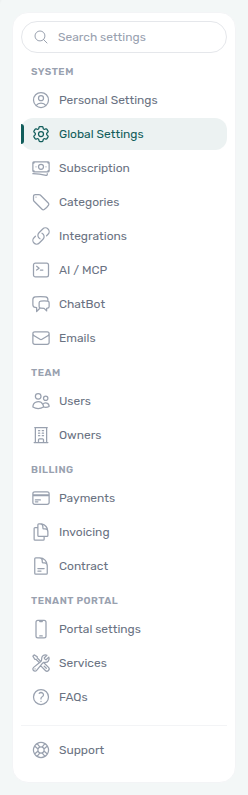
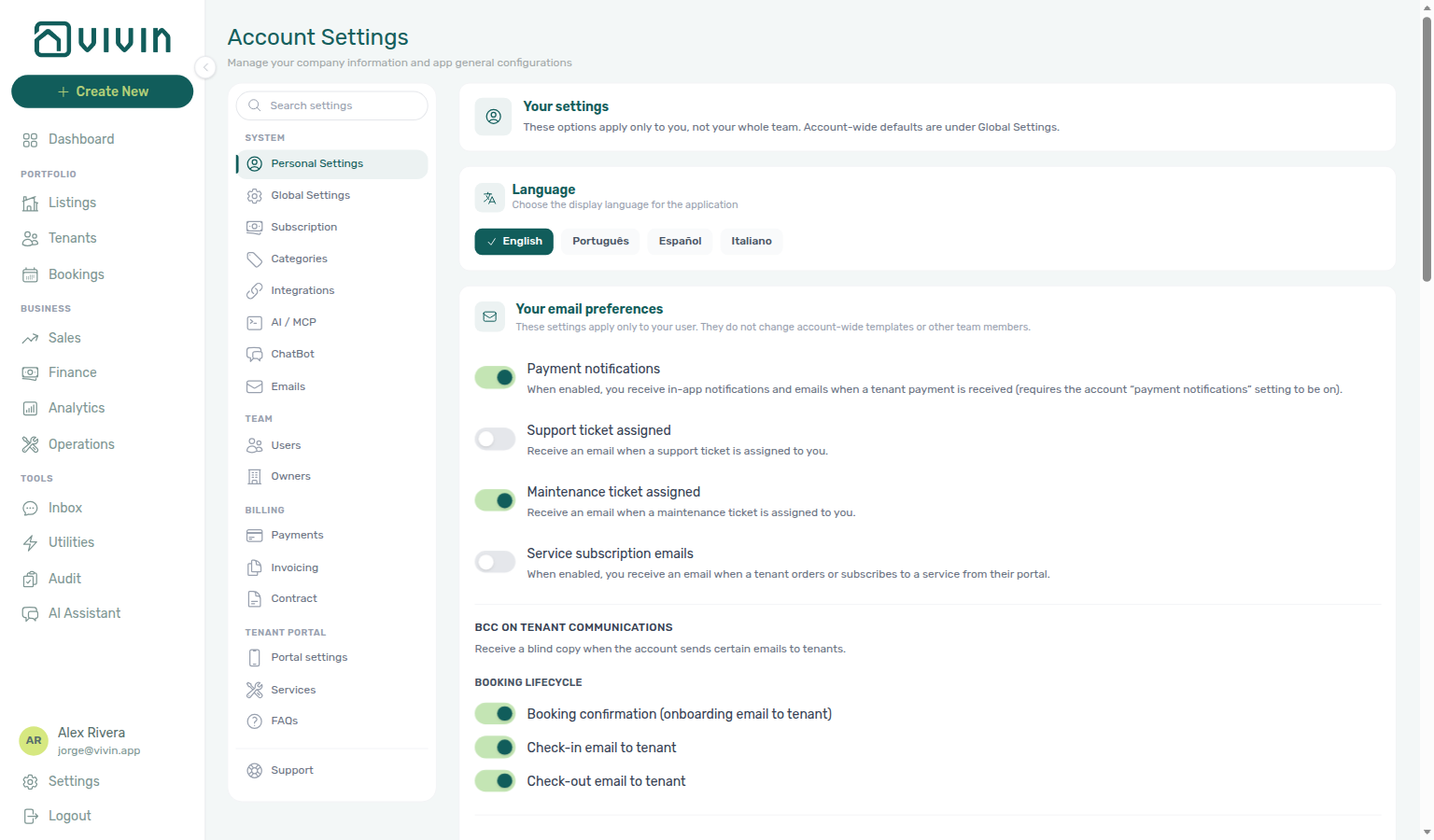
The module is organised into sections of tabs in the left sidebar: System, Team, Billing, and Tenant Portal. The exact tabs you can open depend on your role and permissions (some tabs are hidden or read-only if your role does not include the underlying setting). Use Search settings at the top of the sidebar to jump straight to a tab or a labelled card inside it.
The bare /settings URL opens Global Settings (English sidebar label). Company identity, branding, booking defaults, fees, and utilities live as cards on that tab — not as separate sidebar rows.
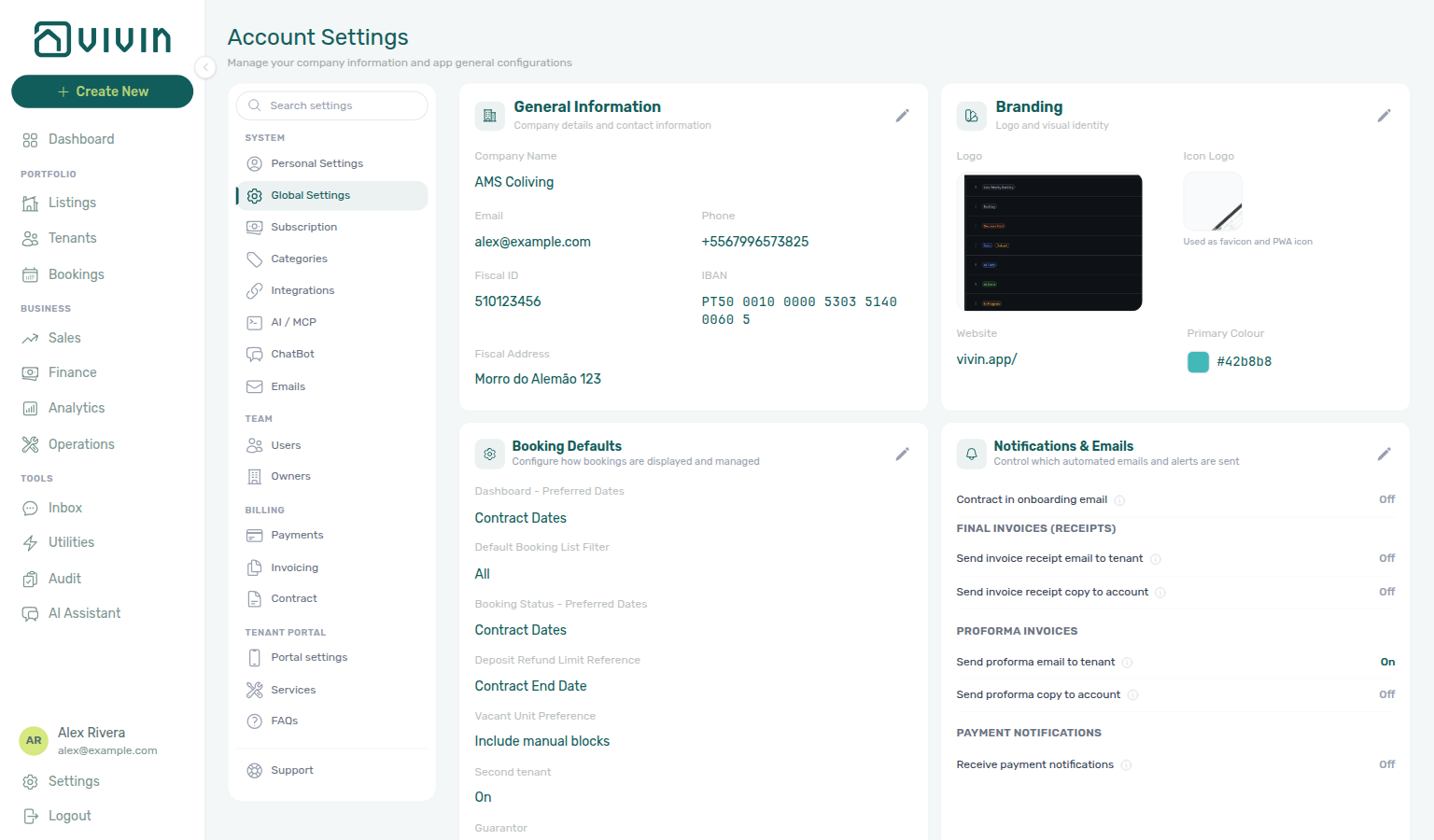
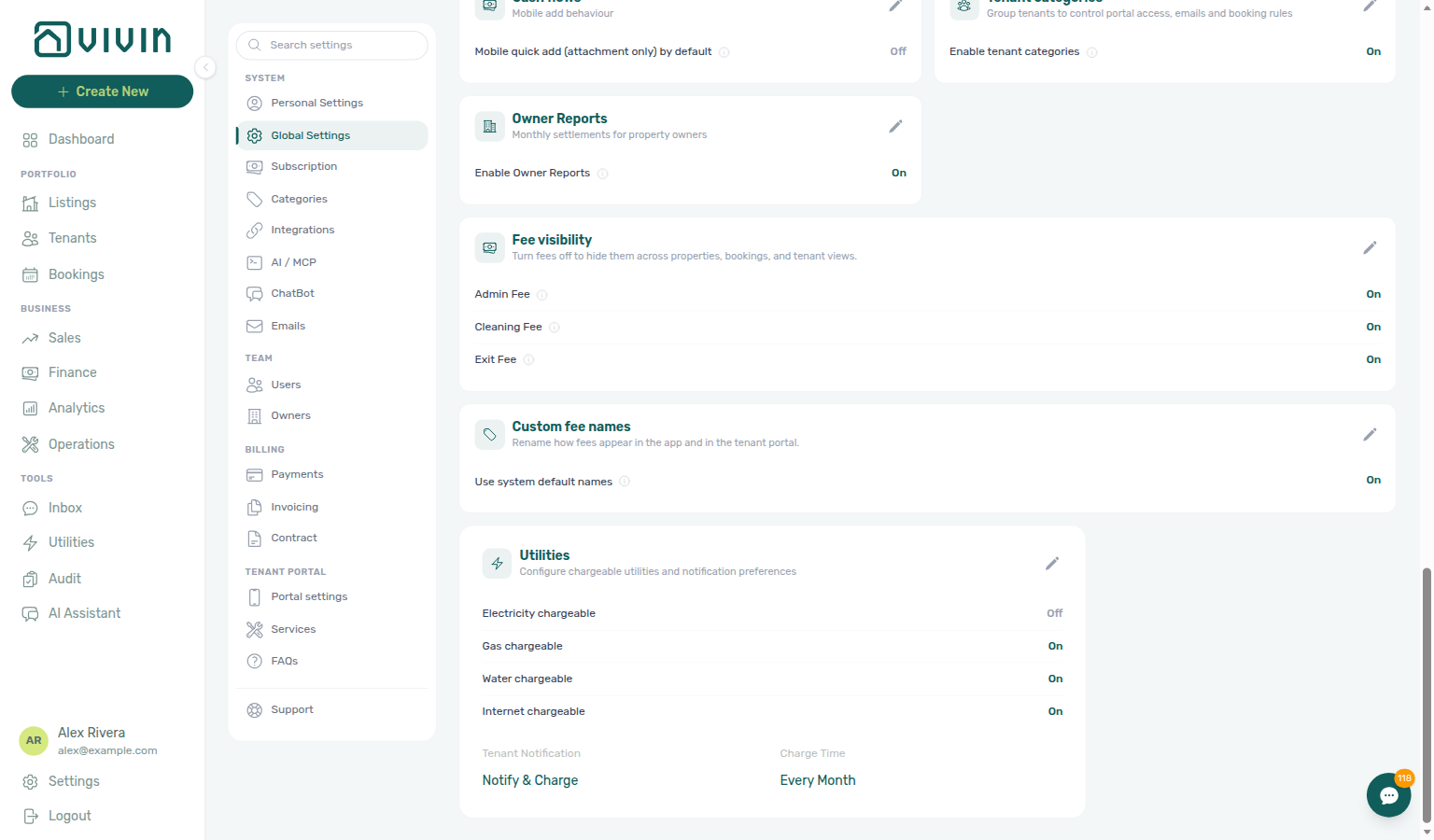
Search settings
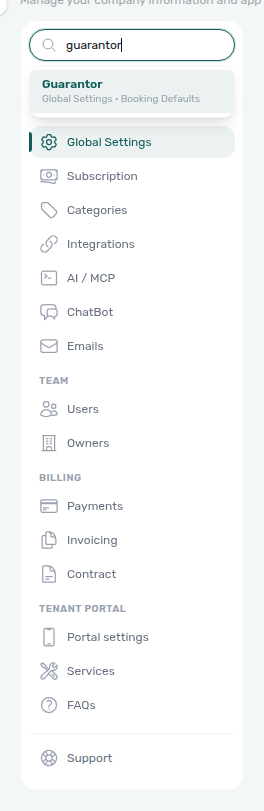
Search settings sits at the top of the Account Settings sidebar on every settings tab. Type a name you remember from the screen to open that tab or card instead of scanning the sidebar groups.
- Open any Account Settings page — the box is labelled Search settings.
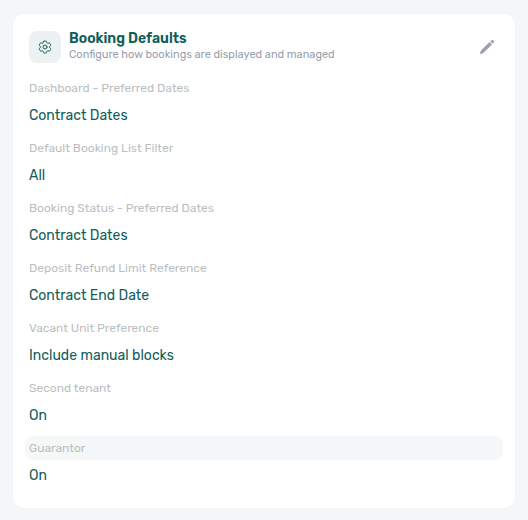
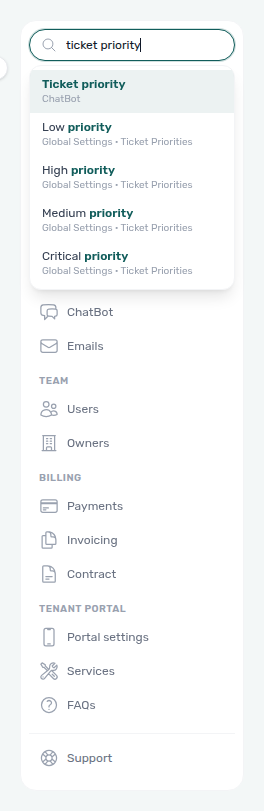
- Type part of a label, for example guarantor or ticket priority. Matching text highlights in teal. A second line shows tab · card (or the sidebar group when the result is a whole tab).
- Click a result, or use the arrow keys and Enter. Vivin opens that tab, scrolls to the control, and briefly highlights it. Escape clears the box.
Results only include tabs and cards your role can open. Search uses the labels in your current interface language, and still finds a setting through a small typo. If nothing matches, try another word from the screen — Guarantor lives on Global Settings → Booking Defaults; Ticket priority as a tab opens ChatBot.
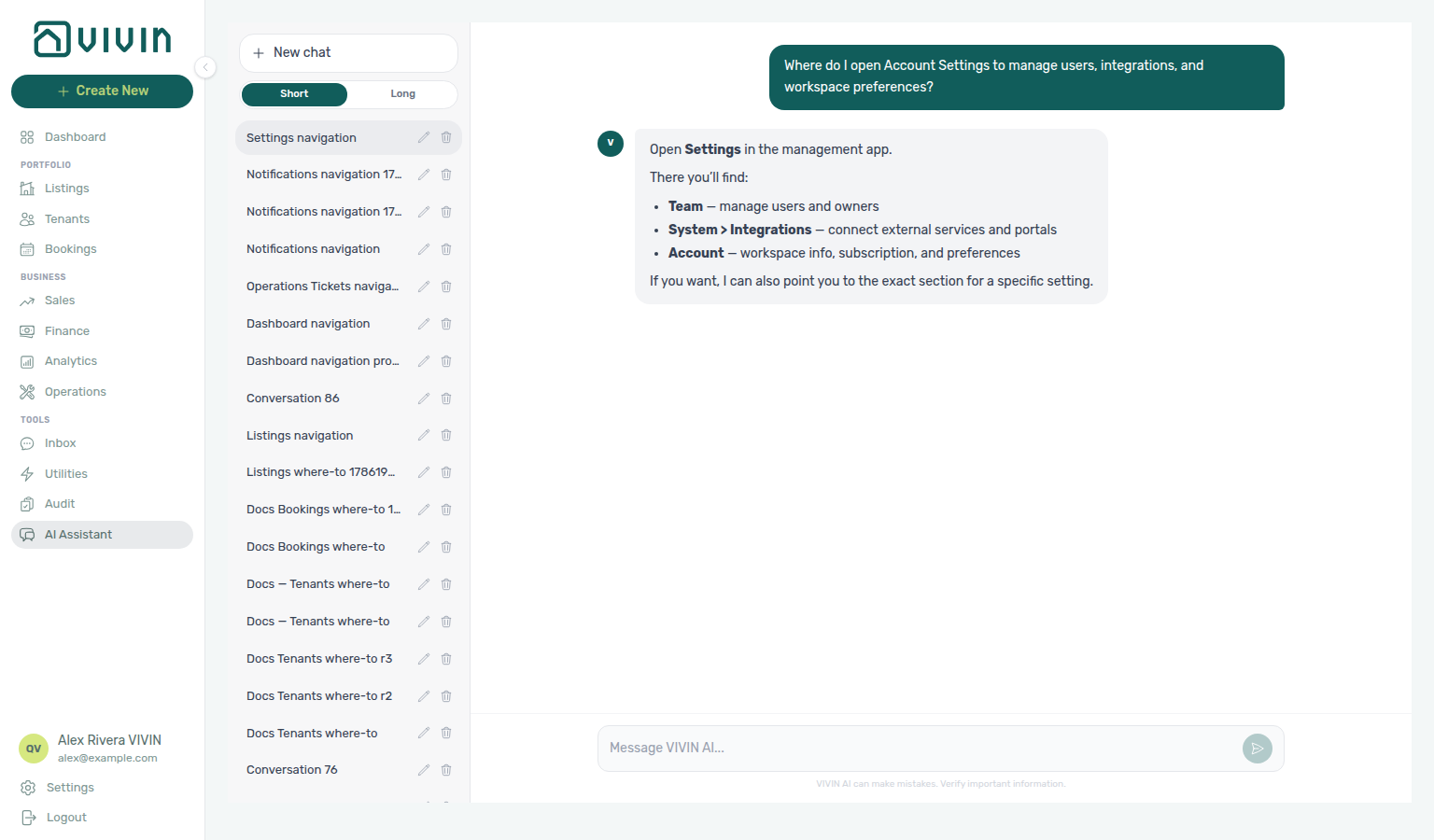
Not sure how to reach this hub from AI Chat? Ask AI Chat “Where do I open Account Settings to manage users, integrations, and workspace preferences?” — then open sidebar Settings (ai-chat-product-context-settings-reply.png, ai-chat-product-context-settings-flow.mp4). The assistant typically says Open Settings in the management app and points at System, Team, and Integrations.
Need the workspace configuration shell — users, integrations, and account defaults (not day-to-day portfolio modules)? Ask AI Chat “Where do I open Account Settings to manage users, integrations, and workspace preferences?” — then open sidebar Settings (ai-chat-product-context-settings-reply.png, ai-chat-product-context-settings-flow.mp4). The assistant typically says Open Settings in the management app and names System → Global Settings, Team, and Integrations. Canonical route: /settings.
The sidebar sections below (System, Team, Billing, Tenant Portal) mirror how operators configure a workspace — pair Recommended setup order with Getting Started — Recommended Setup Sequence and Tab cross-reference when one tab depends on another. Full pairing matrix: Account Settings — Section cross-reference.
System
System is the first sidebar group. It holds personal and account-wide setup in one place (the former separate Settings and System headings are merged here).
- Personal Settings —
/settings/personal: interface language, your email preferences (payment notification emails per user, service subscription emails per catalogue offering, BCC on tenant communications), tab-order controls for the management shell, and Operations ticket columns - Global Settings — Root tab at
/settings. Cards cover General Information and branding, booking defaults, notifications, Fee visibility / Custom fee names, Utilities, Owner Reports, and the account switch for Tenant categories - Subscription — Vivin plan pricing, payment method, and billing history; When a card is required when checkout cannot be dismissed after sign-in
- Categories — Listing tags and types, bookings, tickets, suppliers, cash flows, lease purpose, and the Tenants card for Tenant categories (old
/settings/tenantCategoriesbookmarks open Categories) - Integrations — External platform and service connections; partner field coverage and VIVIN Invoicing settings live on the connection cards (old
/settings/integrationFieldCapabilityand/settings/vivinInvoicingbookmarks open Integrations). Matrix reference: Integration capabilities - AI / MCP — Landlord MCP connection URL, API keys, connector OAuth scope (Claude.ai, ChatGPT), account and per-user tool permissions, permission audit trail, assistant activity, plus Genius WhatsApp connection and Scheduled reports on the same tab (
/settings/mcp; old/settings/geniusbookmarks open here). Opens for roles granted the AI / MCP row in Role permissions (the same switch as/ai-chat; on by default for Admin and Super Admin); only Admin / Super Admin edit, every other role gets a read-only view. HTTP contract: MCP OAuth. Concept guide: Landlord MCP - ChatBot — Tenant-facing assistant: Persona Setup, IF/THEN rules, Ticket priority as a ChatBot subtab (old
/settings/ticketPrioritybookmarks open ChatBot), and a General subtab for one-off options such as the WhatsApp send confirmation on booking Communication composers. Tab visibility follows the Chatbot permission in Users and roles. Distinct from the operator AI Chat under Tools (/ai-chat) - Emails — Automated tenant email customization, communication rules (Select smart locks stays open, Booking tags stays open, Tenant categories stays open, Send now is fire-once), schedule modal, and Send now confirmation (includes short MP4 walkthroughs)
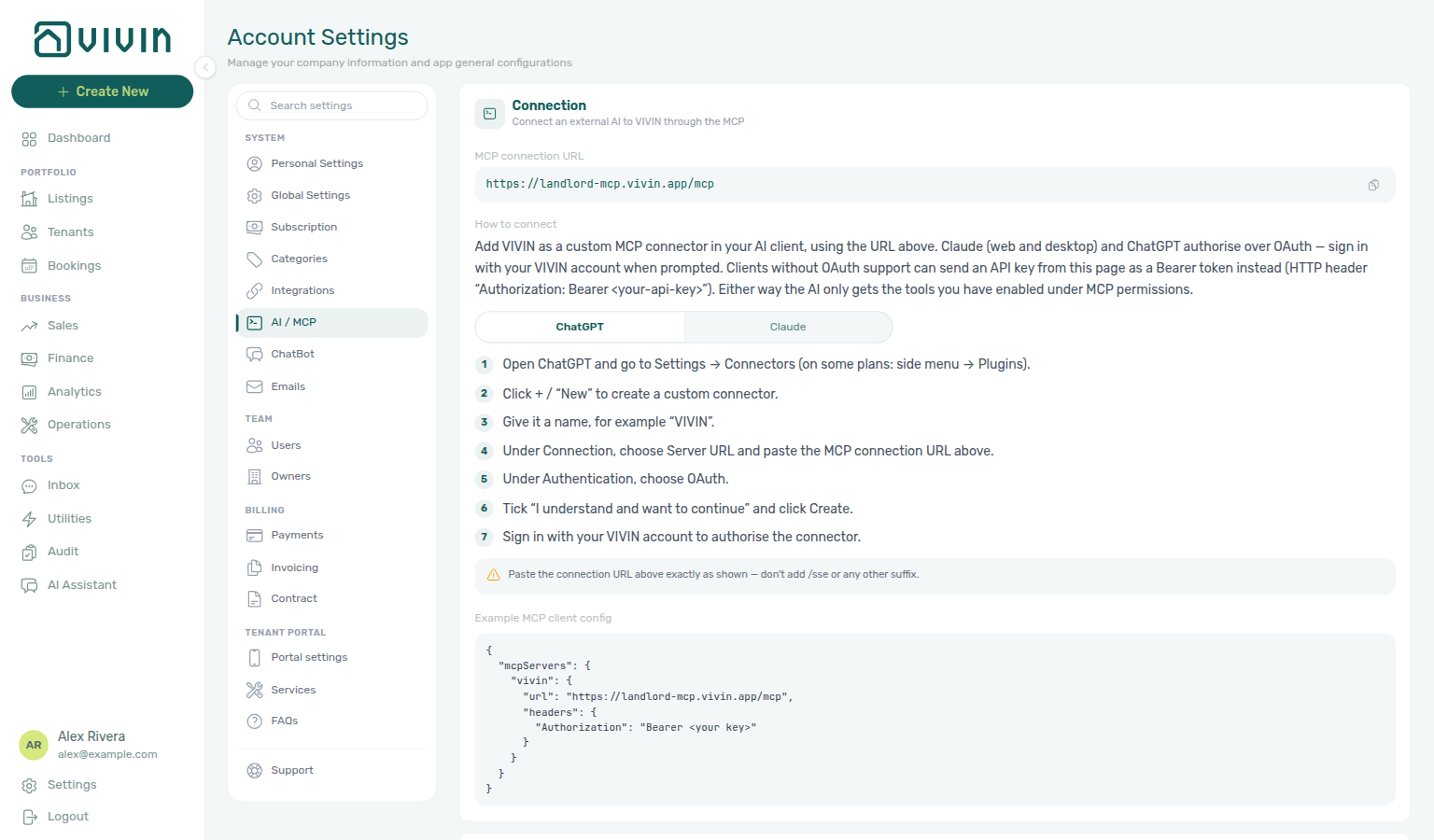
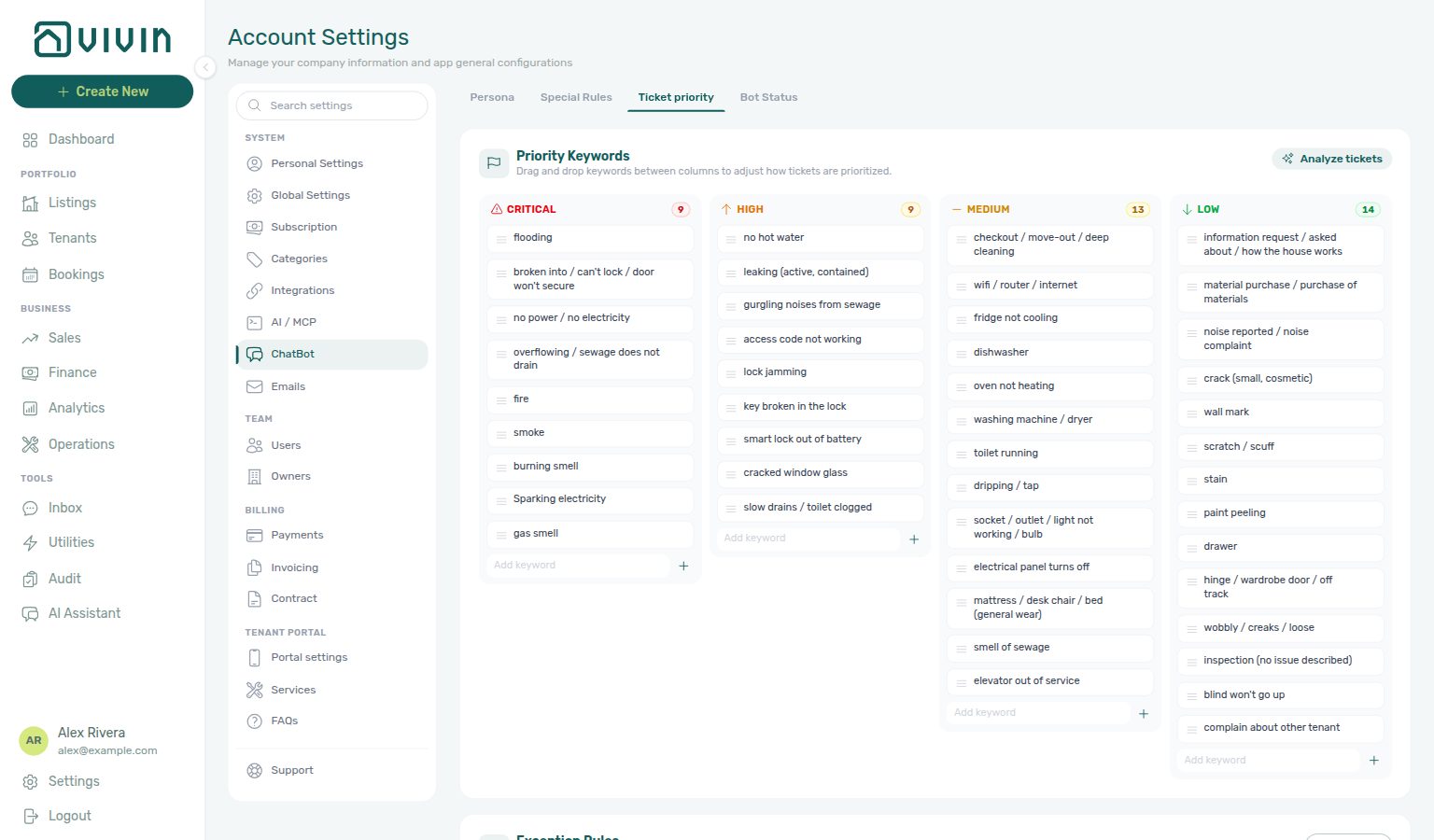
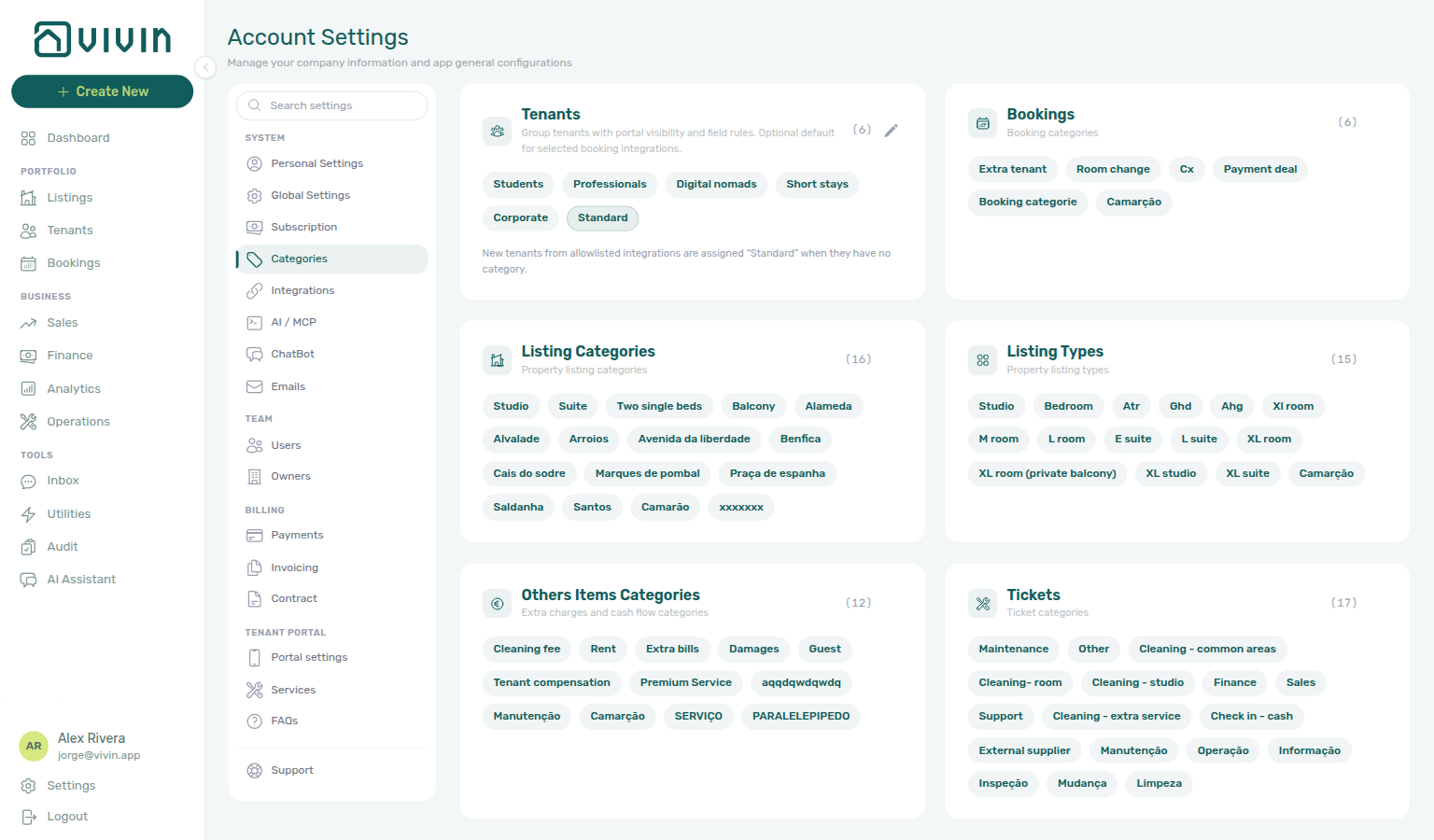
System tabs pair with API Reference (partner HTTP contracts), AI usage API (operator JWT ledger for landlord_chat and utility_bill_extraction — distinct from tenant billing), Inbox (portfolio WhatsApp triage), and operator AI Chat (distinct from tenant Chatbot).
Roles granted the AI / MCP row in Role permissions use Tools → AI Assistant at /ai-chat for portfolio questions in natural language. That experience is documented under AI Chat; it is separate from ChatBot settings above. Administrators configure Landlord MCP keys, Genius schedules, and tool scope on AI / MCP (/settings/mcp).
Team
The Team section groups member access and owner records under the same Account Settings shell:
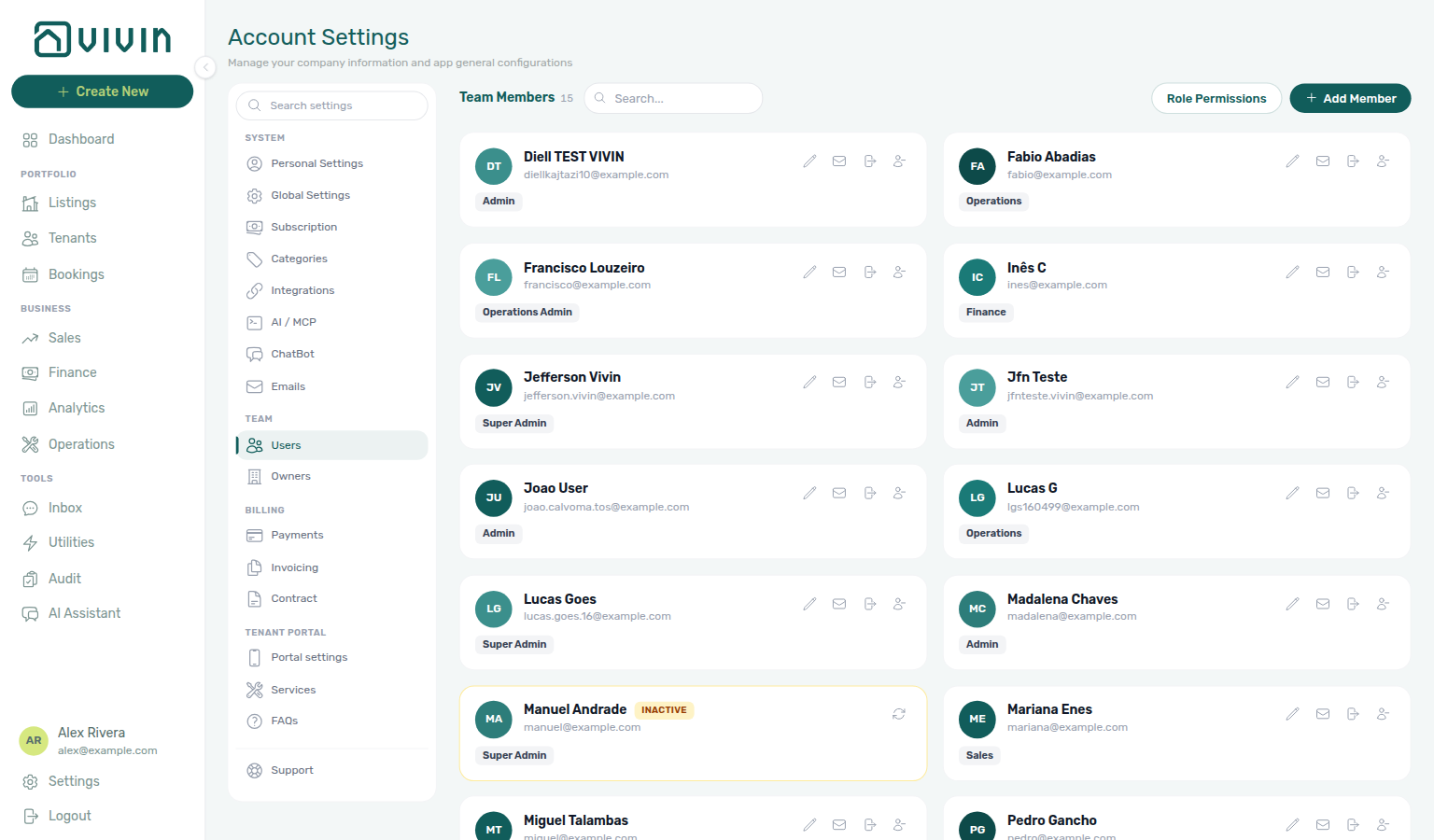
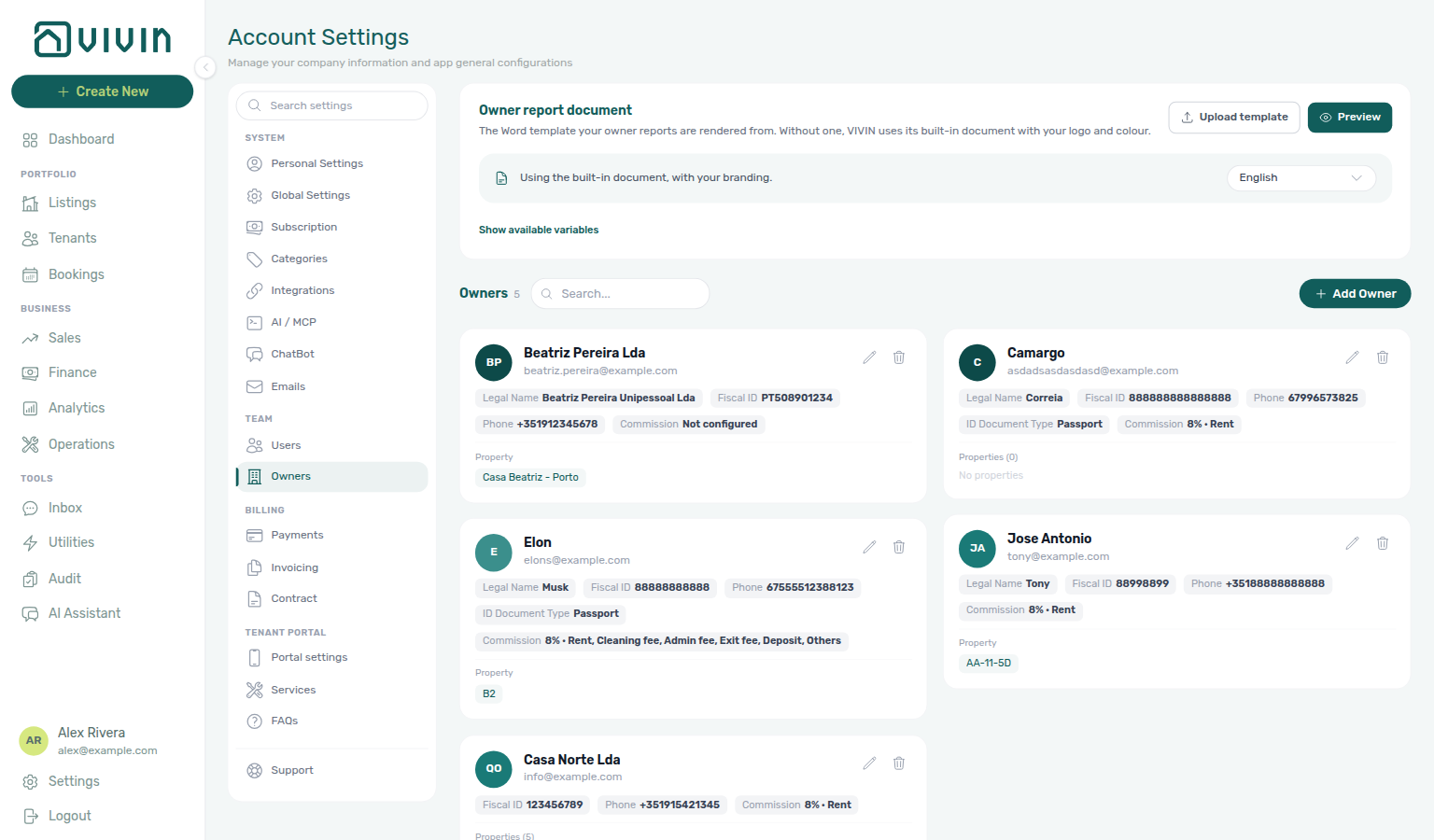
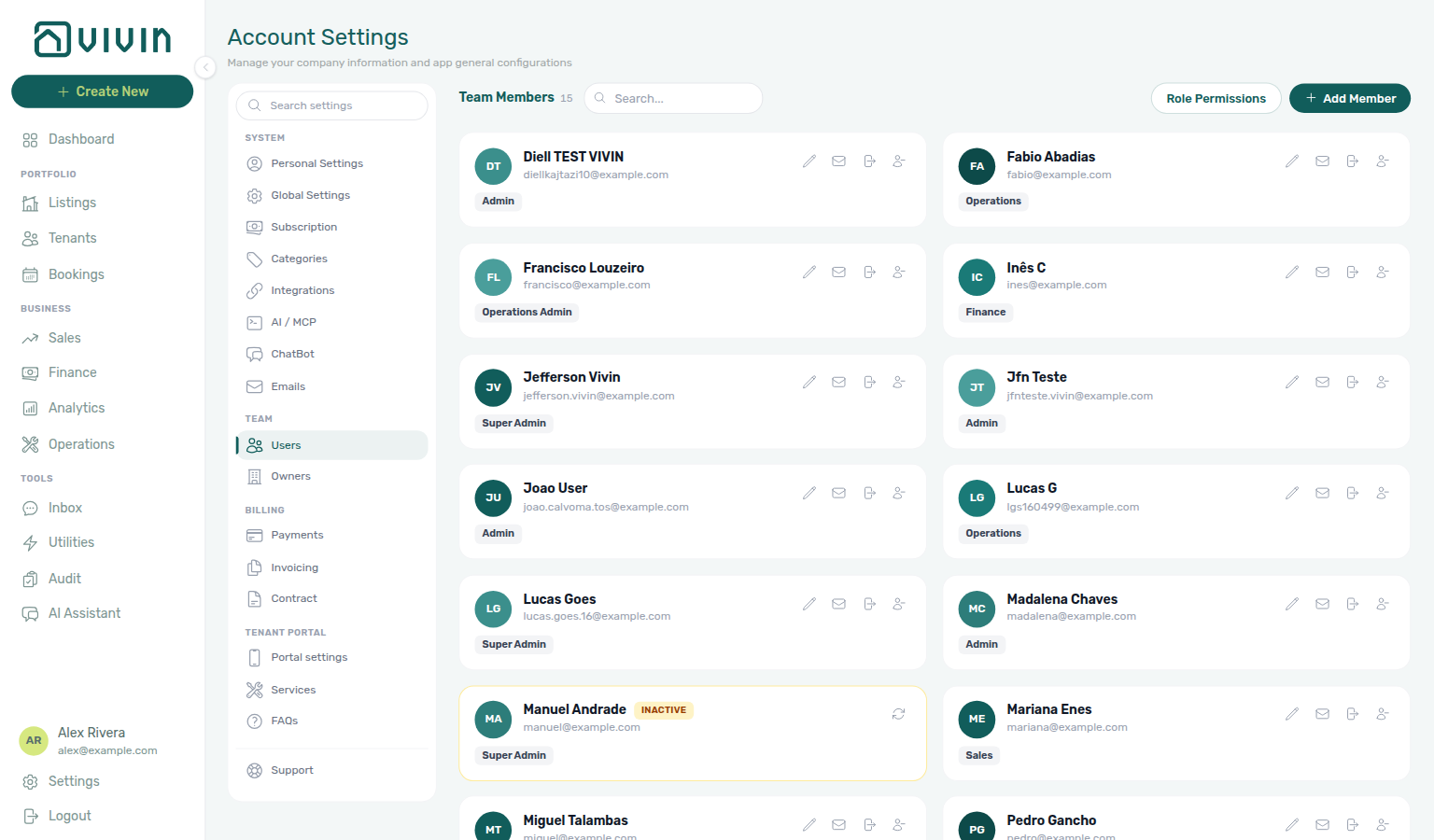
Identity and access tabs above pair with Billing (payment deadlines and invoicing) and Tenant Portal (what tenants can edit) before go-live. Role-gated tabs: Users and roles.
Billing
- Payments — Payment deadlines, penalties, deposit rules, payment priorities, and Rent adjustment (bulk percentage raise; Select properties / Select categories stay open and View booking details stays on the preview on Step 2)
- Invoicing — VAT rates for invoice line items
- Contract — Rental agreement generation with dynamic variables and empty-value N/A
Fee toggles and invoice labels moved to Global Settings (Fee visibility / Custom fee names cards). VIVIN Invoicing issuer setup lives under Integrations when that connection is active — see VIVIN Invoicing.
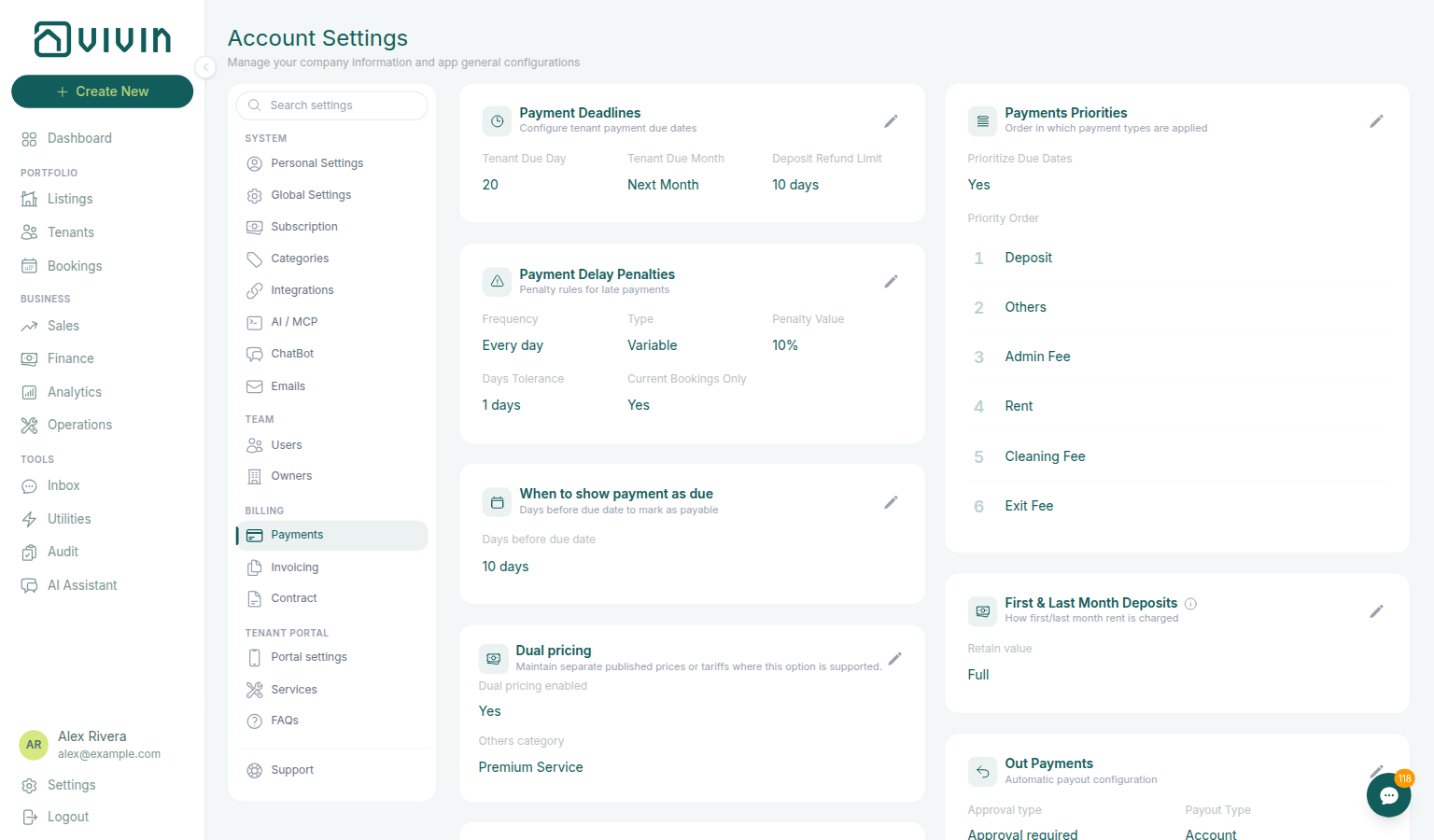
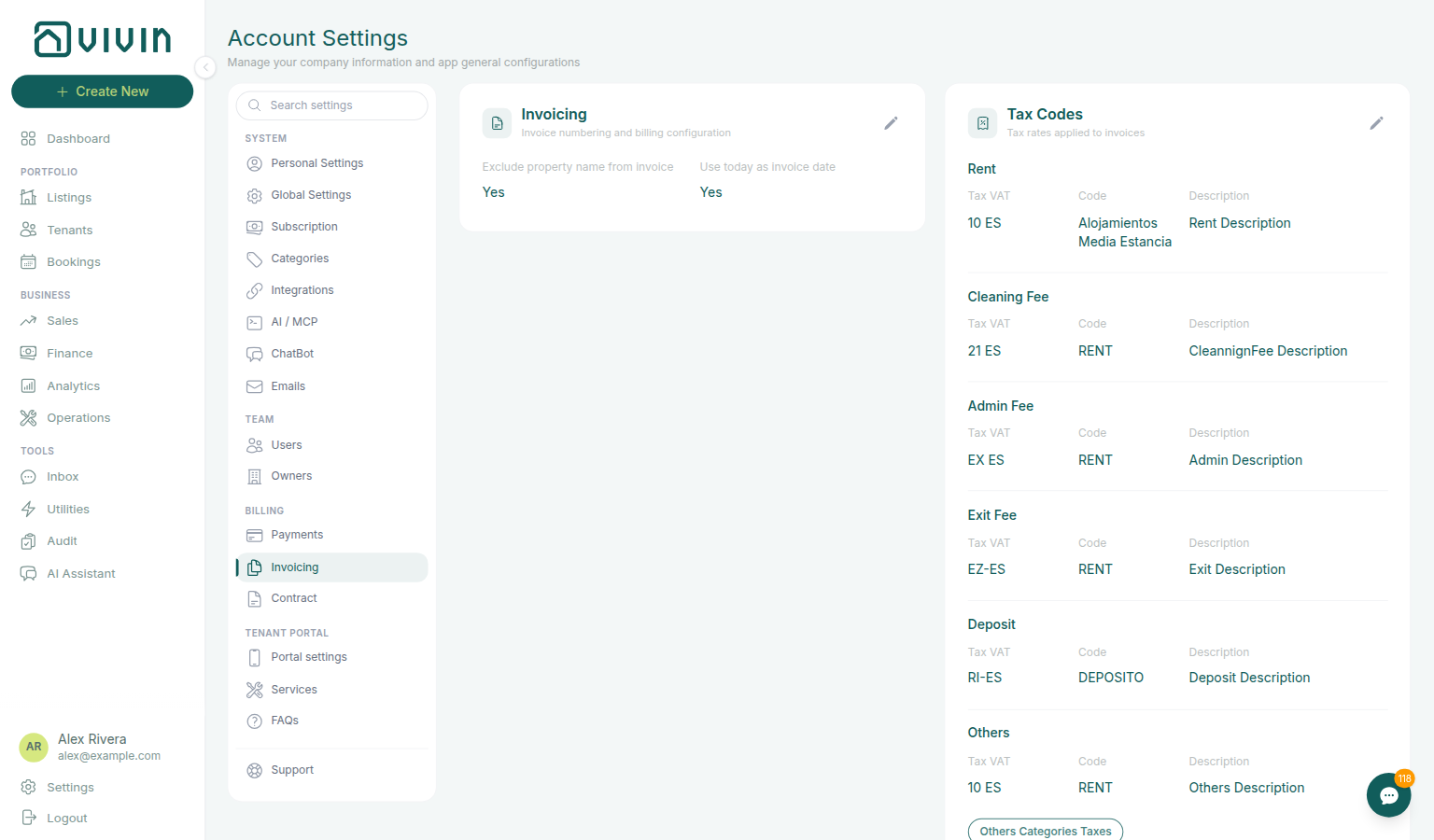
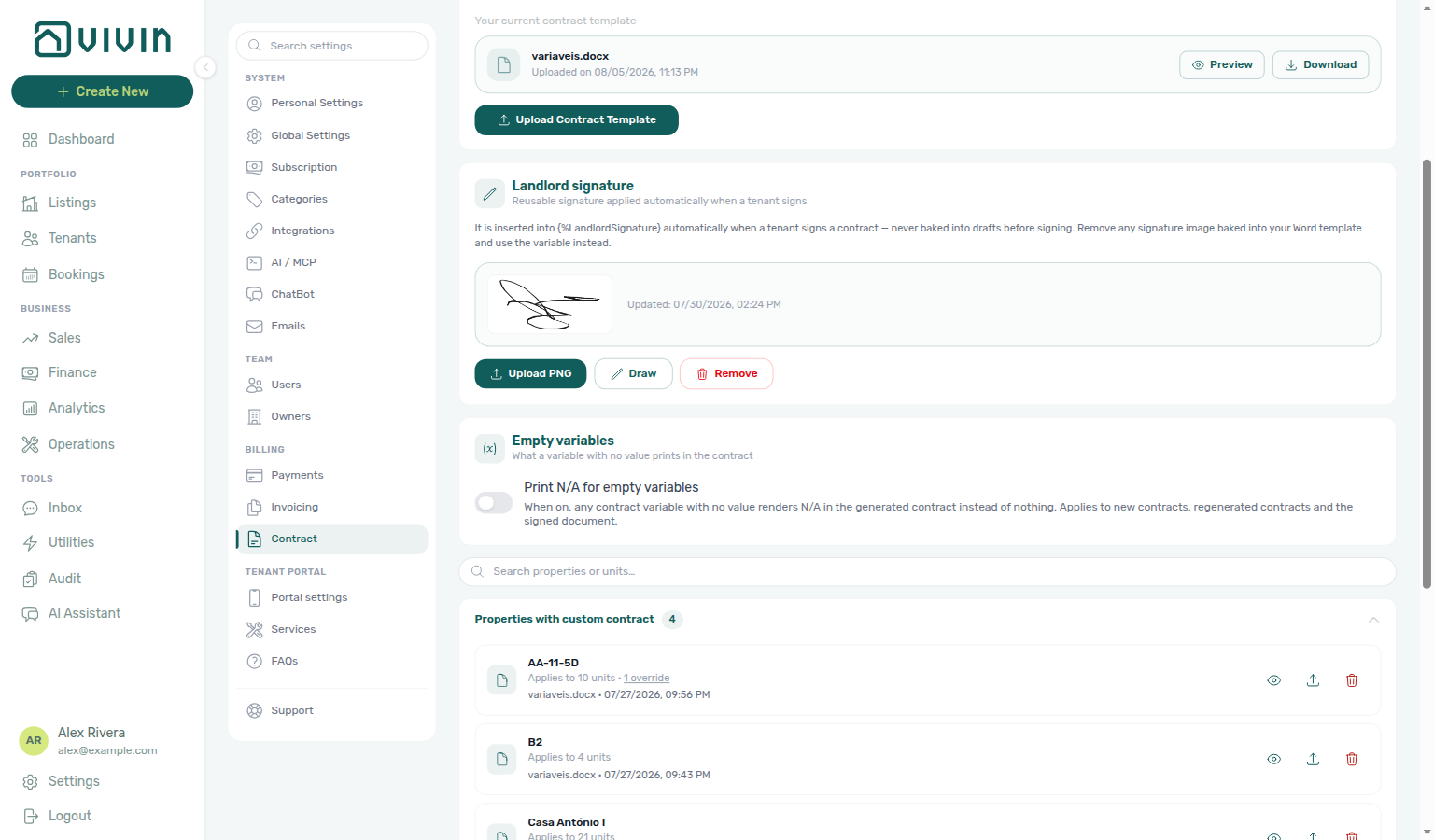
Financial policy tabs here pair with Integrations (Hostkit / Invoice-xpress / VIVIN Invoicing) and Emails (payment reminders) before operators reconcile in Finance. Deposit and penalty rules: Invoicing & Payments.
Tenant Portal
Everything that exists because the tenant-facing portal does — gathered in one sidebar group:
- Portal settings —
/settings/tenantPortal: default Tenant can edit, Portal modules, and Mandatory for contract signing toggles (moved here from Global Settings) - Services — Tenant services catalogue (cleaning, gym, parking, etc.)
- FAQs — FAQ catalogue and FAQ Generator at
/settings/faqs— AI drafts from WhatsApp / email / IF/THEN history; published rows appear on portal Requests (faq_generationon AI usage API)
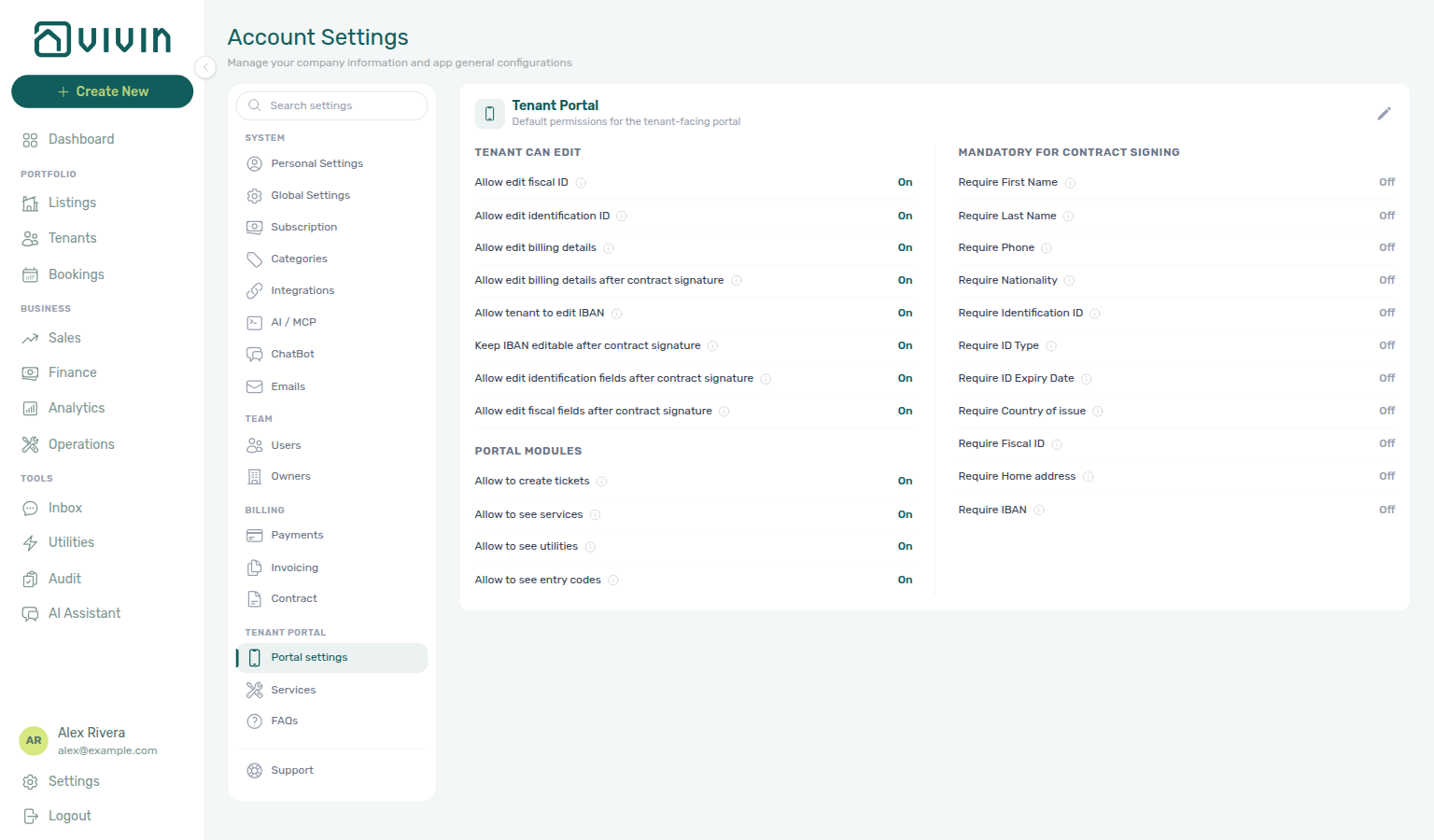
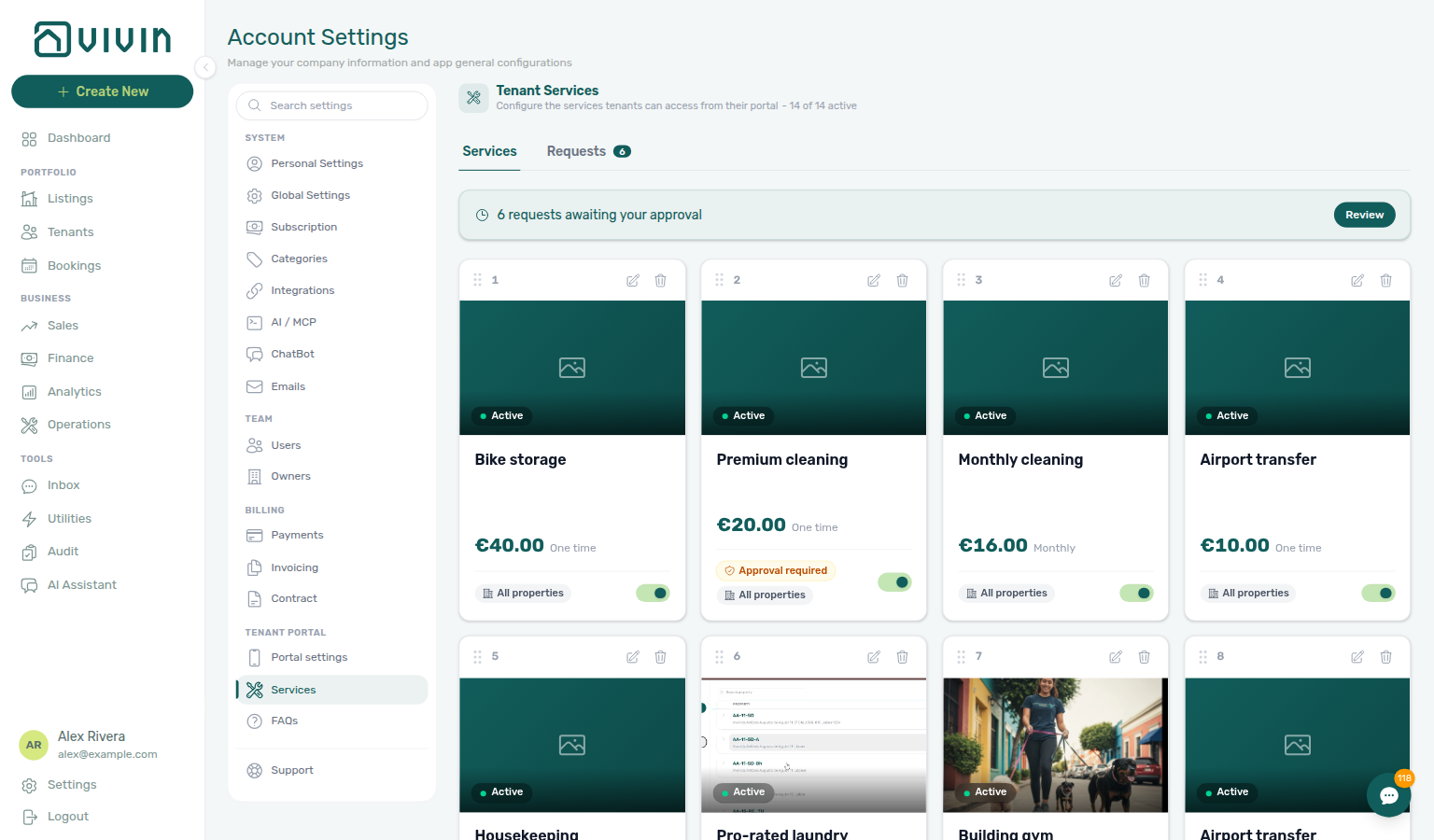
Portal tabs pair with Portal settings (account-wide edit / module / signing gates), Tenant categories (segment overrides on the Categories Tenants card), ChatBot (tenant WhatsApp), and the concept guide Tenant Portal.
Support (Vivin support tickets)
If your role includes Support access (support.module in Users and roles), you can open Support from the Account Settings shell (lifebuoy entry) to view and manage Vivin support tickets. Full-page routes: /settings/support and /settings/support/:ticketId for a specific ticket. See Using in-app support.
Support-only Account Settings (browse layout)
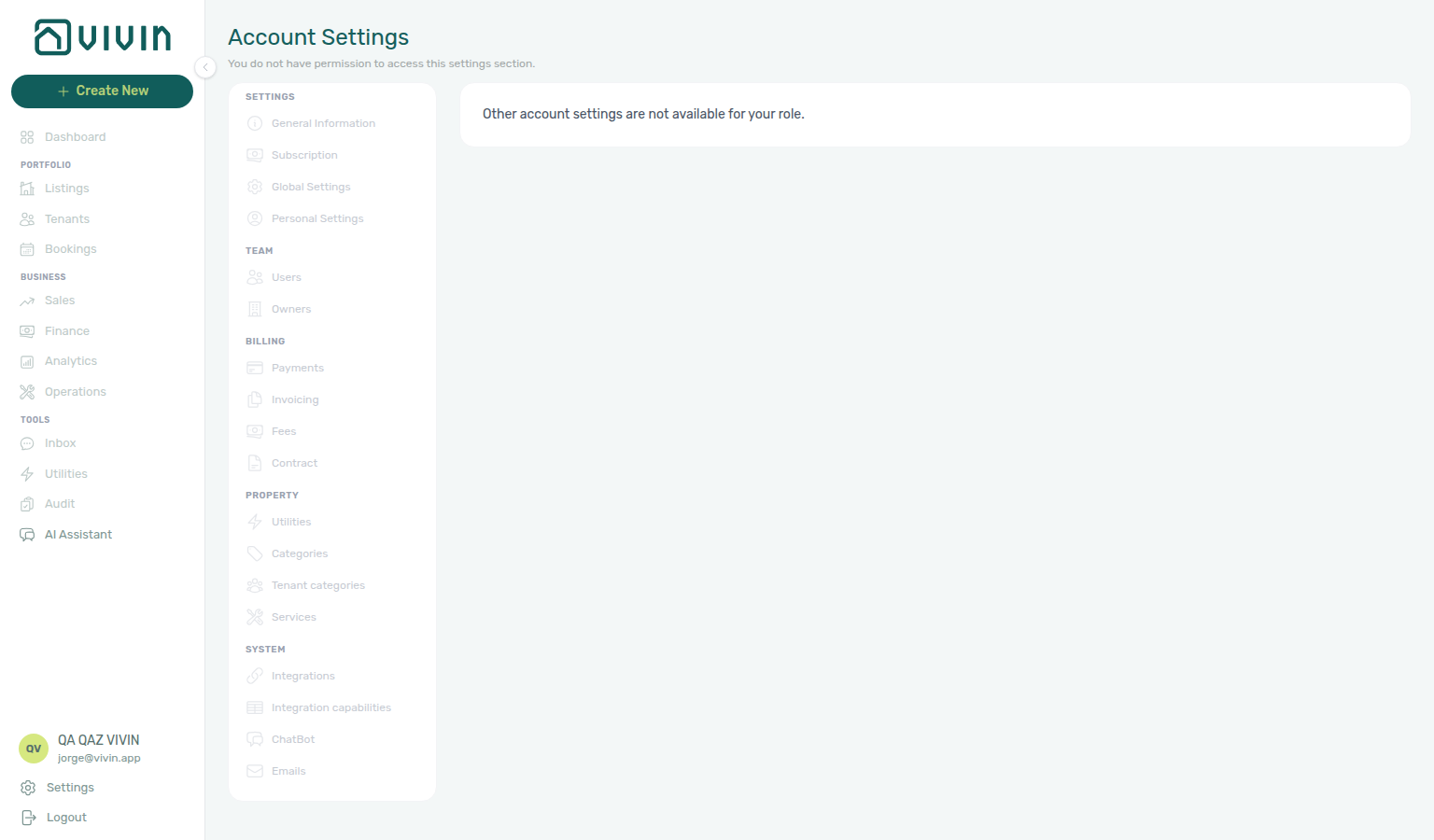
Some roles are granted Support without any editable Account Settings tabs (for example General Information, Users, or Preferences). When you open /settings in that situation, the product shows a browse-only shell instead of a permission error:
- Page subtitle — Use Support below to reach the Vivin team.
- Settings tabs — Every standard tab appears in the sidebar but is disabled (greyed out, not clickable). Deep links such as
/settings/usersredirect back to/settingsso you cannot open tabs your role cannot edit. - Support — An active Support control at the bottom of the sidebar opens the same Help & Support drawer used elsewhere in the app.
- Main panel — A short note: Other account settings are not available for your role.
Operators with Support still use the floating Help & Support button on desktop (when applicable) and /settings/support for the full inbox; the browse layout is only the entry when Account Settings itself would otherwise be empty.
Your personal profile is managed separately via My Profile at platform.vivin.app/profile (or header user menu → My Profile), outside the Account Settings tab list.
Personal interface language is changed from Account Settings → Personal Settings (platform.vivin.app/settings/personal), with an extra compact language control in the mobile navigation drawer. It is not on My Profile (/profile) and not under Preferences. See Interface Language.
Account Settings routes: platform.vivin.app/settings, plus tab paths such as /settings/users, /settings/integrations, /settings/preferences. See Deep Links for the full route reference.
Support-only operators use the browse layout above without editable tabs — pair with Using in-app support and Get Help & Support. Personal profile routes: My Profile and Personal Settings.
Tab cross-reference
Use this table when one Account Settings tab depends on another — each row links to the guide for that tab. Each sub-guide also opens with a First-time workspace setup tip for that tab's step in Recommended setup order. Individual tabs with longer pairing matrices: General Information, Subscription, Personal Settings, Users, Owners, Contract, Categories, Tenant categories, Portal settings, Integrations, Integration field capabilities, Payments, Invoicing & Utilities, Services, ChatBot, AI / MCP, Emails, Preferences, My Profile.
Partner HTTP contracts configured alongside Integrations are documented in the API Reference hub — distinct from management UI deep links in Deep Links.
This table is the primary go-live pairing matrix for Account Settings tabs — each sub-guide also opens with a First-time workspace setup tip, a Finding your way in this guide subsection pairing operational workflows. Hub map: the Finding your way tip at the top of this page. Setup sequencing: Recommended setup order.
Recommended setup order
Use this table when you are configuring a new Vivin workspace — it maps Getting Started — Recommended Setup Sequence steps 1–12 to Account Settings tabs. Steps 13–15 open Listings, Bookings, and Tenants (not Account Settings). Full onboarding context, optional sections, and go-live verification: Getting Started — Recommended Setup Sequence and Onboarding a New Property — Step 7. After modules go live, pair each setup phase with operational workflows in Setup sequence after go-live.
| Setup step | Account Settings tab |
|---|---|
| 1 | General Information on Global Settings |
| 2 | Preferences (same Global Settings tab) |
| 3 | Users |
| 4 | Owners |
| 5 | Payments |
| 6 | Invoicing |
| 7 | Utilities on Global Settings |
| 8 | Contract |
| 9 | Categories |
| 10 | Tenant categories (Categories Tenants card) |
| 11 | Emails |
| 12 | Integrations |
Optional tabs configured during or after the core sequence — see Getting Started optional subsections: Portal settings, Services, and FAQs under Tenant Portal, ChatBot (tenant WhatsApp assistant, including Ticket priority and the General subtab with the WhatsApp send confirmation), AI / MCP (Landlord MCP keys, Genius schedules, and tool permissions — opens for roles granted the AI / MCP row), Subscription (Vivin platform billing), Personal Settings (per-user locale), and Integration field capability (partner payload matrix on Integrations cards).
Steps 1–12 here map to Account Settings tabs; steps 13–15 open Listings, Bookings, and Tenants. Guided walkthrough: Onboarding a New Property. Workflow pairing after go-live: Setup sequence after go-live.
Account Settings section cross-reference
Use the sections above for this settings area. Related setup pages are linked from Related below when present, or from Account Settings.
Account Settings hub subsection index
Use the sidebar sections below when configuration spans multiple tabs. Habit shortcuts live under Related.
| Subsection | When to open it | Pair with |
|---|---|---|
| Search settings | Jump to a tab or card by name | Global Settings, Ticket priority, FAQ — Search settings |
| System | Personal locale, Global Settings, integrations, emails | Global Settings, General Information, Integrations, AI / MCP, Emails |
| Team | Member access and owner registry | Users, Owners |
| Billing | Payment deadlines, invoicing VAT, contract templates | Invoicing & Payments, Contract |
| Tenant Portal | Portal edit toggles, services catalogue, FAQ catalogue | Portal settings, Services, FAQs, Tenant Portal concept |
| Support (Vivin support tickets) | Vivin product tickets | Using in-app support, Get Help & Support |
| Tab cross-reference | Go-live tab pairing | Recommended setup order |
| Recommended setup order | Setup steps 1–12 tab map | Getting Started — Recommended Setup Sequence, Onboarding a New Property |
| Setup sequence after go-live | Post-setup workflows | Common Workflows, Modules |
| Documentation map & escalation | Cross-hub navigation | FAQ, Get Help & Support |
| Key glossary terms | Definitions cited on settings pages | Glossary |
Related
Setup sequence after go-live
Post-go-live pairing starts with Getting Started — Recommended Setup Sequence (steps 1–15) and Onboarding a New Property — Step 7. When a tab save or wizard step still blocks progress, continue to Support — Setup sequence escalation.
- Setup steps 1–3 (General Information, Preferences, Users) — Complete before Onboarding a New Property; greyed-out + Create New rows usually mean step 3 permissions are missing (FAQ — Navigation & shortcuts)
- Setup steps 4–12 — Onboarding a New Property (property wizard Steps 1–6 mirror settings configuration; Steps 1–6 of the workflow walk owners through integrations)
- Setup steps 13–15 (Listings, Bookings, Tenants) — First operational data; pair with Processing a New Booking once reservations exist
- After steps 13–15 — Onboarding a New Property — Step 7 go-live verification before you escalate Listings/Multicalendar display defects
- Optional setup sections on Getting Started — Recommended Setup Sequence map to workflows: Entering Monthly Utility Bills (utilities), Managing a Check-in / Managing a Check-out (operations), Handling a Late Payment (finance), Notification triage (communication), Portfolio KPI review (dashboard/analytics), Manual block hygiene (audit)
- When a settings tab, property wizard step, or module permission still blocks progress after self-serve docs, open Get Help & Support or Using in-app support — cite the matching setup step and pair with Support — Setup sequence escalation
- After the first full month on live inventory — optional AI usage API poll during Portfolio KPI review; see Deeper API reads
Documentation map & escalation
- Getting Started — Recommended Setup Sequence (steps 1–12 on Account Settings tabs; steps 13–15 in modules; Step 7 go-live verification); first-time setup tip on that page pairs with Setup sequence after go-live above
- Introduction — Platform overview and how documentation sections connect
- Common Workflows — Task-oriented guides that depend on settings configured here, Setup sequence after go-live)
- Concepts — How preferences affect Tenant Portal, integrations, and automation;
- Modules — Where configured settings surface in daily operator work;
- API Reference — Partner HTTP contracts configured alongside Integrations);
- AI usage API — Account-scoped internal LLM token ledger (
GET /ai-usage,GET /ai-usage/summary) gated byaccount_settings.modulefrom Users and roles; pair with AI Chat (landlord_chat) and Utilities — Bills tab (utility_bill_extraction) — see Deeper API reads and FAQ — How do I see AI token usage for my account? - Glossary — Term definitions used across settings and module docs, Setup sequence vocabulary, Setup sequence after go-live)
- FAQ & Troubleshooting — Quick answers when a settings change does not match expected module behaviour, Setup sequence after go-live; including Settings & tenant communications during steps 10–12)
- Get Help & Support — Escalation when a settings change is blocked or unclear, Setup sequence after go-live, Setup sequence escalation)
- Using in-app support — Vivin product tickets when Account Settings behaviour is unclear; setup tickets: Support — Setup sequence escalation (step-to-module pairing)
Navigation & bookmarks
Bookmark routes pair with Deep Links — Account Settings and Management Frontend Deep Links. Personal profile: My Profile and Interface language.
- Deep Links — Account Settings — Bookmarkable
/settings/*tab routes for support escalations - Management Frontend Deep Links — Full route table including module tabs, booking sidebar anchors, and
/settings/supportinbox paths - Create New menu — Sidebar shortcuts into module modals after settings tabs are configured
- FAQ — Permission denied toast — Red You do not have permission to perform this action. toast when RBAC blocks a save; fix in Users → Role Permissions
- Interface language — Personal UI locale and per-user email/in-app notification opt-outs paired with Preferences alert masters; Payment overdue alerts when personal Payments opt-out hides operator rows
- My Profile — Operator profile at
/profile(outside the Account Settings tab list)
Tab cross-cuts (beyond the sidebar)
Payment alerts: Notifications — Payment overdue alerts.
- Preferences — Enable deposit disputes — Account toggle before operators use Mark as Disputed on booking deposits
- Preferences — In-app notifications — Account-wide alert masters that gate Dashboard bell and
/notifications; Payment overdue alerts when scheduled charges are overdue - Invoicing & Payments — Due dates, deposit rules, VAT rates, utility types, penalty policy, and export providers referenced across Finance and Bookings; Rent adjustment Select properties / Select categories stay open and View booking details stays on the preview on Step 2; Payment overdue alerts when scheduled charges pass due date
- Emails — Communication Rules, lifecycle templates, and Send now confirmation paired with Preferences notification masters; Send now is fire-once after you confirm a blast; Select smart locks stays open while you add a second Nuki device; Booking tags stays open while you add a second booking label; Tenant categories stays open while you add a second named segment
- Tenant categories — Portal segments and default for integrations before channel imports assign new tenants
- Integrations — Marketplace connections, invoicing providers, and calendar feeds paired with Listings Channels
- Integration field capability — Read-only matrix of partial vs full partner payload fields
- Chatbot — Tenant-facing assistant rules distinct from operator AI Chat
- Users & Roles — Role permissions that gate each Account Settings tab; Handling a Late Payment — Step 1 when teammates cannot triage payment overdue row-clicks
- Subscription — Vivin platform billing (distinct from tenant payment overdue alerts on Finance → Transactions)
Deeper concept reads
Tenant-facing: Tenant Portal. External automation: Landlord MCP and Tenant MCP.
- Payment Allocation — Two-layer receipts, credit note reject/revert warnings, and invoiced floor (rent) behaviour configured via Invoicing & Payments
- Booking Lifecycle — Computed Upcoming → Ongoing → Ended / Canceled status model shaped by contract and category defaults
- Integrations & Distribution — Marketplace calendar sync, booking imports, and white-label direct bookings after the Integrations tab is enabled
- Tenant Portal — Portal settings, Emails, Services, and Tenant categories shape tenant-facing portal behaviour
- FAQ — Tenant contract signing blocked — No PDF yet, mandatory Your Details gates, category locks, or Lease purpose; portal signing vs paper upload on Contract Info
- Services Marketplace — Services catalogue and portal toggles for tenant add-on revenue
- Automation & AI — Tenant Chatbot vs operator AI Chat (distinct tools and permissions)
- Landlord MCP · Tenant MCP — External AI clients that wrap the same Core API as the management app (Landlord MCP section cross-reference, Tenant MCP section cross-reference; hub)
Deeper API reads
Permission gate: Users and roles (account_settings.module).
- AI usage API — Poll
GET /ai-usage/summaryafter go-live; requires management JWT from Management session andaccount_settings.modulefrom Users and roles - Management session — Operator JWT login and refresh before scripting usage polls
- Users and roles —
account_settings.modulepermission gatesGET /ai-usage - Invoicing & Payments — Chargeable utility types that drive
utility_bill_extractionwhen operators use the AI invoice reader - Portfolio KPI review — Month-end habit to reconcile AI spend with chat and utility extraction adoption
Recommended operator workflows
Onboarding a New Property (guided steps 4–12).
- Onboarding a New Property — Guided walkthrough of Recommended Setup Sequence steps 4–12; finish with Step 7 — Verify in Listings after setup steps 13–15
- Processing a New Booking — Contract template, payment deadlines, and tenant category defaults applied at reservation creation
- Portfolio KPI review — Month-end settings audit alongside Finance reconciliation
- Resetting a Management User Password — Recover access when a lockout blocks Account Settings tabs
- Managing a Check-in — Preferences check-in defaults and Emails lifecycle rules before arrival week
- Managing a Check-out & Deposit Refund — Verify Enable deposit disputes and invoicing exports before departure week
- Handling a Late Payment — Penalty policy and notification defaults configured under Invoicing & Payments and Preferences; upstream path from Notifications — Payment overdue alerts
- Entering Monthly Utility Bills — Chargeable utility types and Tenant Notification settings before supplier billing
- Notification triage — Preferences in-app notification masters after busy booking or payment days
- Manual block hygiene — Categories ticket labels and Listings calendar holds when Sales heatmaps look suppressed
Deeper workflow reads
- See Recommended operator workflows and Common Workflows for step-by-step procedures shaped by Account Settings tabs.
Modules shaped by Account Settings
Modules — Settings that shape modules. Escalation tiles: Using in-app support — Module picker layout.
- Dashboard — Preferences in-app notification masters and post-login KPI snapshot
- Analytics — Month-range portfolio KPI charts when Analytics module permission is granted from Users roles
- Listings — Property wizard, Channels tab, Bills Included ceilings, and category tags from Categories
- Properties workspace — Legacy
/propertiesURL redirects into Listings when operators follow old bookmarks after setup - Booking engine details — Rich marketplace payload via the Full integration pill after Integrations and Integration field capability
- Bookings — Contract generation, payment plans, and portal behaviour from Contract, Payments, and Tenant categories
- Tenants — Tenant directory segmentation and Tenant category filters on profiles
- Finance — VAT, deposit rules, payment priorities, and invoicing exports from Invoicing & Payments
- Operations — Ticket labels, cash flows, and check-in/out coordination from Categories and Preferences
- Sales — Channel manager connections after Integrations and per-listing Channels setup
- Inbox — Portfolio WhatsApp triage paired with Chatbot and Emails lifecycle rules
- Notifications — Full
/notificationshistory gated by Preferences alert categories; operator Payment overdue alerts when scheduled charges are overdue - Audit — Manual Blocks and Discounts when fee and payment rules configured here affect live bookings
- Utilities — Bills Included ceiling model and tenant overage charges from Utilities types and Listings Step 3
- AI Chat — AI Assistant paired with Chatbot and Landlord MCP for portfolio Q&A
Operator habit hubs
Day-to-day operator habits (lockout catch-up, pending receipts, payment triage, handoffs, and related playbooks) live on the Common Workflows habit hub.
Deep-link anchors for habit hubs
Lockout catch-up after password recovery
Notification row-click navigation
Payment alert to receivables triage
Finance debt receivables triage
Handling a Late Payment collections
Finance Income status drill-down
Cash flow forecast drill-down
Same-day turnover coordination
Check-out final utilities handoff
Check-out collections before refund
Check-out ledger cleanup before refund
Check-out vs cancellation
Cancellation collections before void
Wrong tenant on a booking
Cancel Booking vs Delete Booking
Portfolio retirement decisions
Archive property (building-level)
Utility overage collections
Property setup to first arrival handoff
New inventory to first booking handoff
Confirmation to check-in handoff
Check-in to check-out handoff
Occupancy KPI to block hygiene handoff
Confirmation alert triage
Portfolio segmentation by tenant category
Pending manual receipt approval
Reject/revert mistaken receipts
Month-end invoicing (fixed date)
Bulk Hostkit invoicing
Rent reduction after invoicing
Walkthrough media
- [Common Workflows — Operator habit hub
Key glossary terms
- Search settings — Account Settings sidebar jump-to-control box
- Credit note (payment reject/revert) — Finance Transactions reject/revert after invoicing exports; concept walkthrough: Payment Allocation — Correcting mistaken receipts; workflow hub: Common Workflows — Reject/revert mistaken receipts
- Invoiced floor (rent) — Rent edits on Bookings after Finance export
- Deposit dispute — Finance → Deposits and booking Deposit tab freeze before refund
- Glossary — End-of-Booking cost split — Charge Time → End of Booking splits daily overage across every occupied unit; still-staying roommates stay in the denominator
- Glossary — Change history — Operator-initiated edits on Listings setup and Bookings Changelog; create-time defaults excluded
- Glossary — Archived booking ledger visibility — Delete Booking hides manual/provider_platform rows on Finance → Transactions; vIBAN and credit card stay visible
- Glossary — Full term list