Onboarding a New Property
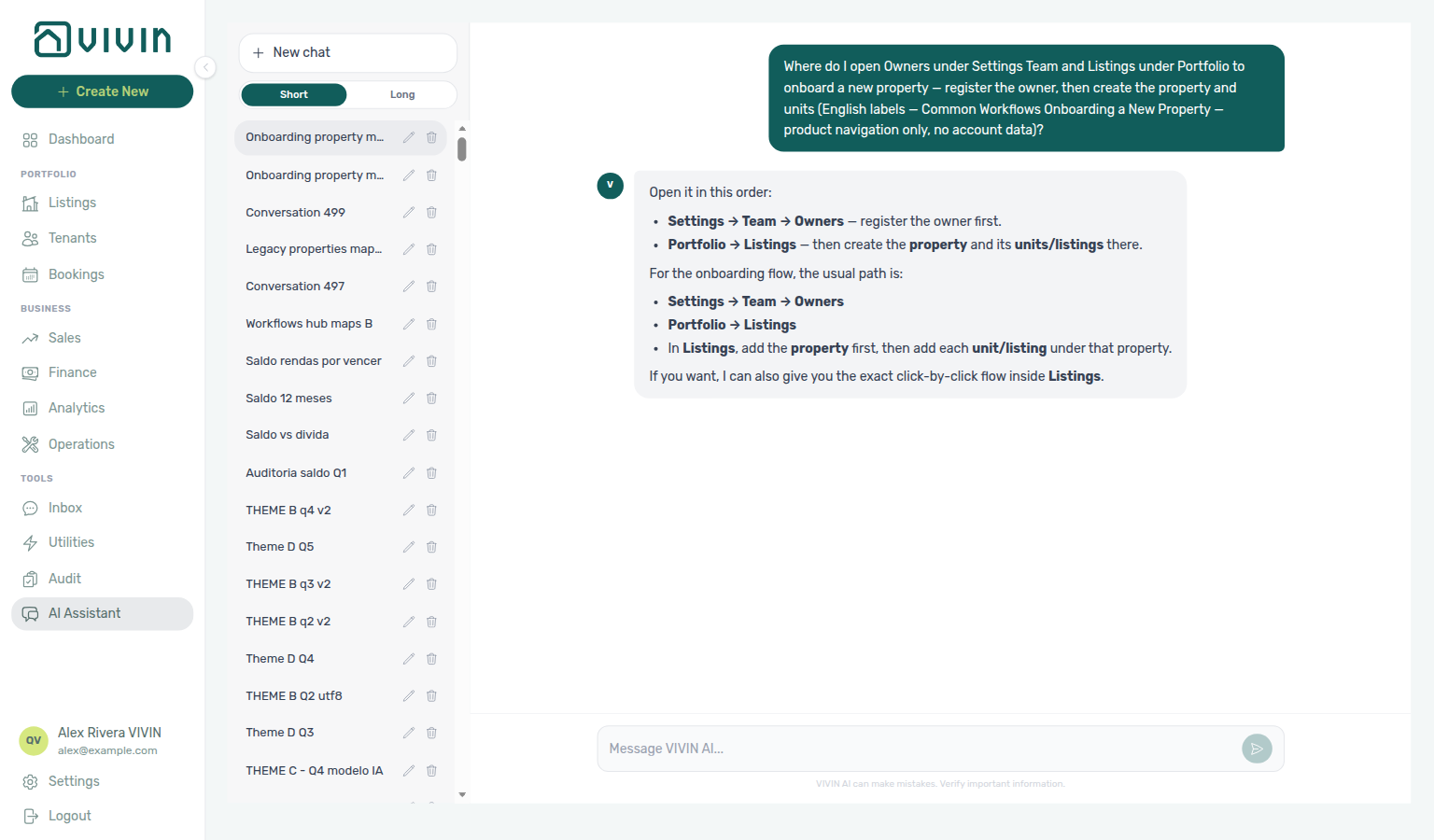
Ask AI Chat “Where do I open Owners under Settings Team and Listings under Portfolio to onboard a new property — register the owner, then create the property and units (English labels — Common Workflows Onboarding a New Property — product navigation only, no account data)?” — then open Settings → Team → Owners and Portfolio → Listings (ai-chat-product-context-onboarding-property-reply.png, ai-chat-product-context-onboarding-property-flow.mp4). The assistant typically says Settings → Team → Owners first, then Portfolio → Listings to create the property and its units. Same grounding external MCP clients get from get-vivin-context-overview (or get-vivin-context-platform / get-vivin-context-properties-listings). Distinct from reservation work on Bookings and from the broader Common Workflows hub product maps.
This workflow is the guided walkthrough for Getting Started — Recommended Setup Sequence steps 4–12 — complete steps 1–3 (General Information, Preferences, Users) per Account Settings — Recommended setup order first. After steps 13–15 in Listings, Bookings, and Tenants, finish with Step 7 — Verify in Listings before daily operational guides. Lockout catch-up: Getting Started — Lockout catch-up after password recovery.
Work steps 1–7 in order — start with Step 1 — Register the owner and Step 2 — Create the property, finish with Step 7 — Verify in Listings go-live checks. Optional channel setup: Step 5 — (Optional) Connect to external platforms. Habit-specific shortcuts live under Related below.
This workflow walks you through adding a new property to your portfolio, from initial setup to listing the first unit. Complete these steps in order — each step depends on the previous one.
After go-live, run Processing a New Booking for the first reservation and Portfolio KPI review when you need a baseline before rate changes — after the first full month, poll AI usage API (utility_bill_extraction + landlord_chat) during Portfolio KPI review — Step 7 to baseline AI adoption on new inventory.
Before starting, ensure you have:
- Completed Getting Started — Recommended Setup Sequence steps 1–3 (General Information, Preferences, Users) when this is your first workspace — Steps 1–6 of this workflow align with setup steps 4–12
- Access to the property's utility account IDs (from electricity, gas, water, and internet statements)
- The property owner's legal name, fiscal ID, and IBAN (if not already registered)
- Your desired contract terms (payment frequency, deposit type, confirmation payments)
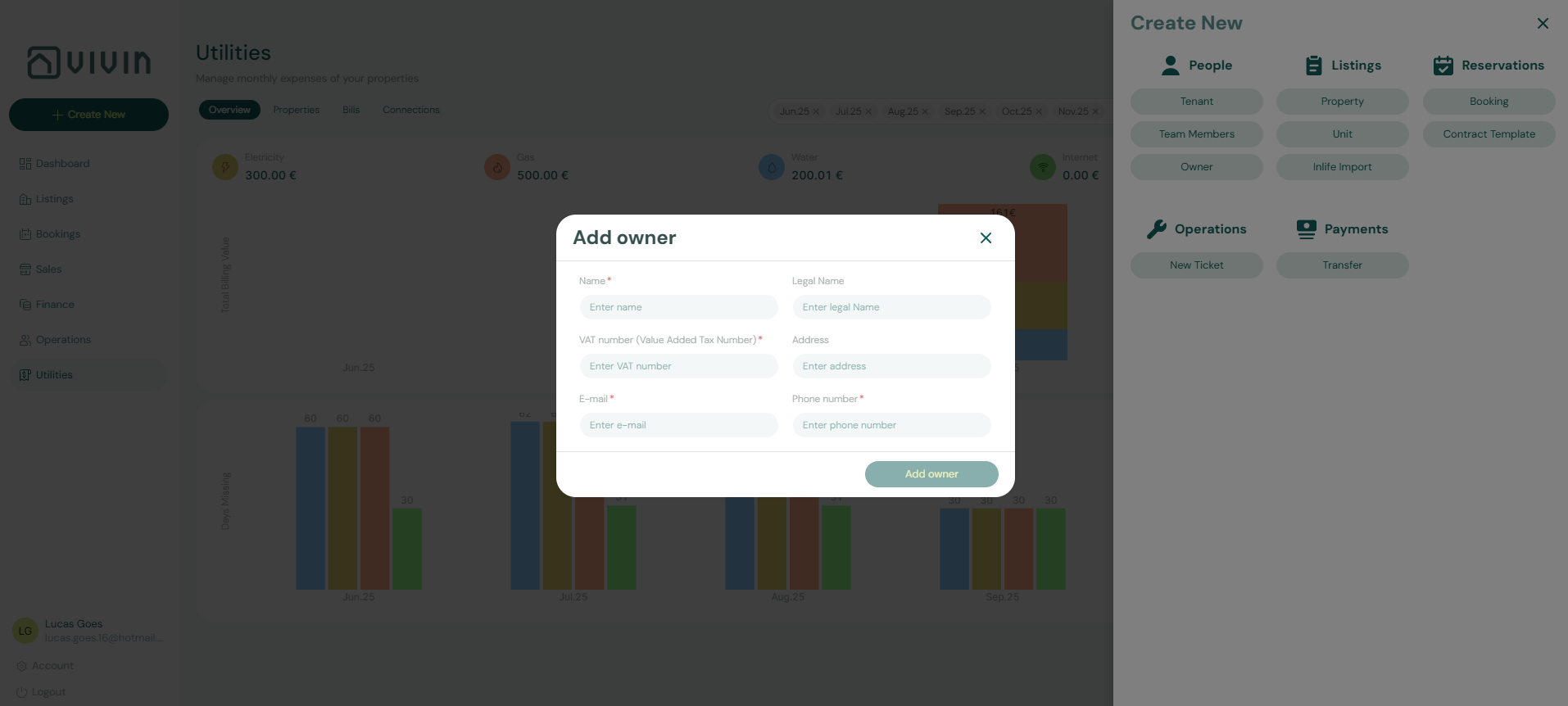
Step 1 — Register the owner.
Owner setup pairs with Settings > Owners, list-owners / create-owner on Landlord MCP, and Settings > Invoicing & Payments (payout IBAN). Downstream: Step 2 (property wizard owner field).
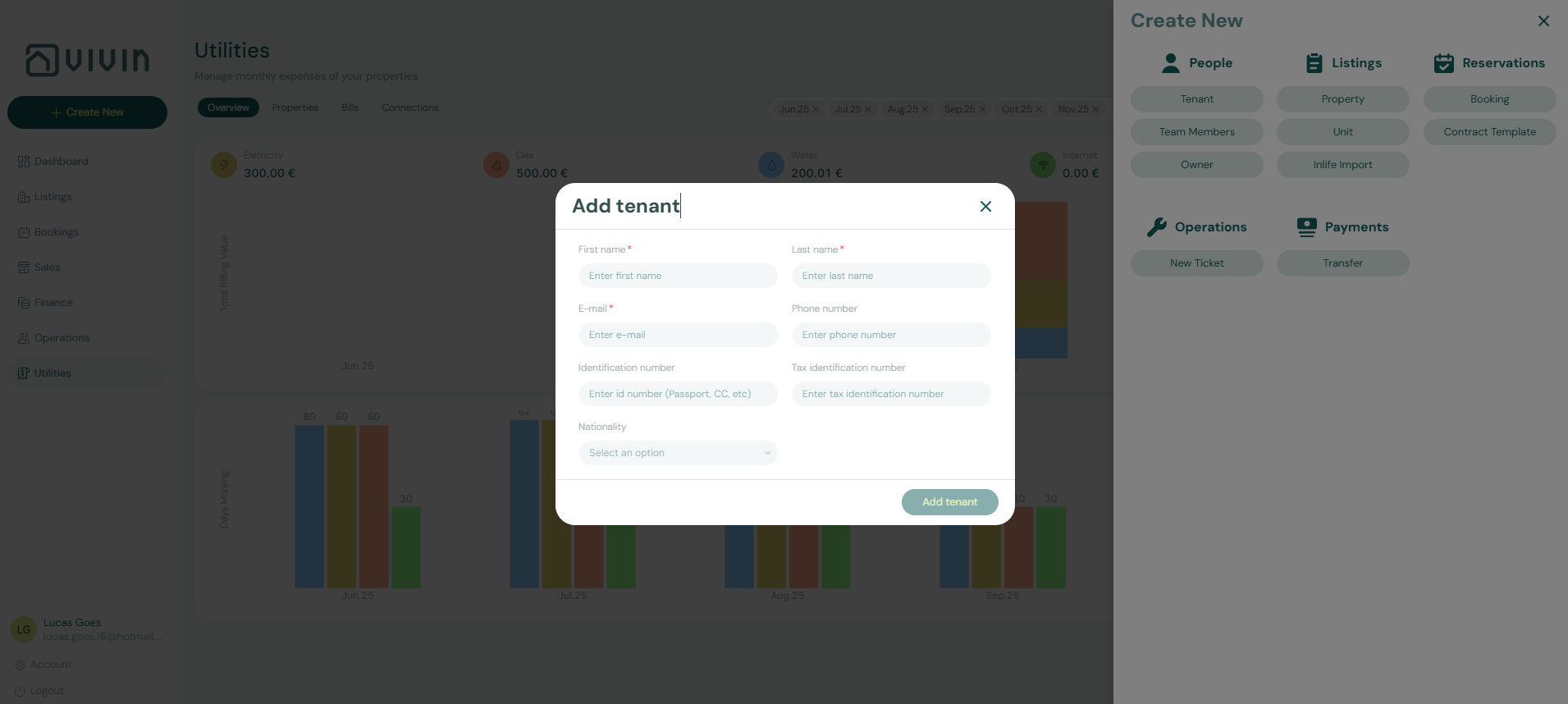
Navigate to Settings > Owners and verify the property owner already exists. If not, click + Add Owner and fill in their legal name, fiscal ID, contact details, and IBAN. The owner must exist before you can create a property.
Account-scoped Landlord MCP list-owners confirms the owner row exists before create-property — create-owner mirrors + Add Owner when an external client onboards several buildings for the same landlord. External tools cannot attach Settings > Contract templates; finish template links in the UI before MCP property writes.
Step 2 — Create the property.
Property wizard pairs with Listings — Creating a New Property, create-property on Landlord MCP, and contract fields that drive Processing a New Booking. Upstream: Step 1. Downstream: Step 3 (units under the building).
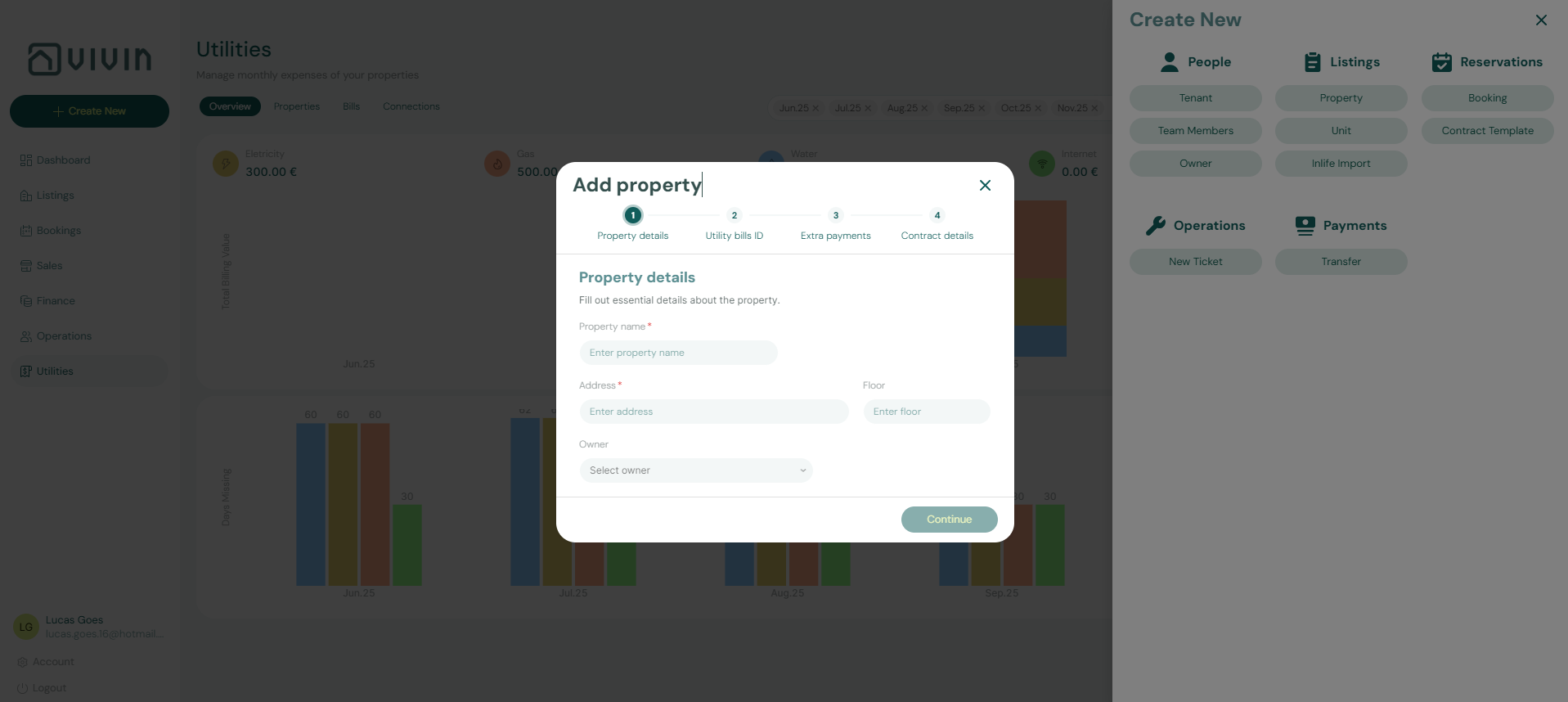
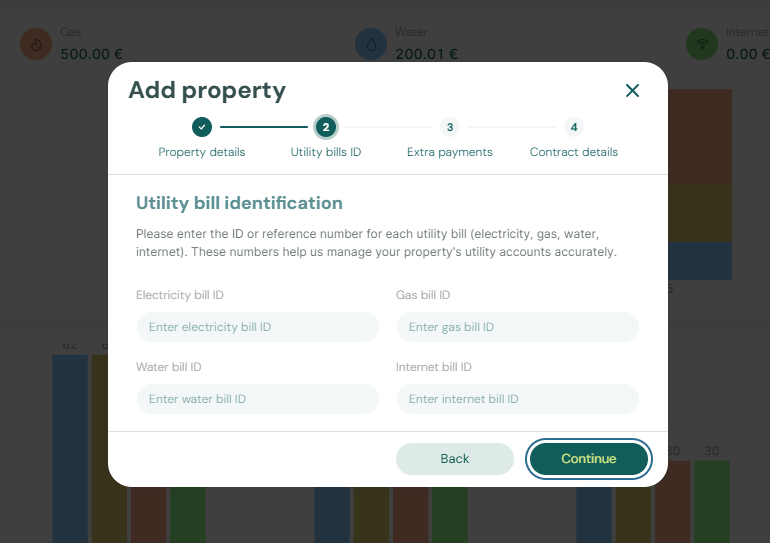
In Listings, open + Create New and choose Property, then complete all four steps of the wizard:
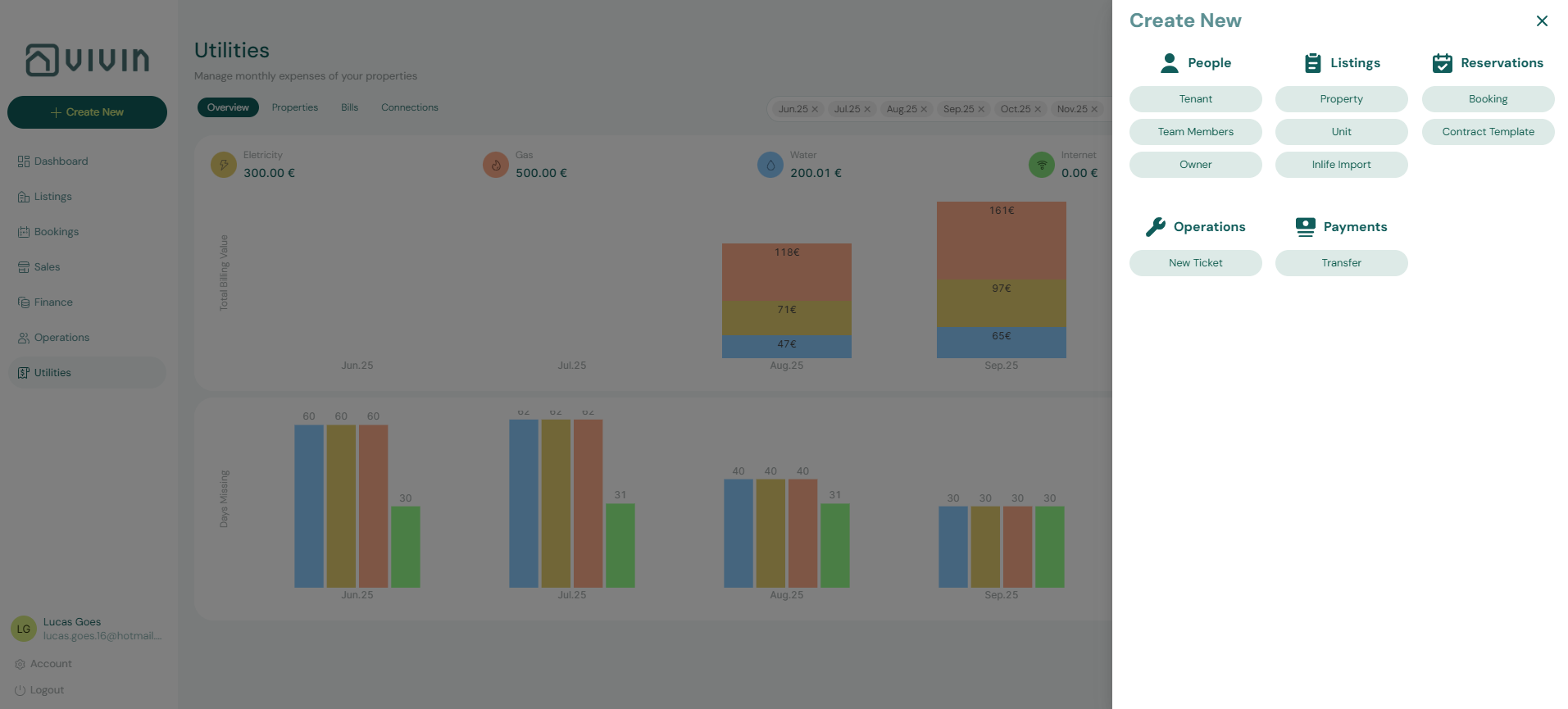
- Property details — name, address, and owner
- Utility bills — account IDs for electricity, gas, water, and internet (from your utility statements)
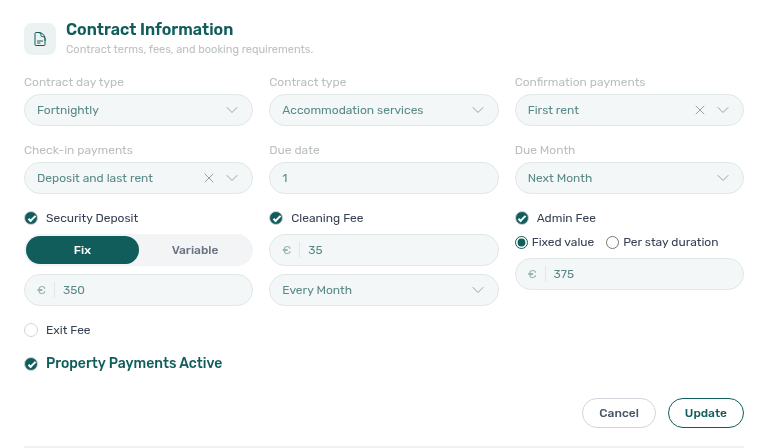
- Extra payments — security deposit type, cleaning fee, admin fee (fixed € only in the wizard), and Bills Included ceilings
To charge admin fees by stay length (Per stay duration tiers), finish the wizard first, then open the property in Listings → Edit property → Contract Information and switch Admin fee to Per stay duration (full reference).
- Contract details — payment frequency (Monthly/Fortnightly/Daily), confirmation payments, and check-in payments
Pay close attention to Steps 3 and 4 — these settings directly control what tenants are charged and when. See Creating a New Property for detailed field descriptions.
Account-scoped Landlord MCP create-property mirrors the four-step Property wizard when an integration seeds buildings programmatically — prefer the UI wizard for utility IDs, deposit tiers, and confirmation-payment timing you will audit visually. After save, get-property / list-properties (paginate with nextOffset) verify address, owner link, and contract fields match Listings before you create units in Step 3.
The cleaning fee frequency defaults to Every Month and cannot be changed during creation. If you need One-Time Fee at Booking Confirmation or One-Time Fee at Move-in, edit the property after creation in Contract Information (Payments tab).
Step 3 — Create units.
Unit creation pairs with Listings — Rent Value tab, create-listing on Landlord MCP, and Sales → Channels readiness in Step 5. Upstream: Step 2. Downstream: Step 4 (property edit tabs).
Click + Create New > Unit for each rentable space in the property. Set the unit name, type, base rent, capacity, and min/max stay periods. If rent varies by season or demand, choose "Variable Rent" and configure pricing ranges afterward in the unit's Rent Value tab.
Account-scoped Landlord MCP create-listing creates a unit under a property id — pair with get-listing and get-listing-pricing-table when variable-rent spans need verification before channel linking in Step 5. set-listing-pricing-month adjusts monthly grid rows the UI Rent Value tab shows; external clients cannot upload booking-engine photo galleries — use the Full integration pill in Step 4 for partner payload.
Step 4 — Configure property settings.
Property settings pair with Settings > Tenant categories, Communication Rules audience, Listings — Access Lockers, and get-chatbot-rules on Tenant MCP. Upstream: Step 3. Downstream: Step 5 (channel links).
After creation, open the property's edit view (pencil icon in Listings) and review these tabs:
- Payments tab: Confirm the cleaning fee Frequency (Every Month, One-Time Fee at Booking Confirmation, or One-Time Fee at Move-in) — it defaults to Every Month and cannot be changed during creation
- Maintenances tab: Set up automatic check-in/check-out tickets if desired — far-future schedule dates may show Draft (display status) in Operations → Tickets until the date nears; link paid contractor rows from the ticket Cost allocation panel when you reconcile Cash Flows. Individual reservations can still opt out on Add booking — see Glossary — Per-booking maintenance ticket opt-out
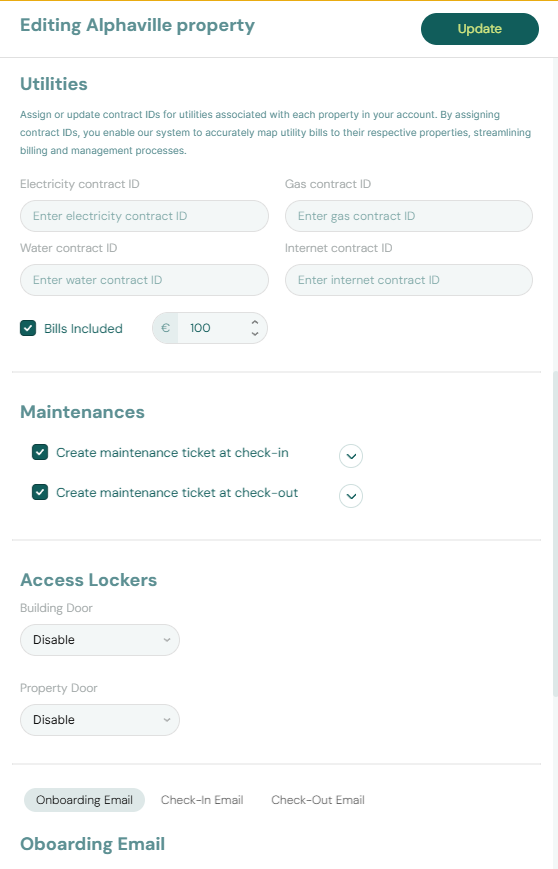
- Email Customization tab: Add any property-specific messages to tenant emails
Before your first reservation, confirm Settings > Tenant categories defines the segments you will assign on tenant profiles — categories drive portal modules, Communication Rules audience, and portfolio filters on Bookings, Finance, and Tenants during month-end review. Mark Default for integration-created tenants before high-volume channel imports in Step 5; direct bookings still need manual assignment in Processing a New Booking — Step 2 (FAQ — Assign tenant category for direct booking). Mirror segment checks on Bookings → Tenant categories or Tenants — Tenant category filter when Finance Overview still shows the old segment — see Glossary — Tenant category and FAQ — Finance tenant category filter parity. Month-end segment review: Portfolio KPI review — Step 6.
Booking-scoped Tenant MCP clients inherit the tenant-category and chatbot work you finish in Step 4 — get-chatbot-rules and get-chatbot-persona mirror Settings > Chatbot IF/THEN guidance, and get-portal-links surfaces the same self-service URLs tenants see once the first reservation is live in Processing a New Booking. Confirm portal access by tenant category before external assistants hand over keys or payment links. For portfolio-wide vacancy reads during channel setup (Step 5–7), pair with Landlord MCP instead of tenant-scoped tools.
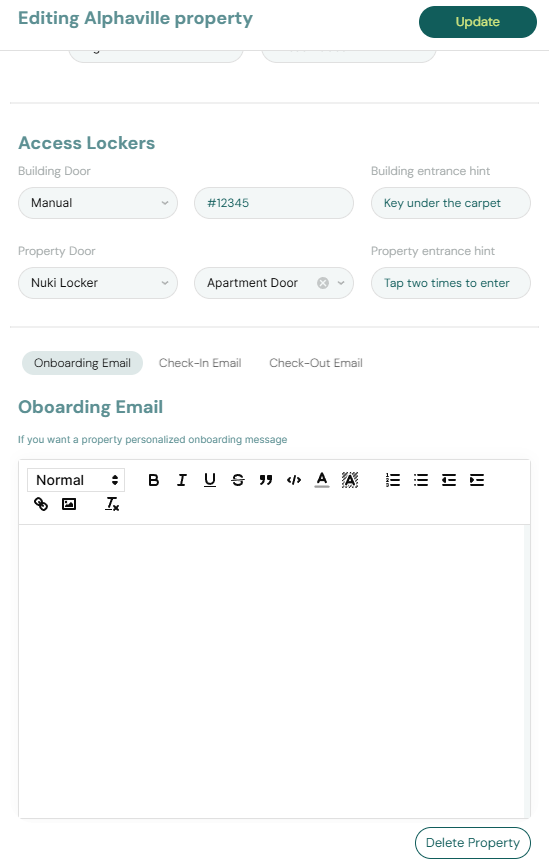
- Access Lockers tab: Enter building and unit access codes or link Nuki devices
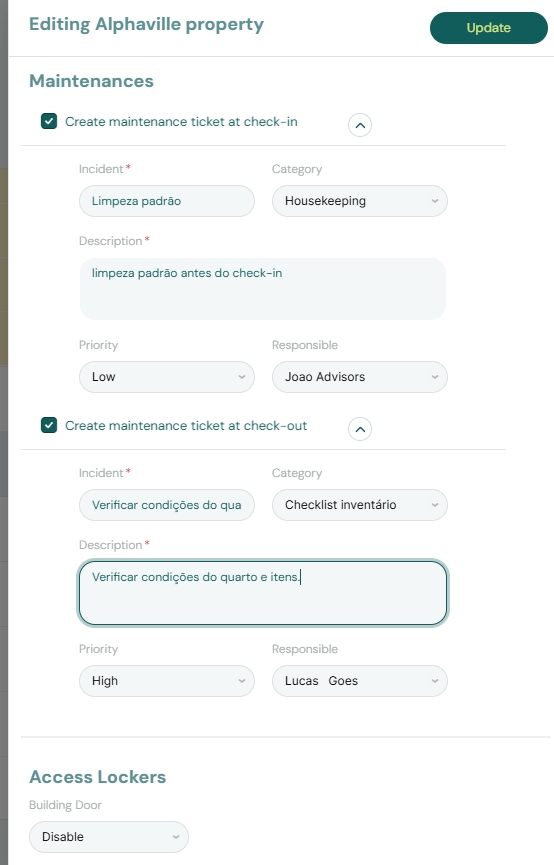
Standard Listings Setup pill tabs cover contract, payments, access, and email customization. For integration and marketplace payload fields (extra copy blocks, amenities, rules, bilingual content, partner-platform sections), switch to the Full integration pill; use Photos for booking-engine galleries. The three pills replaced the legacy Go to details header. See Glossary — Property edit sidebar pills, Property & listing details (booking engine), and bookmark patterns in Deep Links — Booking engine details layer.
Step 5 — (Optional) Connect to external platforms.
Channel linking pairs with Sales → Channels, Settings > Integrations, and Processing a New Booking — Step 1 (duplicate import checks). Upstream: Step 4. Downstream: Step 7 (Multicalendar after first import).
Navigate to Sales > Channels (/sales/channels) and verify the property's units are linked to their counterpart listings on Airbnb, Booking.com, or other platforms. This enables automatic calendar sync. Platform connections are configured in Settings > Integrations.
Account-scoped Landlord MCP list-listings and get-listing-calendar mirror Sales → Channels per-unit link status and availability bars when external clients verify outbound iCal before the first import — property context uses list-properties / get-property. When a unit still shows unexpected blocks after you toggle a channel link, get-listing includes unavailabilities (manual and channel holds) the same way Processing a New Booking — Step 1 resolves overlap before create-booking — pair with Manual block hygiene when stale holds survive an import test. get-booking-summary after the first marketplace import lands so occupancy counts match Sales → Overview without opening Bookings. Inbound partner webhooks (Housing Anywhere, Uniplaces, Channex) still deliver paid/cancelled events through Core API callbacks — wire those in Settings > Integrations and confirm Integration Swagger paths in Webhooks & Notifications and API Reference — iCal feeds; MCP does not replace Sales → Channels link toggles or iCal export URLs.
Booking-scoped Tenant MCP is not the right surface for channel setup — portfolio-wide listing links stay on Landlord MCP or the management UI. After the first marketplace booking lands, list-bookings-by-email in Processing a New Booking — Step 1 confirms the guest row before you create a duplicate manually; get-portal-links is the tenant-facing read once Processing a New Booking — Step 6 sends contract mail. notify-landlord alerts your team when a guest messages through a chatbot about a missing import — it does not link units on Channels. Surface-choice contrast: Automation & AI — Workflow pairing for surface choice.
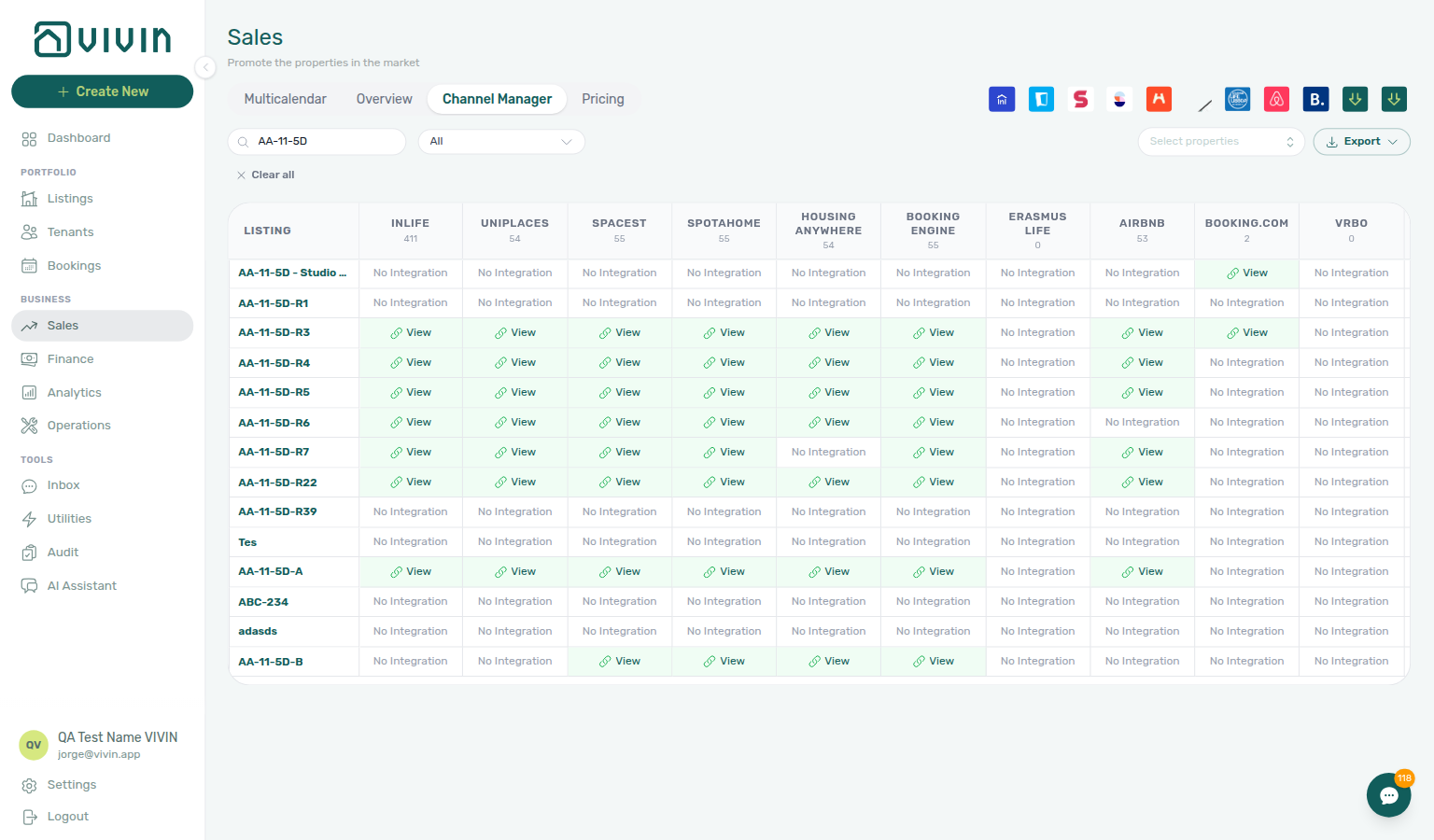
Use Export on the Channels toolbar when you need a spreadsheet of outbound iCal URLs and link status for the rows you filtered — see Sales > Channel Manager.
Step 6 — Verify utility connections (recommended)
Utility Connections pairs with Utilities → Connections, get-property on Landlord MCP, and Entering Monthly Utility Bills — Step 5 (missing bill gaps). Upstream: Step 2 (wizard utility IDs). Downstream: Step 7 before first bill cycle.
After the wizard saves utility account IDs, open Utilities > Connections and confirm each new property shows the expected Electricity, Gas, Water, and Internet rows (contract IDs and account numbers match your supplier statements). For SIMAR (Loures e Odivelas) water, compare Cód. Local on the supplier PDF — not Nº de Contador — and strip leading zeros; see Glossary — SIMAR water contract ID. Use Select properties or Search connections when your portfolio is large so the grid focuses on the building you just onboarded. If a service does not apply, turn the teal toggle off and confirm Remove contract ID — or Cancel to keep the ID. Gaps here block AI bill upload matching and monthly Entering Monthly Utility Bills overage math — fix account IDs in the property editor Utility bills step before your first bill-entry cycle.
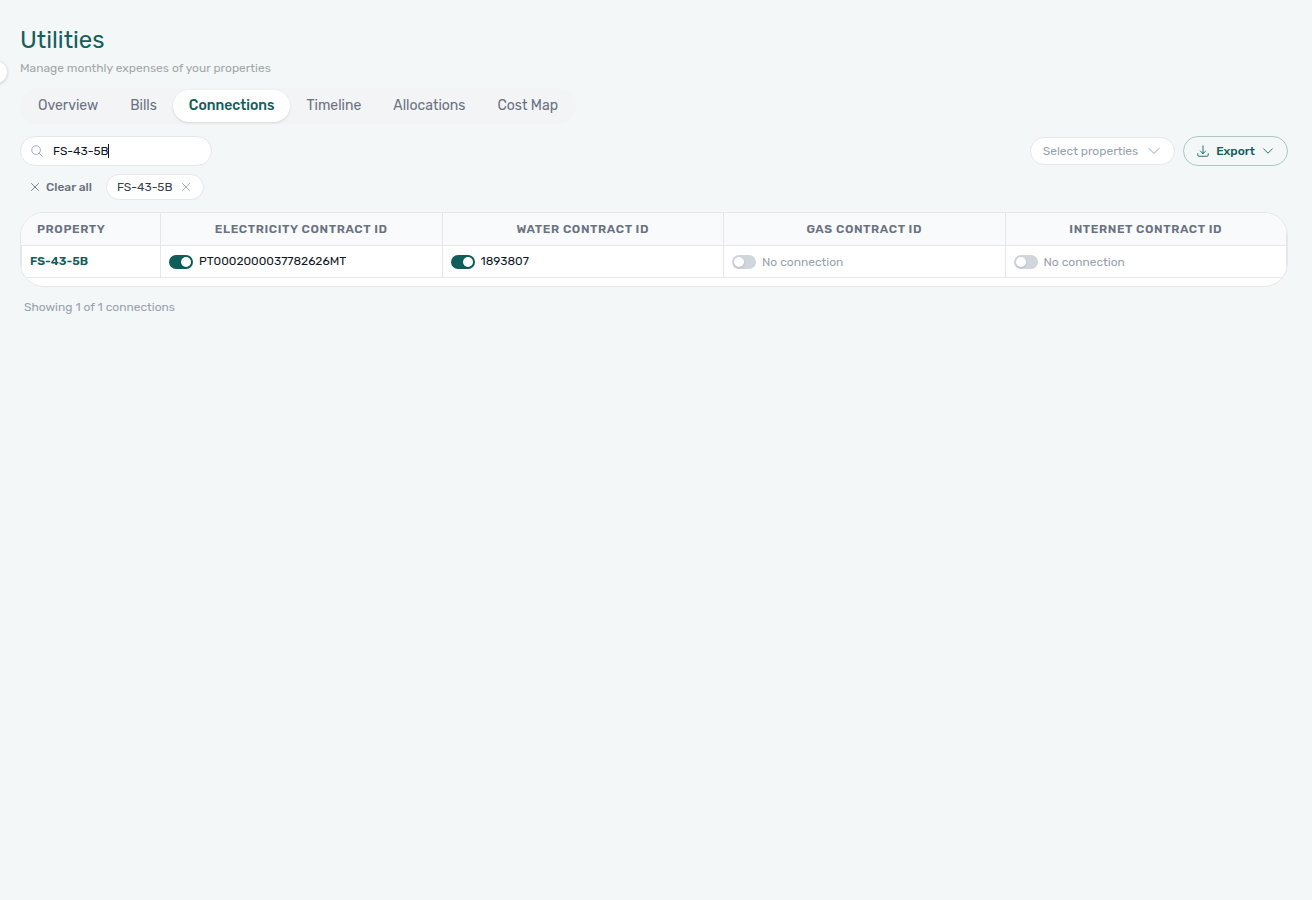
Account-scoped Landlord MCP get-property confirms the wizard Utility bills account IDs saved on the property record — compare each Electricity, Gas, Water, and Internet field against the Utilities → Connections matrix before your first bill cycle. list-bills, get-bill, and create-bill cover monthly supplier invoices in Entering Monthly Utility Bills — they do not replace this Connections verification grid or inline cell edits (operator UI with utilities.edit_connections). When chasing Missing gaps after go-live, list-bills plus get-property mirror Entering Monthly Utility Bills — Step 5 before you re-run bill upload.
Step 7 — Verify in Listings.
Go-live verification pairs with Common Workflows — Property setup to first arrival handoff (Step 7 → Managing a Check-in — Step 1; listings-property-edit-access-lockers-tab.png, workflows-operations-check-in-out-planning-view.png), Common Workflows — New inventory to first booking handoff (Step 7 → Processing a New Booking — Step 1 / Step 6; workflows-onboarding-property-wizard.mp4), Listings portfolio table, Bookings → Timeline, Processing a New Booking, Managing a Check-in, and Notification triage — Step 4 (first alerts). Upstream: Steps 1–6. Downstream: Portfolio KPI review baseline.
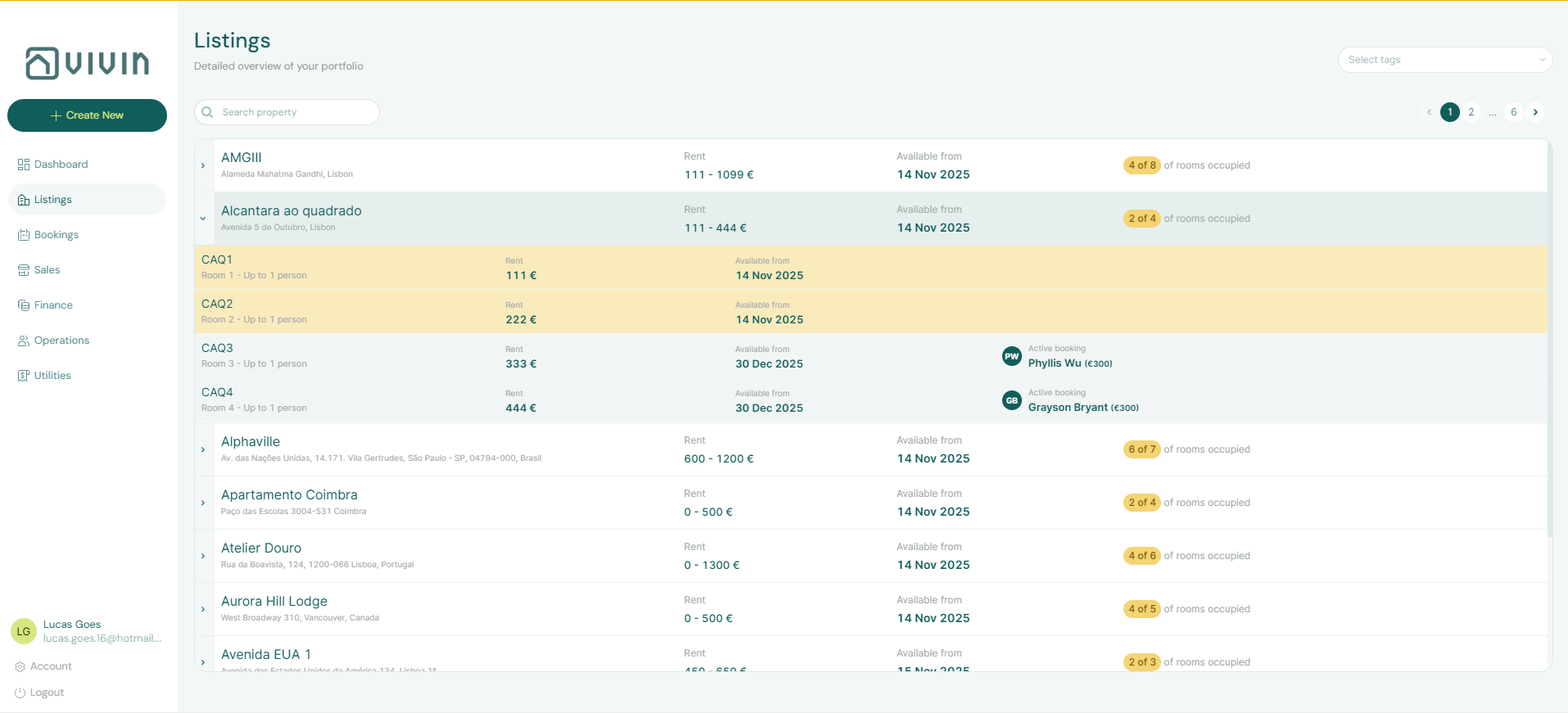
Open the Listings module and confirm the property and all its units appear correctly with the right rent values and availability dates. When neighbourhood tags are already on the buildings, Select tags stays open while you add a second area (for example Alameda, then Saldanha) so both clusters stay in one view — see Listings — Select tags stays open. After your first reservation, use Bookings → Timeline or Sales → Multicalendar to confirm stay bars and channel blocks look correct on the unit row — see Processing a New Booking — Visual overlap check. When unexpected manual holds or channel blocks survive verification, run Manual block hygiene before you escalate calendar defects — Manual block hygiene — Step 6 when Multicalendar edits stay blocked. When the first payment overdue or booking-created alert arrives, triage from Notification triage — Step 4 before you chase collections in Handling a Late Payment — Step 1 — when row-click or read-state APIs fail on first-booking alerts, continue Notification triage — Step 6 before you file Vivin support. Plan the first arrival in Managing a Check-in once confirmation payments clear — when the deposit transfer is short, triage Partially paid on the booking Deposit tab or Finance → Deposits → Partial paid lifecycle card on Finance → Deposits before move-in (Partly collected security deposit); confirm portal gates in Processing a New Booking — Step 6 before you send contract mail; when access-code or Nuki defects block arrival week, pair with Managing a Check-in — Step 6. When a channel import is a duplicate or wrong guest, cancel with Cancelling a Booking and close related prep work in Cancelling a Booking — Step 6 before you create a manual replacement — clear lingering cancellation alerts and settlement receipts in Cancelling a Booking — Step 6b at month-end. Clear first-booking alerts in Notification triage — Step 5 after verification. At month-end on new inventory, pair lingering Pending confirmation receipts (Processing a New Booking — Step 6b), move-in requirement rows (Managing a Check-in — Step 6b), and utility overage receipts (Entering Monthly Utility Bills — Step 4b) with Portfolio KPI review — Step 7, segment baselines in Portfolio KPI review — Step 6, and collections-week Pending rows in Handling a Late Payment — Step 6b when confirmation and rent receipts share the same ledger queue — segment-wide arrears on new inventory may still need Handling a Late Payment — Step 6 after the mesh settles. If a management lockout delayed go-live verification, recover access with Resetting a Management User Password (Step 3) before you rerun Step 7 — refresh Landlord MCP Bearer JWT after Step 3 there; catch up first-booking alerts in Notification triage — Step 5 (file Step 6 when row-click fails), finish Entering Monthly Utility Bills — Step 5 / Step 4b when the first bill cycle lagged during lockout, then plan first arrivals in Managing a Check-in.
Booking-scoped Tenant MCP get-portal-links, get-chatbot-rules, and get-chatbot-persona inherit the Step 4 segment and chatbot work once Processing a New Booking creates the first stay — confirm portal access by tenant category before external assistants hand tenants keys or payment URLs. list-bookings-by-email resolves the correct bookingId when a guest has more than one active reservation.
Account-scoped Landlord MCP list-properties (paginate with nextOffset) and list-listings mirror the portfolio table and unit rows you confirm here — get-vacant-units-next-month and get-booking-summary give occupancy snapshots after channels connect (Step 5) without opening Sales → Multicalendar. Write tools such as create-property / create-listing belong to setup (Steps 2–3), not this read-only pass.
Finish Steps 1–6 and channel link toggles on Sales → Channels before you open a Vivin support ticket — portfolio table gaps and Multicalendar holds are usually operator configuration, not product defects. After your first reservation, triage confirmation Pending receipts with Processing a New Booking — Step 5b and month-end lingering rows with Processing a New Booking — Step 6b before Finance → Contract Values looks wrong. File Using in-app support when Vivin behaviour blocks verification despite correct operator steps:
- Create New → Property wizard cannot Submit though required fields are filled — attach property name and owner id (Listings module).
- Utilities → Connections rows stay Missing after you saved account IDs in the property editor — attach the property id (Utilities module).
- Channel link toggles on Sales → Channels fail without a clear integration error in Settings > Integrations — attach unit internal name and platform (Sales module).
- Landlord MCP
create-propertyorcreate-listingreturns persistent validation errors while the UI wizard succeeds on the same payload — attach request ids (Settings module).
Use the Help & Support drawer from Listings when screenshots should include the wizard or portfolio table — Deep Links — Support. If a management lockout delayed go-live verification, recover access with Resetting a Management User Password before you rerun Step 7 — refresh Landlord MCP Bearer JWT after Step 3 there; catch up first-booking alerts in Notification triage — Step 5 (file Step 6 when row-click fails), finish Entering Monthly Utility Bills — Step 5 / Step 4b when the first bill cycle lagged during lockout, then plan first arrivals in Managing a Check-in. Pair with Manual block hygiene — Step 6 when unexpected Multicalendar holds survive onboarding verification.
Account-scoped Landlord MCP list-properties, list-listings, get-listing (unavailabilities), and get-property attach portfolio context before you file support — channel toggles and wizard Submit remain operator UI. Booking-scoped Tenant MCP is not the right surface for property onboarding verification. Surface-choice contrast: Automation & AI — Workflow pairing for surface choice.
After onboarding, follow the Processing a New Booking workflow to create the first reservation for your new property.
Onboarding a New Property section cross-reference
Use the steps above for the main path. For related guides, open Related below, or return to Common Workflows.
Related
Related below links this workflow to modules, concepts, settings, and escalation paths.
Documentation map & escalation
- Common Workflows — Hub pairing matrix across all operator guides
- Getting Started — Recommended Setup Sequence — Account-wide configuration steps 1–12 before this workflow’s property wizard; after setup steps 13–15, return here for Step 7 — Verify in Listings
- Getting Started — Lockout catch-up after password recovery — Operational backlog mesh when sign-in was restored mid-onboarding
- Glossary — Term definitions referenced in the steps above
- FAQ & Troubleshooting — Quick answers when a step does not match live product behaviour
- Get Help & Support — Escalate when permissions or account state block property setup
- Using in-app support — Vivin product tickets when onboarding steps are blocked; Step 7 when wizard submit or Utilities → Connections verification fails
Upstream & downstream workflows
- Processing a New Booking — First reservation workflow after the property wizard
- Processing a New Booking — Step 5b — Approve first confirmation receipts after channel import (Step 7)
- Processing a New Booking — Step 6b — Month-end lingering confirmation receipts on new inventory (Step 7)
- Handling a Late Payment — Step 1 — Collections on the first live bookings; upstream path from Notifications — Payment overdue alerts
- Notification triage — First booking-created or payment alerts on new inventory (Step 4)
- Notification triage — Step 5 — Clear first-booking alerts after Step 7 verification
- Cancelling a Booking — Duplicate or wrong channel import before manual replacement (Step 7)
- Cancelling a Booking — Step 6 — Close prep tickets after duplicate cancel (Step 7)
- Cancelling a Booking — Step 6b — Clear cancellation alerts and lingering settlement receipts on new inventory (Step 7)
- Processing a New Booking — Step 6 — Portal gates before first contract mail (Step 7)
- Handling a Late Payment — Step 6 — Segment-wide arrears on new inventory after first bookings (Step 7)
- Handling a Late Payment — Step 6b — Collections Pending on new inventory at month-end (Step 7)
- Managing a Check-in — Step 6 — Access-code or Nuki blockers before first arrival (Step 7)
- Managing a Check-in — Step 6b — Move-in Pending on new inventory at month-end (Step 7)
- Notification triage — Step 6 — Row-click blocked on first-booking alerts (Step 7)
- Managing a Check-in — First arrival-week prep after the first reservation is confirmed (Step 7)
- Entering Monthly Utility Bills — First monthly bill cycle after utility IDs are saved (Step 6)
- Portfolio KPI review — Month-end pass once the property has bookings
- Portfolio KPI review — Step 6 — Baseline tenant-segment filters once bookings accumulate (Step 7)
- Portfolio KPI review — Step 7 — Month-end Total Debt and Pending pill triage on new inventory (Step 7)
- Manual block hygiene — Audit pass when Step 7 Multicalendar still shows unexpected holds; Step 6 when calendar edits are blocked
- Resetting a Management User Password — Recover access when a lockout delayed go-live verification (Step 7); refresh Landlord MCP JWT after Step 3, then catch up Notification triage — Step 5 / Step 6 and Entering Monthly Utility Bills — Step 5 / Step 4b
- Entering Monthly Utility Bills — Step 4b — Utility overage Pending on new inventory at month-end (Step 7)
- Entering Monthly Utility Bills — Step 6 — AI extraction or overage posting blocked after the first bill cycle (Step 7)
Navigation & bookmarks
Bookmark routes pair with Management Frontend Deep Links and Create New menu.
- Create New menu — Property and Unit wizard shortcuts from any screen
- FAQ — Permission denied toast — Red You do not have permission to perform this action. toast when RBAC blocks a save; fix in Users → Role Permissions
- Management Frontend Deep Links — Booking engine details — Bookmarkable
?propertyDetails=1/?listingDetails=1URLs (Vivin internal)
Concepts & settings that shape this workflow
- Integrations & Distribution — Enable platforms in Settings, then link each unit on Sales Channels (Steps 5–6)
- Tenant Portal — Portal branding and self-service before the first tenant moves in
- FAQ — Tenant contract signing blocked — No PDF yet, mandatory Your Details gates, category locks, or Lease purpose; portal signing vs paper upload on Contract Info
- Tenant MCP — Booking-scoped
get-chatbot-rules,get-chatbot-persona, andget-portal-linkswhen external assistants inherit Step 4 segment and chatbot setup (Step 4);list-bookings-by-emailafter the first channel import (Step 5 → Processing a New Booking — Step 1);get-portal-linksafter contract mail andnotify-landlordfor missing-import chatbot escalations (Step 5);get-portal-linksand chatbot reads after the first reservation in Step 7 - Landlord MCP —
list-owners/create-ownerbefore property setup (Step 1);create-property,get-property,list-propertiesduring the wizard (Step 2);create-listing,get-listing,get-listing-pricing-table,set-listing-pricing-monthfor units (Step 3);list-listings,get-listing(unavailabilities),get-listing-calendar,get-booking-summary, and property reads during channel verification (Step 5);get-propertyfor utility IDs vs Utilities → Connections matrix, pluslist-bills/get-bill/create-billcontrast for monthly bills (Step 6; inline Connections edits remain operator UI);list-properties,list-listings,get-vacant-units-next-month,get-booking-summaryfor post-onboarding verification (Step 7); hub - Automation & AI — Landlord vs Tenant MCP surface choice during channel linking (Step 5)
- Payment Allocation — Two-layer payment model before the first confirmation receipt
- Booking Lifecycle — Status progression after the first reservation is created
- Services Marketplace — Configure Services catalogue before the first tenant moves in
- Settings > General Information — Company branding before the property wizard
- Settings > Tenant categories — Default segment and default for integrations before marketplace channel imports (Step 4); assign on Tenant Info in Processing a New Booking — Step 2 for direct reservations; mirror Bookings/Tenants filters when Finance Overview still shows the old segment (FAQ — Finance tenant category filter parity)
- Settings > Categories — Seed ticket, booking, and listing tags before the first turnover
- Settings > Tenant Portal — Portal settings — Portal permissions and contract-signing gates
- Settings > Preferences — Enable deposit disputes — Account toggle before first move-out disputes
- Settings > Emails — Lifecycle templates and Communication Rules before move-in
Listings, sales & channel surfaces
- Listings module — Property wizard, unit setup, and sidebar tabs
- Sales — Overview tab — Post-onboarding occupancy heatmap after channels connect (Step 5)
- Sales — Channel Manager — Per-unit link status and iCal export (Step 5)
- Property & listing details (booking engine) — the Full integration pill for partner payload (Step 4)
- Dashboard module — Vacant Units and Today KPIs once channels and listings are live
Utilities, operations & finance surfaces
- Utilities module — Verify Connections after utility IDs are saved (Step 6)
- Operations module — Automatic turnover tickets from Maintenances (Step 4)
- Operations — Linking cash flows to a ticket — Cost allocation when contractor invoices follow setup
- Finance module — Portfolio ledgers once live bookings accumulate Contract Values
Deeper workflow reads
See Upstream & downstream workflows above for the same guides.
Deeper API reads
- Listings & Availability — Partial
GET /listingspulls paired with Step 5 — Connect to external platforms verification - Property & Unit Mapping — External listing IDs before channel imports land in Listings
- Full listing feeds — Partner full JSON feeds behind marketplace Channels setup
- iCal feeds — Calendar retrofeed imports on Sales → Channels (Step 5)
- Authentication — Integration Bearer keys vs management JWT before you enable platforms
- Creating Bookings — First reservation verification after Step 7 — Verify in Listings
Operator habit hubs
Day-to-day operator habits (lockout catch-up, pending receipts, payment triage, handoffs, and related playbooks) live on the Common Workflows habit hub.
Deep-link anchors for habit hubs
Check-out vs cancellation
Lockout catch-up after password recovery
Pending manual receipt approval
Utility overage collections
Check-out final utilities handoff
Check-in to check-out handoff
Check-out collections before refund
Check-out ledger cleanup before refund
Cancellation collections before void
Notification row-click navigation
WhatsApp per-booking messaging
Bot reasoning (audit)
ChatBot settings
Payment notification (operator)
Payment alert to receivables triage
Finance debt receivables triage
Handling a Late Payment collections
Finance Income status drill-down
Cash flow forecast drill-down
Reject/revert mistaken receipts
Month-end invoicing (fixed date)
Bulk Hostkit invoicing
Rent reduction after invoicing
Same-day turnover coordination
Occupancy KPI to block hygiene handoff
Deposit missing on Finance Deposits
Deposit lifecycle status
Partly collected security deposit
Wrong tenant on a booking
Cancel Booking vs Delete Booking
Portfolio retirement decisions
Provider platform Delete Booking guard
Archived booking ledger visibility
Archive property (building-level)
Confirmation to check-in handoff
Confirmation alert triage
Portfolio segmentation by tenant category
Dashboard Total Debt subtitle
First reservations on new inventory may move Total Debt from zero — pair Step 7 with Finance → Overview when headline and Uncovered Debt diverge.
- FAQ — Dashboard Total Debt subtitle — Headline vs >15 days subtitle (
dashboard-kpi-total-debt-tooltip.png) - Processing a New Booking — Step 5b — First confirmation Pending lag
- Finance debt receivables triage — Debt Aging on first live portfolio debt
- Portfolio KPI review — Dashboard Total Debt subtitle — First month-end baseline
- Getting Started — Recommended Setup Sequence — Setup order before KPI reads
Uncovered Debt KPI
First reservations on new inventory may move Total Debt from zero — when Uncovered Debt tracks Total Debt after Step 7, deposit cushions are thin on early debtors.
- FAQ — Uncovered Debt KPI — Deposit coverage vs Total Debt (
finance-overview-kpi-cards.png) - Glossary — Uncovered Debt — First live-portfolio receivables baseline
- Finance debt receivables triage — Debt Aging on first portfolio debt
- Processing a New Booking — Step 5 — Confirmation deposits vs arrears
- Dashboard Total Debt subtitle — Ongoing-only
/vs Finance strip
Directory list refresh
When a directory such as Bookings, Notifications, or Listings needs a refresh during this workflow, use Retry on the alert, or reload the page. Zero rows after a successful load means your filters matched nothing — widen filters or clear search.
See FAQ — Directory list refresh and Common Workflows — Directory list refresh.
Booking sidebar tab refresh
Inside an open booking, Communication and Tickets load independently — use header Refresh (Communication) or banner Retry (Tickets). Other sidebar tabs stay usable. Whole-module list refresh is Directory list refresh.
See FAQ — Communication or Tickets won't open and Common Workflows — Booking sidebar tab refresh.
Key glossary terms
- Glossary — End-of-Booking cost split — Charge Time → End of Booking splits daily overage across every occupied unit; still-staying roommates stay in the denominator
- Glossary — Change history — Operator-initiated edits on Listings setup and Bookings Changelog; create-time defaults excluded
- Glossary — Archived booking ledger visibility — Delete Booking hides manual/provider_platform rows on Finance → Transactions; vIBAN and credit card stay visible
- Glossary — Finance tenant category cache refresh — Recategorizing a tenant updates
booking.tenantCategoryIdimmediately; ledger tabs reflect it on reload, while Overview can lag up to ~10 minutes - Glossary — SIMAR water contract ID — SIMAR (Loures e Odivelas) water bills use Cód. Local in Connections — not Nº de Contador; leading zeros stripped
- Glossary — Per-booking maintenance ticket opt-out — Add booking checkboxes skip automatic CI/CO tickets for one reservation only; property rule unchanged
- Glossary — Full term list
Module documentation hubs
- Analytics module — Month-range portfolio KPI charts
- Tenants module — Tenant directory and profile sidebars
- Listings module — Property wizard, unit setup, Channels tab, and Archived when sunsetting inventory
- Booking engine details — Rich marketplace payload via the Full integration pill)
- Finance module — Portfolio ledgers once live bookings accumulate Contract Values
- Bookings module — Reservation lifecycle after the first booking
- Audit module — Manual Blocks and Discounts review
- Inbox module — Portfolio-wide WhatsApp workspace
- Notifications module — Full
/notificationshistory - AI Chat module — AI Assistant
- Properties workspace — Legacy
/propertiesURL redirects into Listings - Account Settings — Workspace-wide financial policies and integrations
- API Reference hub — Partner HTTP contracts and partial vs full feeds