Tenant Services Marketplace
Optional after setup step 9 Categories and the Services tab — tenants purchase through Tenant Portal once step 14 Bookings reservations are live. Charge lines follow Payment Allocation. Concept pairing: Concepts — Setup sequence after go-live.
Browse Service Catalogue and Available Service Types, then Operator configuration. Purchase flow: How It Works. Habit-specific shortcuts live under Related below.
The Tenant Services Marketplace lets you generate additional revenue by offering extra services and add-ons directly to your tenants. Services are seamlessly integrated into the booking and billing workflow — tenants can purchase them, and charges appear alongside their regular payment schedule.
Portal visibility and purchase flows pair with Tenant Portal; Layer 1 schedule lines follow Payment Allocation; offer timing (booking, check-in, mid-stay) follows Booking Lifecycle. Month-end ancillary income review pairs with Portfolio KPI review and optional AI usage API (landlord_chat when operators used AI Chat for catalogue triage).
Service Catalogue
Catalogue defaults pair with Settings > Services, Portal settings (Allow to see services), and Settings > Tenant categories per-segment gates.
Create a customisable catalogue of services available to tenants during their stay:
- Flexible timing — services can be offered at booking, check-in, or at any point during the tenancy.
- Configurable per property — in Services settings, use the Properties multi-select on each offering to limit it to specific buildings (empty = all properties). Tenants only see services that apply to the property of their active booking.
- Integrated billing — service charges are automatically added to the tenant's payment schedule and tracked alongside rent and other charges in the Finance module.
Catalogue defaults and per-property scoping pair with Operator configuration (management Services tab) and How It Works (portal purchase → Payment plan). Visibility toggle: Portal settings.
Available Service Types
Illustrative categories pair with Settings > Services — Creating a service and tenant-facing cards on Tenant Portal — Services catalogue.
The marketplace supports a wide range of service categories. Here are common examples:
Cleaning & Household
- Regular cleaning packages (weekly, fortnightly, deep cleaning)
- Laundry and ironing services
- Welcome packs (groceries, toiletries, city guides)
Fitness & Wellness
- Gym and fitness centre memberships or day passes
- Wellness packages and spa access
Insurance & Protection
- Renter's insurance and personal liability coverage
- Extended damage protection plans
Transportation
- Airport transfers and local transportation passes
- Bicycle or scooter rental
- Parking space reservations
Workspace & Productivity
- Co-working space access or desk rental
- Meeting room booking
- High-speed internet upgrades
Storage & Extras
- Storage unit rental for extra belongings
- Furniture rental or room customisation packages
Local Experiences
- Language courses and cultural workshops
- Local experience packages and guided tours
- Event tickets and social activities
Example categories here are illustrative — configure real offerings under Operator configuration and validate tenant-facing cards in Tenant Portal — Services catalogue.
How It Works
Portal purchase → Payment plan pairs with Payment Allocation — Layer 1, Bookings > Payment plan, and Service approvals (Requests queue) when Requires approval is on. Collections: Handling a Late Payment — Step 1.
- Configure your catalogue — set up the services you want to offer, including pricing, descriptions, and which properties they apply to.
- Tenants browse and purchase — services are presented to tenants through the Tenant Portal (web) at the appropriate times (booking, check-in, or during their stay).
- Charges are created automatically — when a tenant purchases a service without manager approval, the charge is added to their payment schedule in the Finance module immediately after they confirm in the portal.
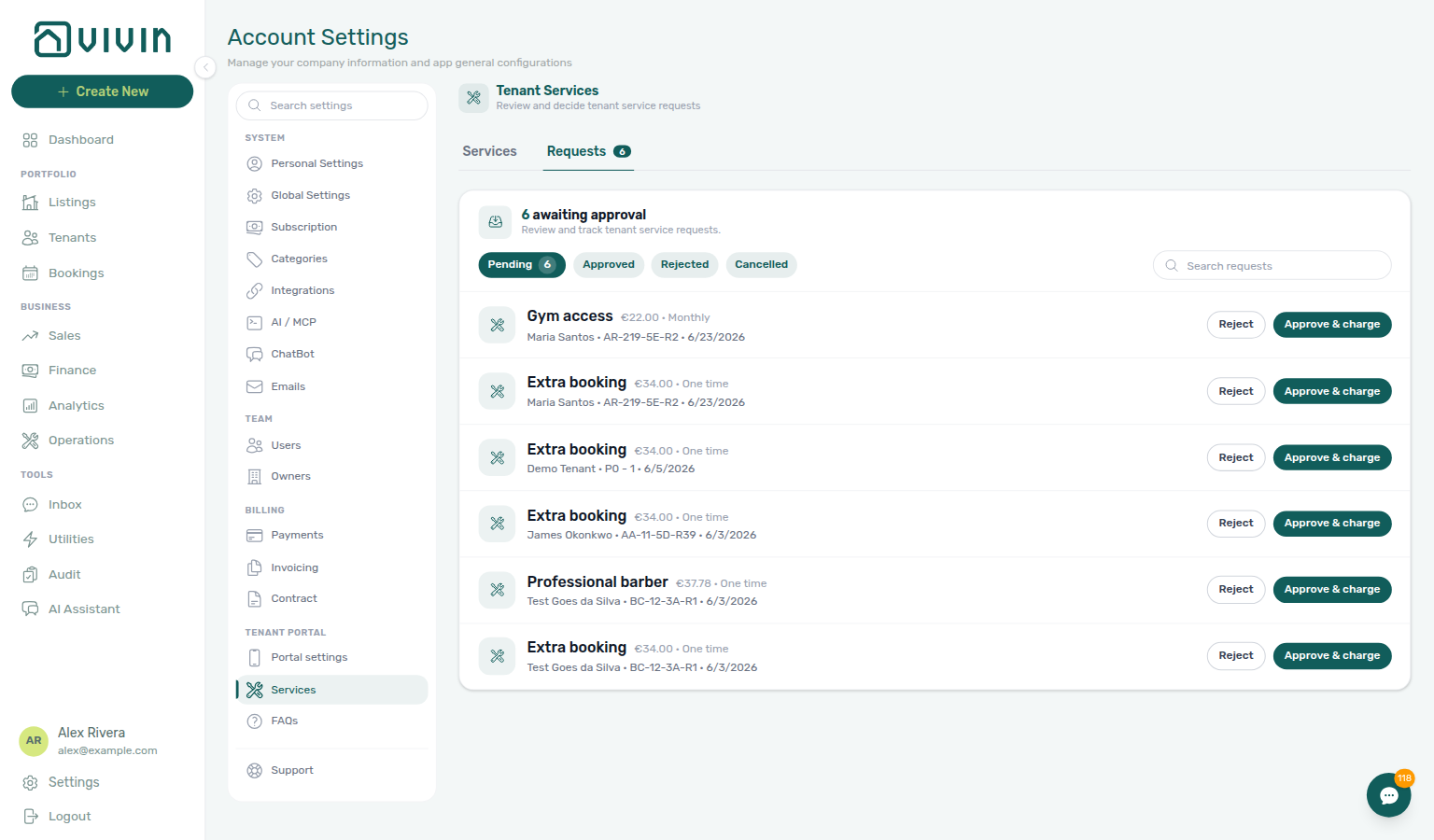
- Optional manager approval — for services marked Requires approval in Services settings, the portal holds the request in pending until an operator approves it in the Requests tab (Approve & charge) or rejects it with an optional reason. Only approved requests create payment lines.
- Operators verify on the booking — open the booking Payment Plan tab (and Finance → Contract Values when you need portfolio-wide income) to confirm the service charge landed on the schedule. There is no separate Operations fulfilment queue for marketplace orders today.
Instant charges vs Requires approval pair with Service approvals (Requests queue) and Payment Allocation — Layer 1. Collections when lines stay unpaid: Handling a Late Payment.
Operator configuration
Management setup pairs with Deep Links — Account Settings (/settings/services, /settings/preferences), Automation & AI upsell messaging, and Bookings — Other filters when reconciling segment uptake.
In the management app, the tenant-facing catalogue is maintained under Account Settings → Services. There you create and edit offerings (name, description, price, billing type, Invoicing category, images, sort order, active state, and optional Requires approval). The Invoicing category must come from Settings → Categories → Others Items Categories so Finance can resolve VAT and product codes when marketplace charges are invoiced — see Services — Creating a Service (settings-tenant-services-invoicing-category.png). When approval is enabled for any service, a Requests tab appears on the same page for the manager queue — see Service approvals (Requests queue).
Ask “Where do I configure the tenant services marketplace catalogue and approve tenant service requests?” in AI Chat — the product-context reply may still say Settings → Property → Services; open Settings → Tenant Portal → Services (catalogue + Requests queue). External MCP clients: get-vivin-context-operations.
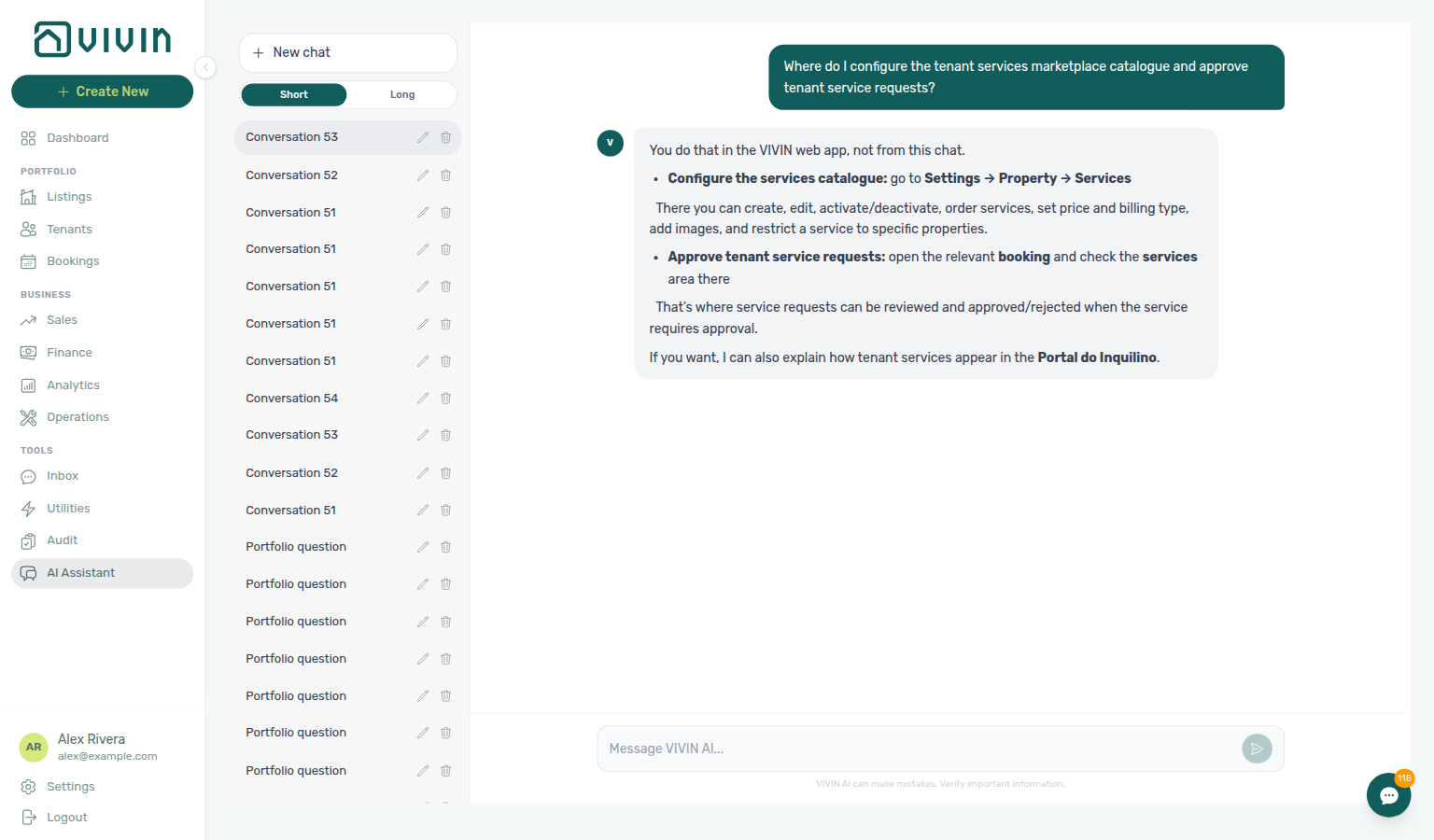
For tenants to see the marketplace at all, enable Allow to see services in Account Settings → Portal settings. Each teammate then picks which catalogue services email them under Personal Settings → Service subscription emails.
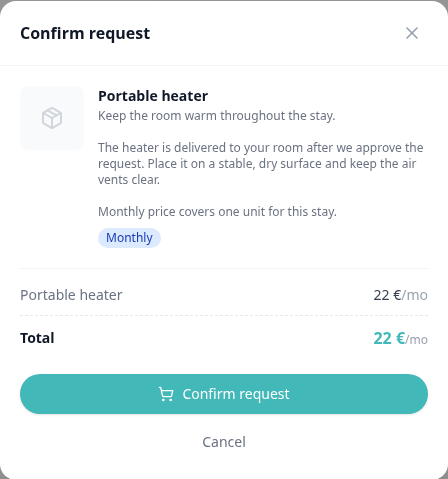
Service descriptions in the Tenant Portal: The catalogue uses compact cards. Long descriptions start as about two lines on the card; tenants tap Show more (then Show less) to read the rest. Confirm request shows the full description (scroll the panel) — it does not use the two-line clamp. Lead with the most important facts, or point to full legal copy via the optional Link field in Services settings. See Tenant Portal — Show more and Tenant Portal — Confirm request.
Management screenshots below pair with Deep Links — Account Settings (/settings/services, /settings/tenantPortal) and tenant-facing captures on Tenant Portal — Services catalogue.
Screenshots
Services catalogue (management app) — open Settings → Tenant Portal → Services (/settings/services) to add or edit offerings tenants can discover in the portal:
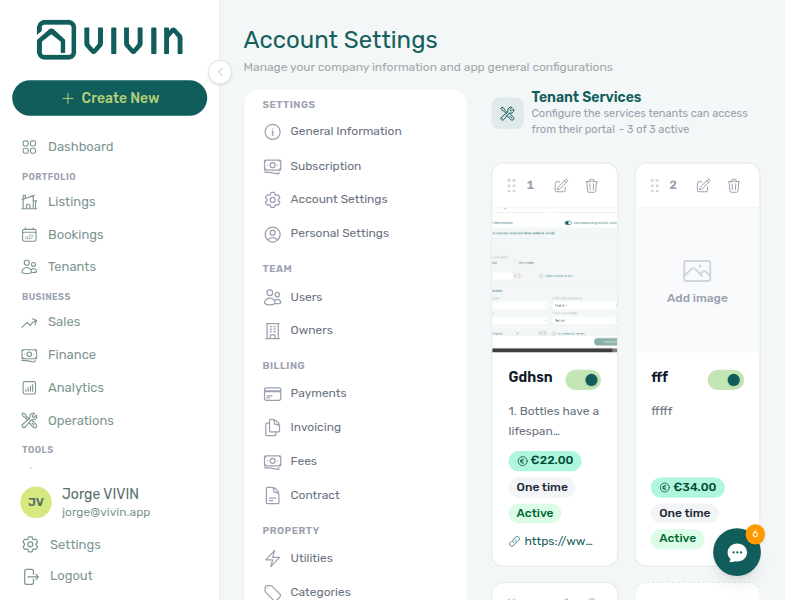
When the catalogue is populated, operators manage cards from the same tab and open Add service or the pencil control to create or edit offerings:
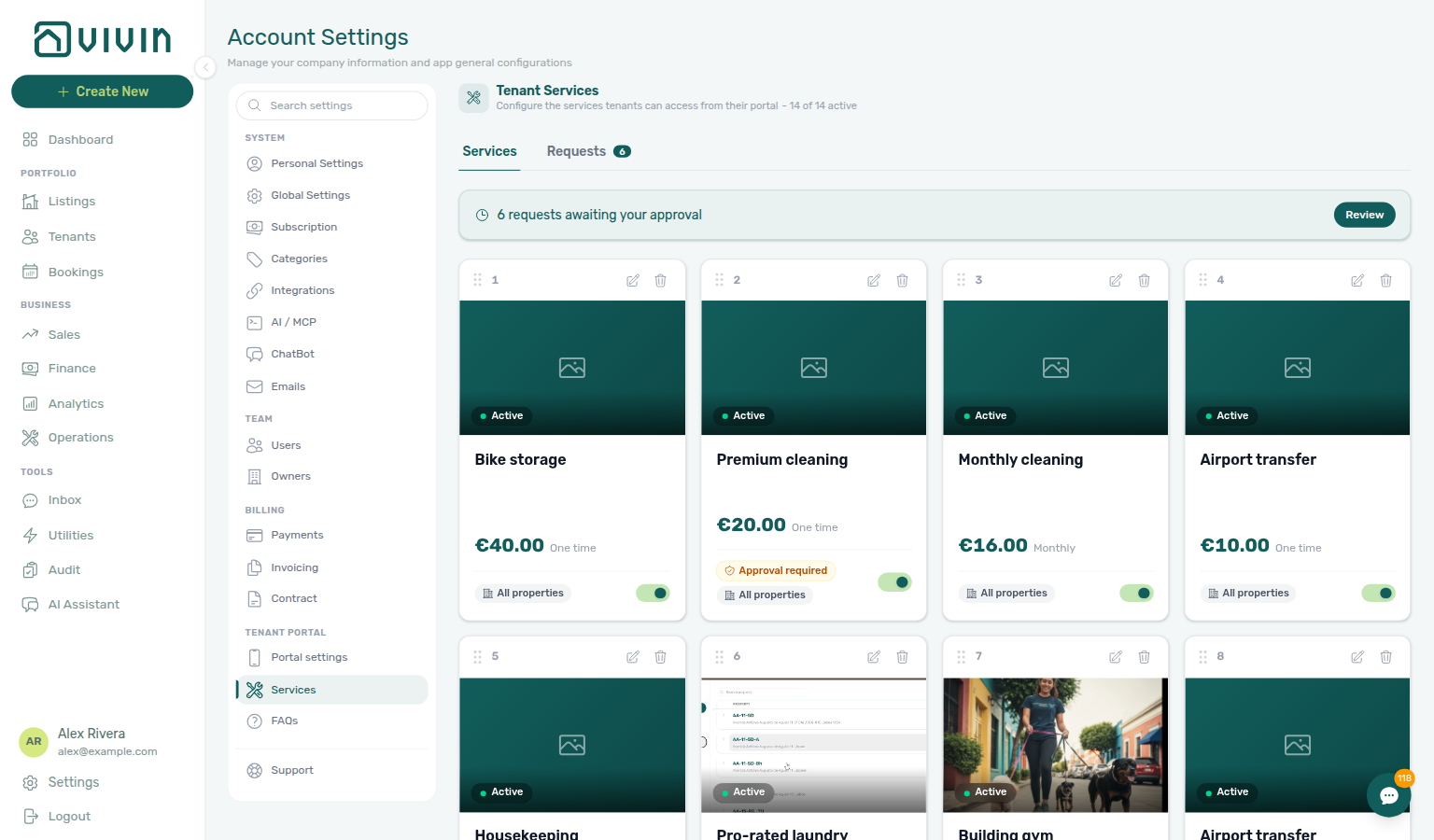
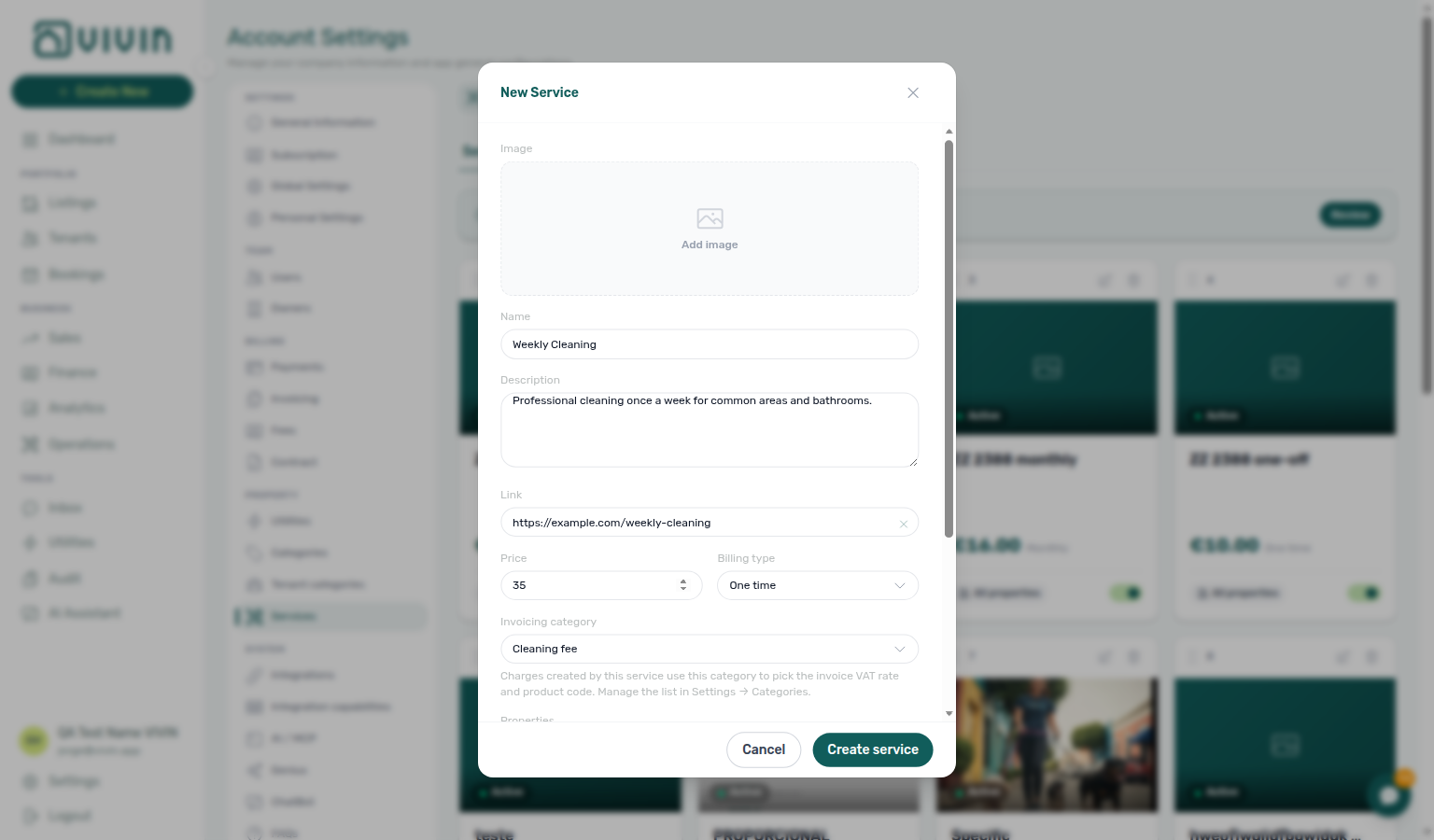
When any catalogue service uses Requires approval, operators review tenant requests on the Requests tab (pending count badge, approve/reject actions, and detail drawer):
Turn on Allow to see services under Account Settings → Portal settings so tenants can see the catalogue in the portal:
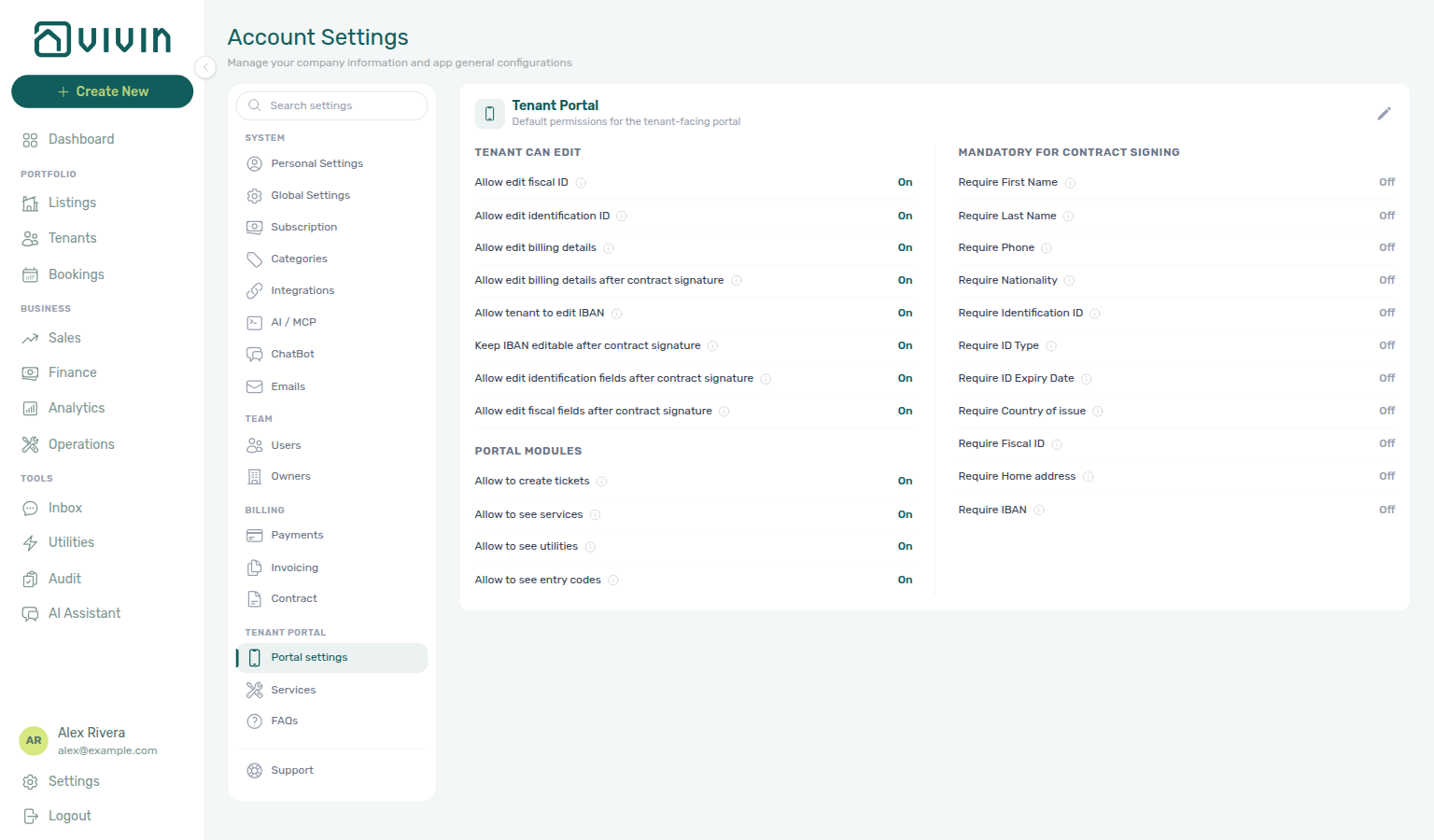
The Tenant Portal card groups Allow to see services with other permission toggles. The full permissions table and a full-page illustration in the Account Settings shell are in Portal settings.
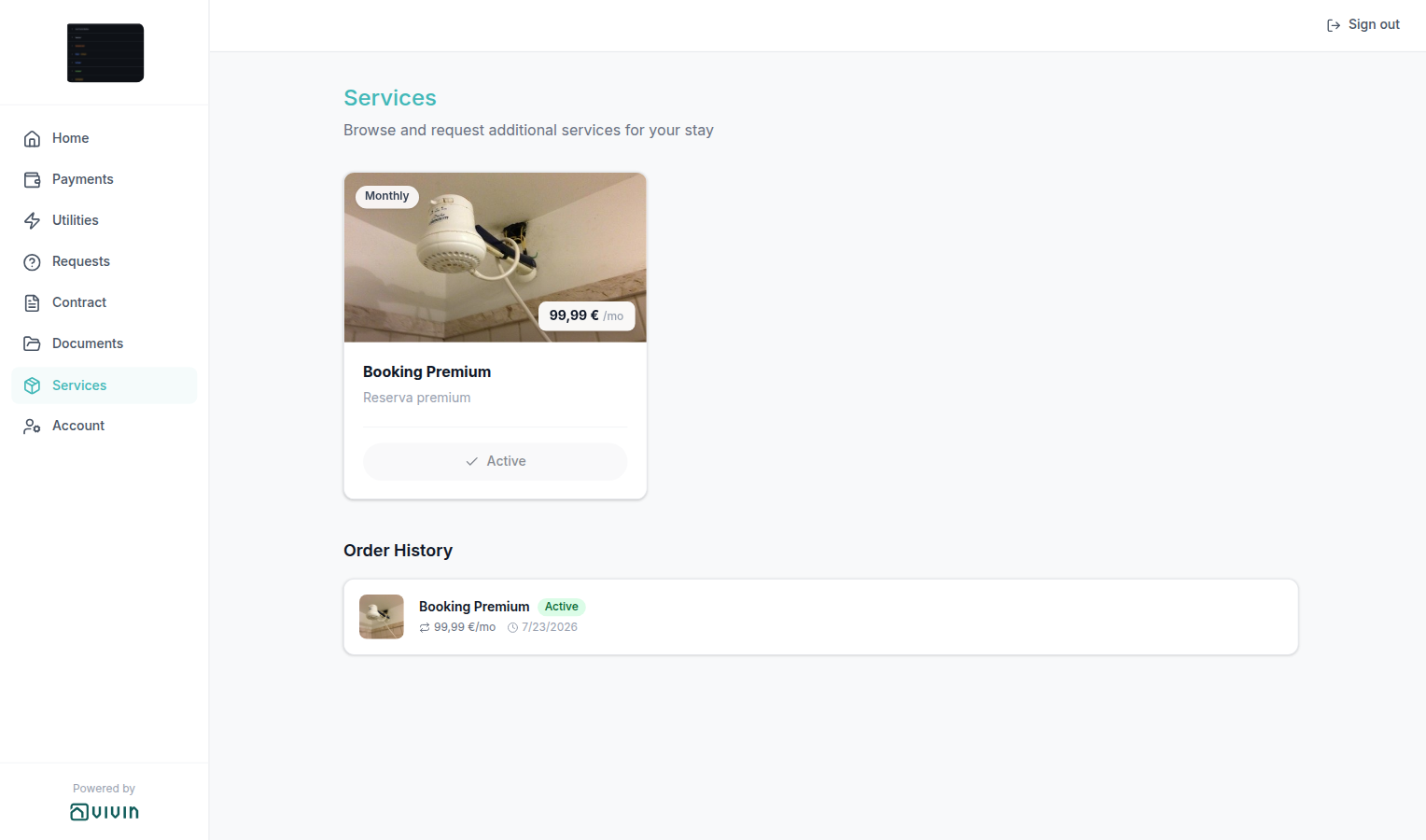
Tenant-facing catalogue — once services are enabled for the booking, tenants browse cards and confirm requests in the portal. Confirmed add-ons appear under Order History (see Tenant Portal — Services catalogue):

Revenue Opportunity
Month-end reconciliation pairs with Analytics — Revenue, ADR, and RevPAR tabs, Portfolio KPI review, and Finance > Income tab.
The Services Marketplace creates a new revenue stream beyond rent:
- Higher average revenue per tenant — by offering services tenants actually need, you increase the value of each booking.
- Improved tenant satisfaction — tenants appreciate the convenience of having services available through a single platform rather than searching for local providers.
- Differentiation — a rich service offering helps differentiate your properties from competitors, especially in the coliving and flex living market.
Start with the services that are most requested by your current tenants (typically cleaning, transportation, and gym access), then expand your catalogue based on demand. Configure different offerings per property to match the tenant demographic at each location.
Month-end reconciliation pairs with Portfolio KPI review and Analytics — Revenue, ADR, and RevPAR tabs.
Services Marketplace section cross-reference
Use the sections above for this concept. Related module and workflow pages are linked inline where they help the next step.
Related
Related below links this concept to modules, workflows, settings, and escalation paths.
Documentation map & escalation
- Introduction — Platform overview and how documentation sections connect
- Getting Started — Recommended setup sequence before you publish a tenant-facing catalogue
- Concepts — Underlying models behind portal purchases, Layer 1 schedules, and lifecycle timing
- Modules — Operator workspaces for Bookings, Finance, and Operations fulfilment
- Common Workflows — Procedures that attach service charges during onboarding, check-in, and collections
- Account Settings — Workspace-wide catalogue, portal toggles, and notification masters
- API Reference — Partner HTTP contracts (distinct from tenant portal Request Service)
- Glossary — Term definitions used across marketplace docs
- FAQ & Troubleshooting — Quick answers when portal service charges disagree with Finance
- Get Help & Support — Escalation when marketplace behaviour is blocked by account state
- Using in-app support — Vivin product tickets when approval queues or charges are unclear
Navigation & bookmarks
Bookmark routes pair with Management Frontend Deep Links and Concepts hub — Navigation & bookmarks.
- Management Frontend Deep Links — Account Settings — Bookmark
/settings/servicesand/settings/preferences - Tenant Portal — Services catalogue — Tenant-facing browse and Request Service confirmation
- Bookings > Contract Info — Tenant Portal link — Copy booking-scoped portal URLs after catalogue go-live
- Settings > Interface language — Operator UI locale before you walk staff through the Requests tab
Catalogue configuration & portal visibility
- Settings > Services — Create offerings, property scoping, Requires approval, and Requests queue (hub)
- Service approvals (Requests queue) — Approve & charge / reject pending tenant orders
- Portal settings — Allow to see services master toggle
- Settings > Preferences — In-app notifications — Account Service requests master before
/notificationspings - Settings > Interface language — Service subscription emails — Per-user chips for which catalogue services email you
- Settings > Emails — Service upsell Communication Rules paired with Automation & AI
- Settings > Tenant categories — Segment tenants before high-volume portal uptake
- Settings > Invoicing — VAT rates — VAT treatment on ancillary charges that export to Finance
- Onboarding a New Property — Configure catalogue and portal toggles before the first tenant moves in
Payment plan, collections, and month-end review
- Payment Allocation — Layer 1 schedule lines and Layer 2 approve/reject on service receipts (hub)
- Bookings > Payment Plan tab — Per-booking due-date grid after portal Request Service
- Bookings > Contract Values tab — Portfolio-wide income including ancillary charges
- Bookings > Discounts and payment adjustments — Goodwill credits on service lines
- Finance module — Income, Contract Values, Transactions, and credit note follow-up (hub)
- Processing a New Booking — Service charges attach after portal confirmation during Upcoming stays
- Handling a Late Payment — Step 1 — Collections when portal service charges stay unpaid; upstream path from Notifications — Payment overdue alerts
- Managing a Check-out — Clear ancillary Payment plan charges before deposit refund (Step 5)
- Portfolio KPI review — Reconcile ancillary income with Finance Income during month-end review
- Entering Monthly Utility Bills — Distinct from marketplace services; utility overages use a separate workflow
Tenant experience, automation, and fulfilment
- Tenant Portal — Tab-to-operator pairing: Tenant Portal section cross-reference
- FAQ — Tenant contract signing blocked — No PDF yet, mandatory Your Details gates, category locks, or Lease purpose; portal signing vs paper upload on Contract Info
- Tenant MCP — External automation for portal links, chatbot rules,
list-available-services, ticket-priority catalog, and maintenance on tenant channels - Booking Lifecycle — Offer timing across Upcoming, Ongoing, and Ended stays (hub)
- Automation & AI — Chatbot and Communication Rules context for service upsell messaging
- Operations — Tickets tab — Maintenance or fulfilment tickets when a service request needs operator follow-up
- Settings > Categories — Cashflow categories on fulfilment tickets tied to service requests
- Notification triage — Clear payment alerts when service charges post to Payment plan; payment overdue → Handling a Late Payment — Step 1
- Create New menu — Operator shortcuts distinct from tenant Request Service in the portal
- FAQ — Permission denied toast — Red You do not have permission to perform this action. toast when RBAC blocks a save; fix in Users → Role Permissions
- Integrations & Distribution — Portal add-on revenue is separate from marketplace distribution and calendar sync
Deeper workflow reads
Payment plan, collections, and month-end review above. Each workflow sub-guide reciprocates with [Deeper workflow reads](../concepts/services-marketplace.md#deeper-workflow-reads) anchors on Services Marketplace bullets —
- Onboarding a New Property — Configure catalogue and portal toggles before the first tenant moves in
- Processing a New Booking — Service charges attach after portal confirmation during Upcoming stays
- Handling a Late Payment — Step 1 — Collections when portal service charges stay unpaid
- Managing a Check-out & Deposit Refund — Clear ancillary Payment plan charges before deposit refund
- Portfolio KPI review — Reconcile ancillary income with Finance Income during month-end review
- Notification triage — Clear payment alerts when service charges post to Payment plan
Deeper concept reads
- Tenant Portal — Visibility and purchase flows on the Services tab
- Payment Allocation — Layer 1 schedule lines for add-on charges on Payment plan
- Booking Lifecycle — Offer timing across Upcoming, Ongoing, and Ended stays
- Automation & AI — Communication Rules and chatbot context for service upsell messaging
Deeper API reads
- Creating Bookings — Core schedule lines partners enqueue; add-ons are operator/portal catalogue driven
- Booking Engine API — White-label checkout may not include ancillary catalogue items partners must add in UI
- Booking Lifecycle & Validations — Timing rules for when add-on charges attach to Payment plan
- AI usage API — Operator JWT ledger when month-end ancillary income review used AI Chat (
landlord_chat)
Operator habit hubs
Day-to-day operator habits (lockout catch-up, pending receipts, payment triage, handoffs, and related playbooks) live on the Common Workflows habit hub.
Deep-link anchors for habit hubs
Lockout catch-up after password recovery
Pending manual receipt approval
Reject/revert mistaken receipts
Portfolio segmentation by tenant category
Notification row-click navigation
Payment alert to receivables triage
Confirmation alert triage
Finance debt receivables triage
Finance Income status drill-down
Cash flow forecast drill-down
Key glossary terms
- Tenant category — Allow to see services and portal module gates per segment; portfolio filters on Bookings, Finance, and Tenants when reconciling add-on uptake
- Glossary — End-of-Booking cost split — Charge Time → End of Booking splits daily overage across every occupied unit; still-staying roommates stay in the denominator
- Glossary — Change history — Operator-initiated edits on Listings setup and Bookings Changelog; create-time defaults excluded
- Glossary — Archived booking ledger visibility — Delete Booking hides manual/provider_platform rows on Finance → Transactions; vIBAN and credit card stay visible
- Glossary — Finance tenant category cache refresh — Recategorizing a tenant updates
booking.tenantCategoryIdimmediately; ledger tabs reflect it on reload, while Overview can lag up to ~10 minutes - Glossary — SIMAR water contract ID — SIMAR (Loures e Odivelas) water bills use Cód. Local in Connections — not Nº de Contador; leading zeros stripped
- Glossary — Full term list
Module documentation hubs
- Utilities module — Bills Included overages on Payment plan (distinct from marketplace catalogue) (hub)
- Operations module — Tickets, cash flows, check-in/out coordination, and linked cash flows (hub)
- Dashboard module — Today, Total debt, and bell notification triage after service charges post (hub)
- Analytics module — Month-range Revenue and occupancy charts for ancillary income review (hub)
- Listings module — Property wizard before per-property service scoping (hub)
- Properties workspace — Legacy
/propertiesURL redirects into Listings (hub) - Booking engine details — Rich marketplace payload editor via the Full integration pill (hub)
- Tenants module — With Debt segmentation when service charges stay unpaid (hub)
- Sales module — Portfolio availability and channel manager (hub)
- Inbox module — WhatsApp triage when tenants ask about add-on services (hub)
- Notifications module — Full
/notificationshistory with row-click navigation (hub) - AI Chat module — AI Assistant distinct from tenant-facing marketplace purchases (hub)
- Audit module — Cross-portfolio Discounts when service charges overlap mid-stay repricing (hub)
- Account Settings — Workspace-wide financial policies, templates, integrations, and operational defaults (hub)
- API Reference hub — Partner HTTP contracts, Swagger onboarding, and partial vs full feeds (hub)