Handling a Late Payment
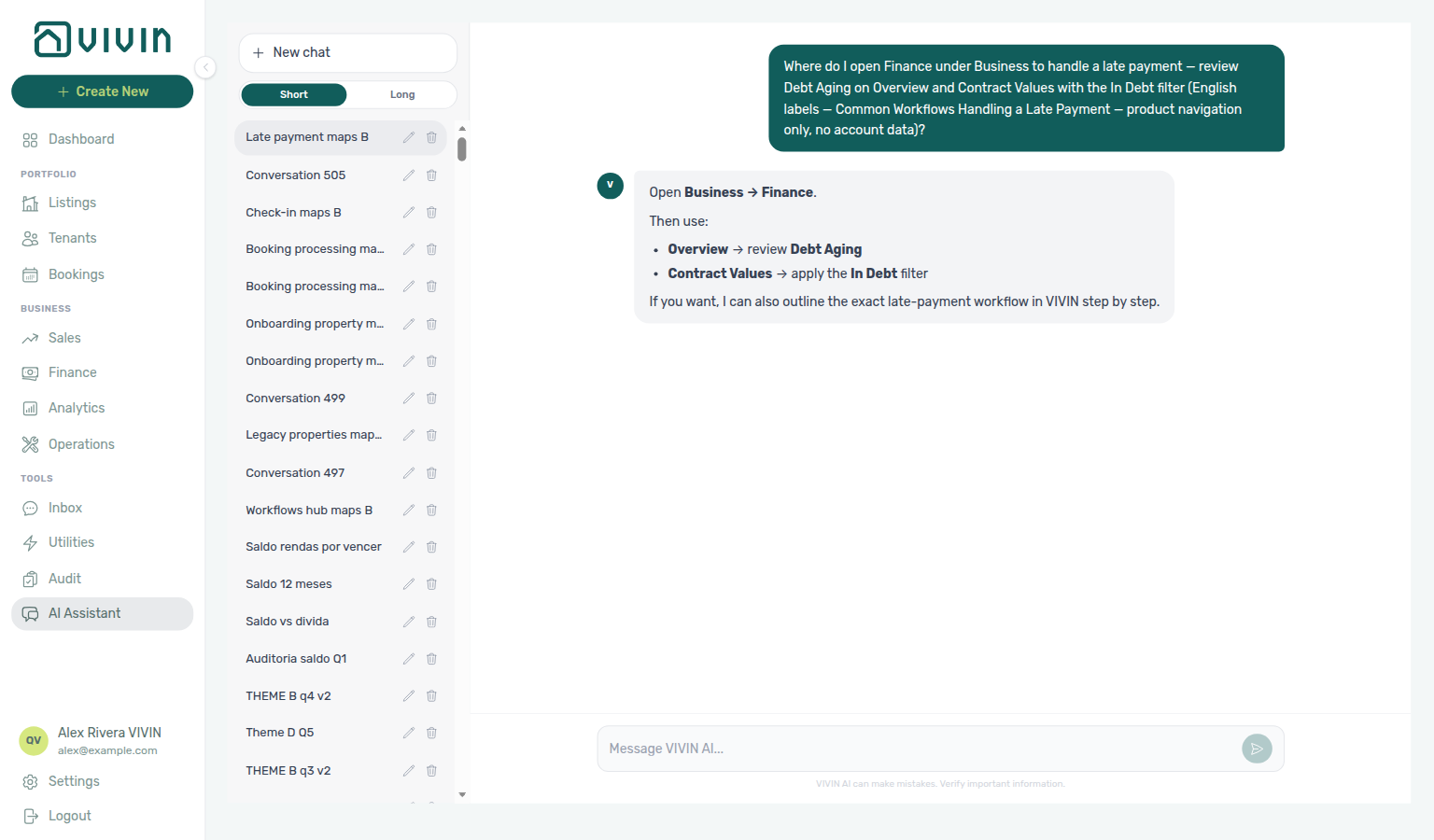
Ask AI Chat “Where do I open Finance under Business to handle a late payment — review Debt Aging on Overview and Contract Values with the In Debt filter (English labels — Common Workflows Handling a Late Payment — product navigation only, no account data)?” — then open Business → Finance (ai-chat-product-context-late-payment-reply.png, ai-chat-product-context-late-payment-flow.mp4). The assistant typically says Business → Finance, then use Overview → Debt Aging and Contract Values with the In Debt filter. Same grounding external MCP clients get from get-vivin-context-overview (or get-vivin-context-finance). Distinct from alert triage on Notification triage and from the broader Common Workflows hub product maps.
Collections assume payment deadlines and reminder emails from Settings → Payments, Invoicing & Utilities and Settings → Emails (setup steps 8 and 11) are configured — complete Getting Started — Recommended Setup Sequence steps 1–15 and at least one live reservation before routine arrears work. Lockout catch-up: Getting Started — Lockout catch-up after password recovery.
Identify arrears in Step 1 — Identify overdue payments; tenant outreach: Step 3 — Contact the tenant. Record and approve: Step 4 / Step 4b; penalties: Step 5. Escalation and month-end Pending: Step 6 / Step 6b. Habit-specific shortcuts live under Related below.
When a tenant misses a payment due date, follow this workflow to manage the situation consistently. Collections usually apply to Ongoing stays (current in the API) with unpaid scheduled charges, though Upcoming bookings can also owe confirmation or move-in requirements before check-in — see Booking lifecycle.
Start from Notification triage when a payment overdue alert brought you here — during month-end, pair Step 4 row-click triage with Portfolio KPI review — Dashboard Total Debt subtitle and clear payment alerts in Notification triage — Step 5 after balances settle. During departure week, pair with Common Workflows — Check-out collections before refund (upstream Managing a Check-out — Step 6 / downstream Step 5 after Steps 1–4; workflows-check-out-coordination-flow.mp4, bookings-detail-payment-plan-tab-schedule.png). Before policy void, pair with Common Workflows — Cancellation collections before void (upstream Cancelling a Booking — Step 2 / downstream Step 4 after Steps 1–4; finance-contract-values-in-debt-filter.png, bookings-detail-transactions-approve-payment-modal.png, workflows-cancel-booking-refund-modal-flow.mp4). For utility overages on Payment plan, pair with Common Workflows — Utility overage collections (upstream Entering Monthly Utility Bills — Step 4 / Step 4b → Steps 1–4 here; utilities-allocations-row-breakdown-expanded.png, finance-contract-values-in-debt-filter.png, utilities-allocations-review-flow.mp4), Entering Monthly Utility Bills, and Check-out final utilities handoff (departure-week subset). During Step 6 / Step 6b month-end sign-off, poll AI usage API (landlord_chat on GET /ai-usage/summary) when teams leaned on AI Chat for debtor lookups — there is no in-app ledger screen yet.
- Payment deadlines and penalty rules should be configured in Settings > Payments
- Automated reminder emails should be set up in Settings > Emails > Communication Module
Step 1 — Identify overdue payments
Step 1 pairs with Common Workflows — Payment alert to receivables triage (upstream Notification triage — Step 4 / Step 5; notifications-row-navigate-to-booking-detail.png, notifications-row-navigation-flow.mp4, finance-overview-debt-aging-walkthrough-flow.mp4), Common Workflows — Finance debt receivables triage, Common Workflows — Handling a Late Payment collections hub (triage surface → collections step decision table), FAQ — Handling a Late Payment hub, Common Workflows — Reject/revert mistaken receipts (tenant insists they paid — check booking Transactions for duplicate approved rows before Step 3), FAQ — Bookings that owe money (Top debtors / overdue buckets on Finance → Overview), and FAQ — Finance debt receivables triage hub.
Collections triage pairs with Notification triage — Step 4, Finance — Debt Aging, Dashboard — Total Debt, and list-bookings / get-payment on Landlord MCP. Downstream: Step 2 when reminders may have fired.
When a payment overdue or balance alert brought you here, you already completed the upstream path in Notification triage — Step 4 — confirm the balance on this booking before you chase the tenant. Hub matrix: Common Workflows — Payment alert to receivables triage (alert → receivables surfaces → Steps 1–6; notifications-row-navigate-to-booking-detail.png, finance-overview-income-chart-debt-aging.png, finance-overview-debt-aging-expanded-bucket.png) · Handling a Late Payment collections hub (triage surfaces vs Steps 1–6).
| You opened from… | Confirm on booking | Then |
|---|---|---|
| Debt Aging / Top debtors row-click | Payment Plan overdue pills | Step 2 → Step 3 |
/notifications payment overdue row-click | Transactions / Payment Plan | Hub: Payment alert to receivables triage — notifications-row-navigate-to-booking-detail.png → Steps 2–3 |
| Dashboard Total Debt headline only | Open Finance → Overview → Debt Aging first | Finance debt receivables triage — card is not clickable |
| Tenant insists they already paid | Booking Transactions for duplicates | Reject/revert mistaken receipts before Step 3 |
| In Debt line is utility overage (not rent) | Entering Monthly Utility Bills — Step 4 / Step 4b | Hub: Utility overage collections — same Steps 1–4 after charge posts (utilities-allocations-row-breakdown-expanded.png, finance-contract-values-in-debt-filter.png) |
| Ready To Refund blocked by rent/fee arrears | Booking Payment Plan overdue pills | Hub: Check-out collections before refund → Managing a Check-out — Step 6 before Step 5 (workflows-check-out-coordination-flow.mp4) |
Otherwise, find overdue payments in one of these locations:
- Notifications — Payment overdue alerts at
/notifications— when you already received a payment overdue or balance alert, click the row to open the related booking (or tenant / listing when those ids are set) — see FAQ — Notification row-click navigation, Glossary — Notification row navigation, and Notification triage — Step 4 - Finance > Overview tab — use the Debt Aging panel (Top debtors or an overdue bucket) for booking-level receivables, or click In debt on the stacked Income chart for payment-line detail — Glossary — Finance income status; see Finance > Debt Aging and Income status drill-down. A row in a bucket list or Total Debt opens the booking on top of that list so you can return to the same queue (Booking sidebar stays on the drill-down). To slice that open list by booking tag or tenant segment without changing Overview KPIs, use Booking category and Tenant category beside search — chips and the € total sit on the grey summary bar under the pickers.
- Finance > Contract Values — narrow to In Debt rows (scheduled charges past due or unpaid). On large portfolios, open Other filters first: use the paged Property picker (and Select owners when you reconcile one landlord) to scope the table, then add Booking → Select categories when you segment collections by booking tag, or Tenant → Tenant category when arrears cluster on one tenant segment — see Finance — Property and listing filters, Finance — Tenant category filter, and Glossary — Booking Tag
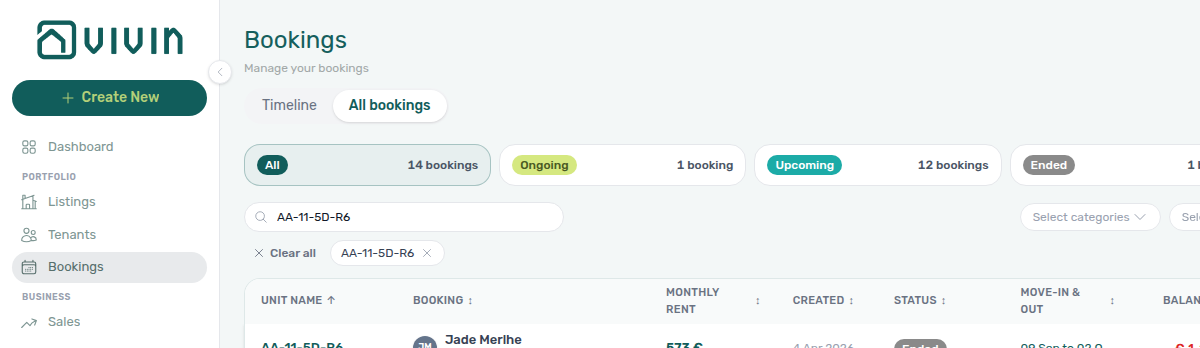
- Bookings — paste the unit internal name in toolbar Search when you know the room but not the tenant spelling; unit hits rank above tenant name or email. See Bookings — Search bar and Glossary — Directory search ranking.
- Tenants — paste a fiscal ID or identification ID in toolbar Search when collections paperwork references the tax id instead of the tenant’s display name; use the With Debt pill for net-negative balances, then switch to table view and expand the row to scan per-booking Balance before you open a profile or booking sidebar. See Tenants — Interface overview (
tenants-directory-fiscal-id-search.png), Table view (expandable booking rows) (tenants-table-row-expanded-bookings.png), and Glossary — Tenants table expand. - Booking → Payment Plan — scan due-date rows for Overdue, Partial Paid, or Partial Overdue status pills; compare Total (expected for that date) with Paid before opening Contract Values for line-level edits — see Schedule table columns
- Portal Home balance card — tenants with the payment module on see Overdue payment and Make payment without waiting for the check-in email. On Payments → Payment Timeline, each late installment also shows Overdue plus N days past due. Settled rows on the same timeline show Paid with no Remaining. A due-window unpaid row shows Pending with amber Remaining. When Total is below the original scheduled amount, that original stays struck through under Total. Future unpaid rows show Due in N days with a grey clock. A Scheduled row whose due date is today or already past (for example a Deposit Refund not yet paid out) shows Upcoming instead — that is not Overdue. When no installment is still in the future, the compact TODAY tick sits after the last card.
- Finance → Deposits — when arrears are a partly collected security deposit (not rent schedule lines), click Partial paid in the Deposit lifecycle status row and open a row — the booking Deposit tab shows Partially paid with a remaining helper. Distinct from Partial Paid rent rows on Payment Plan — see FAQ — Partly collected security deposit and Managing a Check-in — Step 3
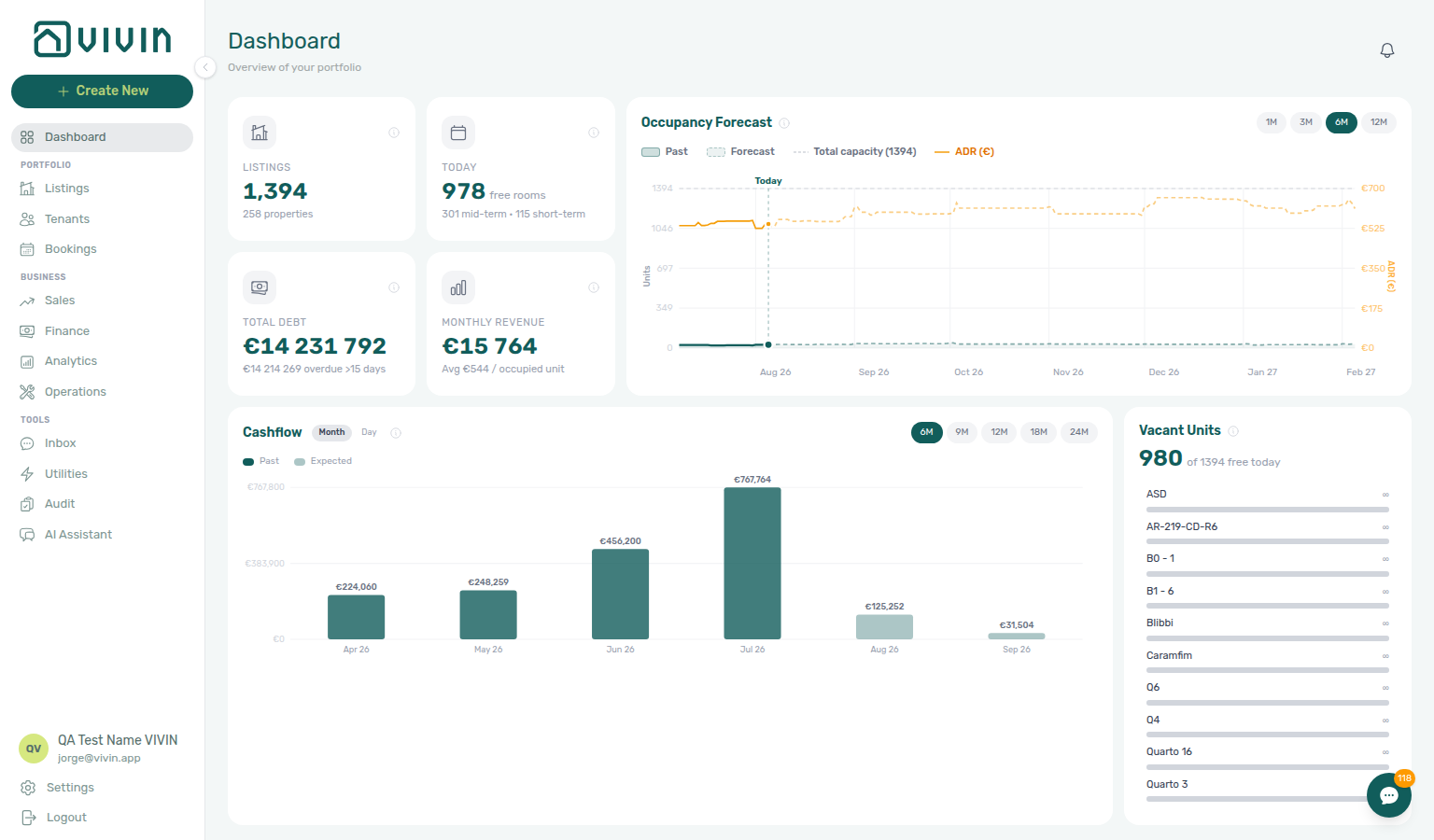
- Dashboard — Total Debt and related KPI cards highlight live-portfolio underpayment at a glance (ongoing bookings only; the card subtitle is debt on stays older than 15 days, not a repeat of the headline — hover the info icon for in-app rules). Finance Total Debt includes all bookings with current underpayment. When the Dashboard headline looks high but you need deposit coverage or ended-booking receivables, open Finance > Overview (Uncovered Debt, seven-card strip) — see Glossary — Dashboard KPI cards, Dashboard — Total Debt vs Finance Overview, Portfolio KPI review — Dashboard Total Debt subtitle, and FAQ — Dashboard Total Debt subtitle.
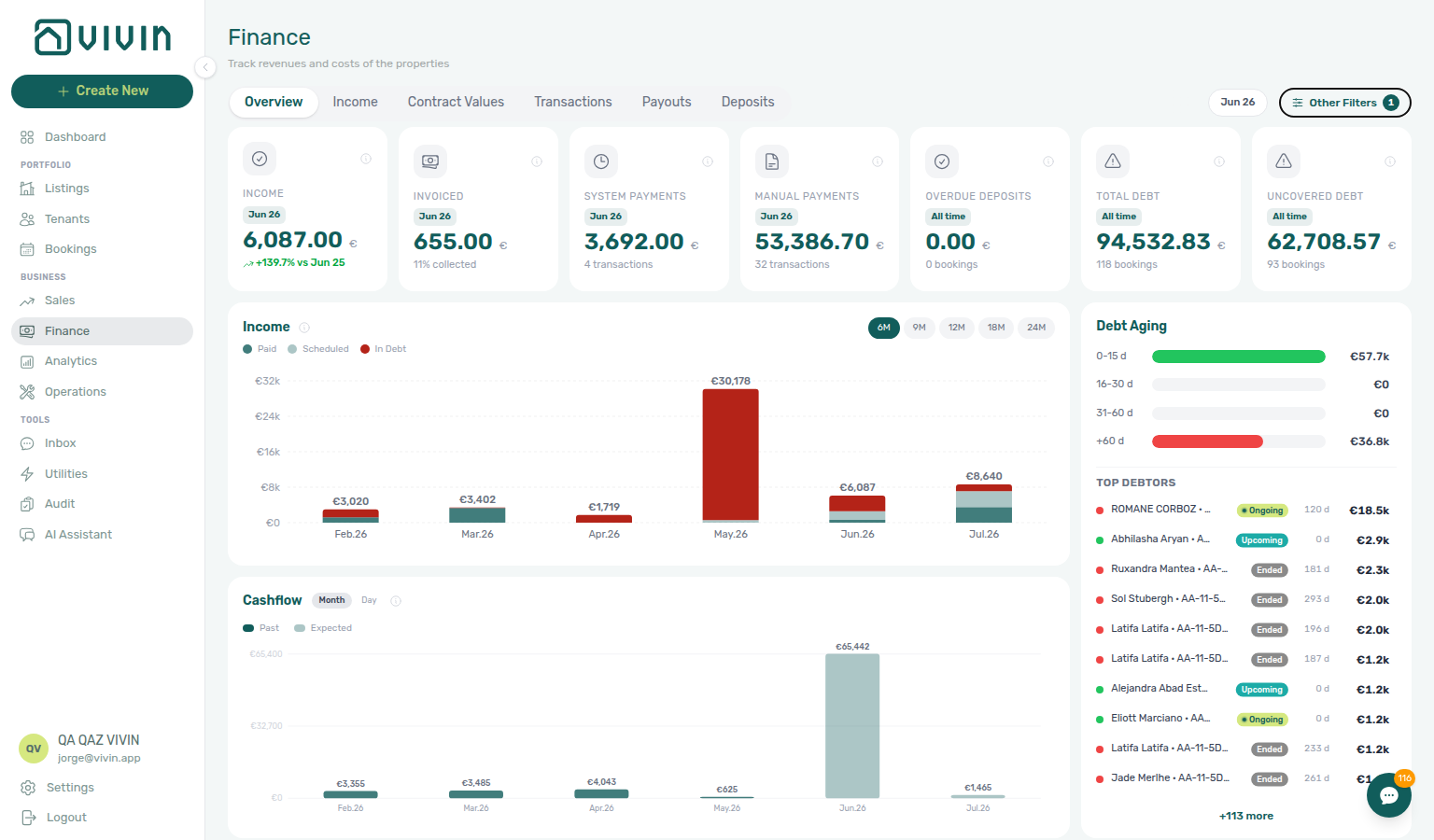
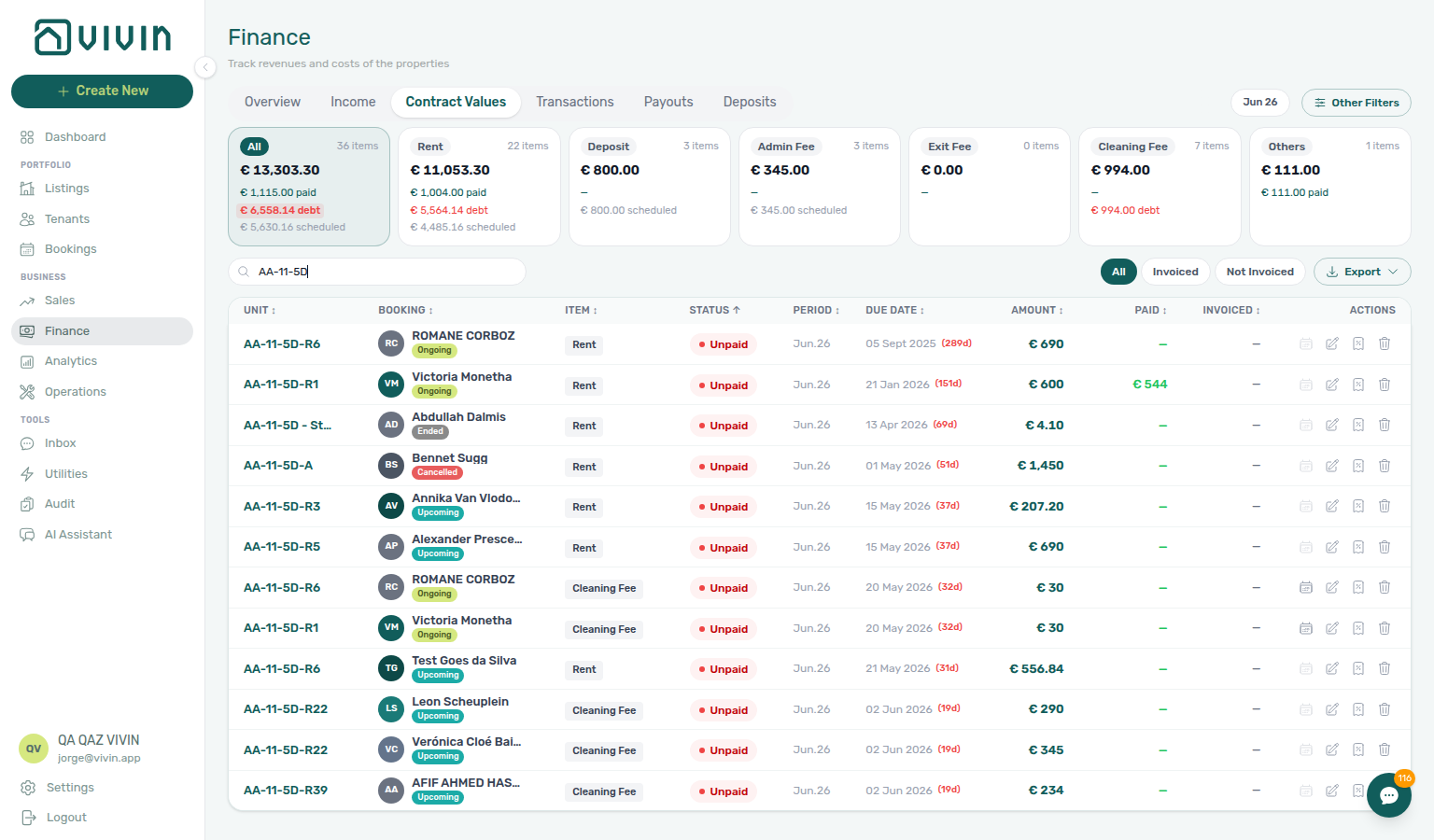
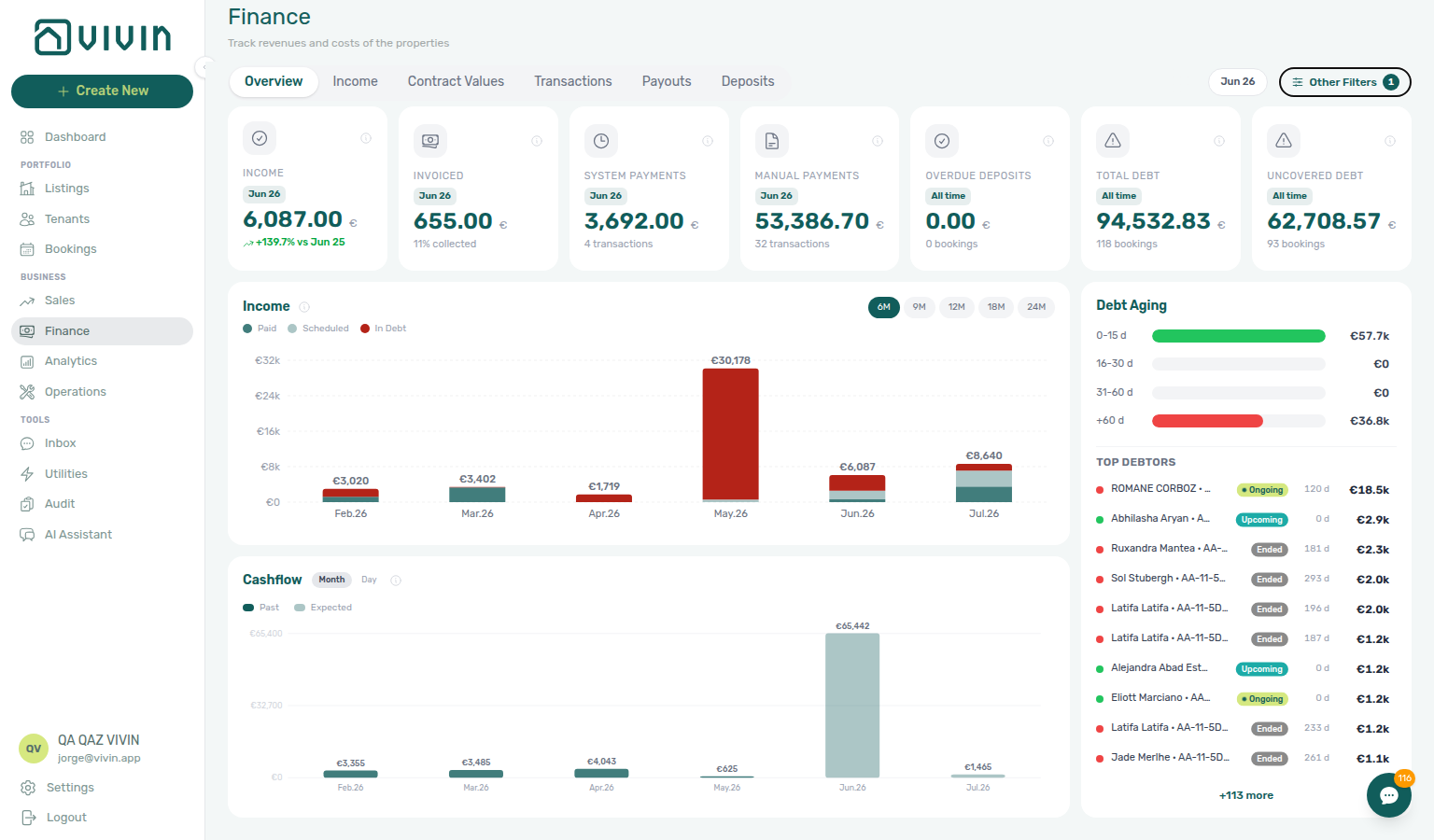
Debt Aging and In debt drill-down clips embedded 2026-06-20 20:08 UTC (shared with Portfolio KPI review — Step 7; recorded via tools/record-finance-overview-debt-aging-walkthrough-mp4.ts and tools/record-finance-overview-income-drill-down-mp4.ts).
On Finance > Overview, scan Uncovered Debt and the Debt Aging top-debtor list to prioritize the largest balances before opening individual bookings. Contract Values → In Debt remains the ledger view when you need every overdue scheduled line.
Account-scoped Landlord MCP clients can surface the same overdue balances you find in Step 1 — list-bookings when several tenants owe on the same property, list-payments / get-payment after you resolve a booking id, and get-booking when a payment overdue alert already supplied the reservation context from Notification triage — Step 4. Booking-scoped Tenant MCP get-payment-info remains the right surface when the conversation is tenant-facing, not portfolio-wide (Step 3).
Step 2 — Check the automated reminder status
Reminder history is operator UI only — pair Settings > Emails — Communication Rules with booking-scoped get-payment-info on Tenant MCP when chatbot tenants ask about due dates. Upstream: Step 1. Downstream: Step 3.
If you have overdue reminder emails configured in Settings > Emails > Communication Module, verify whether a notification has already been sent to the tenant and when. A Due Date rule can show several scheduled or sent rows for the same booking — one per unpaid payment line (not one per stay). Open Communication schedule on that rule to compare dates with Payment Plan.
Communication Rule send history is operator UI only — external clients cannot read Settings > Emails — Communication Rules from MCP. Before you chase a tenant in Step 3, booking-scoped Tenant MCP get-payment-info and get-dates-and-schedule answer chatbot questions about due dates and outstanding balances ("when is rent due?") — contrast with whether your overdue reminder rule already fired, which you confirm in the management UI or on Bookings → Communication. get-portal-links surfaces Make payment when the tenant should self-serve after a reminder. Surface-choice contrast: Automation & AI — Workflow pairing for surface choice.
Step 3 — Contact the tenant
Direct outreach pairs with Tenant Portal — Make payment (Paywall), Bookings — Communication tab, Inbox module, Common Workflows — WhatsApp per-booking messaging / Notification row-click navigation when collections started from a New WhatsApp message from … alert on /notifications. Upstream: Step 2. Downstream: Step 4 when payment arrives.
If automated reminders have not resolved the issue, contact the tenant directly. Many late payments are due to oversight — a quick message is usually enough.
Optional — Tenant self-service (Make payment). When the account payment module and Property Payments Active are enabled, tenants with portal access can pay from Home or Payments → Make payment: they pick an amount (overdue, next installment, overdue + next, or full balance), then Bank Transfer (virtual IBAN) or Credit Card (embedded checkout iframe). The left chevron next to Make payment leaves checkout without paying (back to Home or Payments). Expanding Bank Transfer can open Payment Due Soon when a charge is due soon — tenants dismiss it, then copy the IBAN or tap Credit Card. Card receipts appear on Finance → Transactions after webhook completion — you may still need Approve payment for manual bank transfers your team records. See Tenant Portal — Make payment (Paywall).
Optional — Grant a due-date extension (when agreed with the tenant).
When you negotiate a short extension (for example “pay by Friday”) instead of adding a penalty immediately, an operator with bookings.change_payment_due_date can move the charge due date without rebuilding the whole payment plan:
- Open the booking → Contract Values (or triage from Finance > Contract Values at portfolio scope with In Debt filtered).
- Locate the scheduled or in debt line and use the row calendar action (or Edit due date in the row menu).
- Choose the agreed date in Edit Payment Due Date and save — the Payment Plan tab and Finance roll-ups refresh on the new due date.
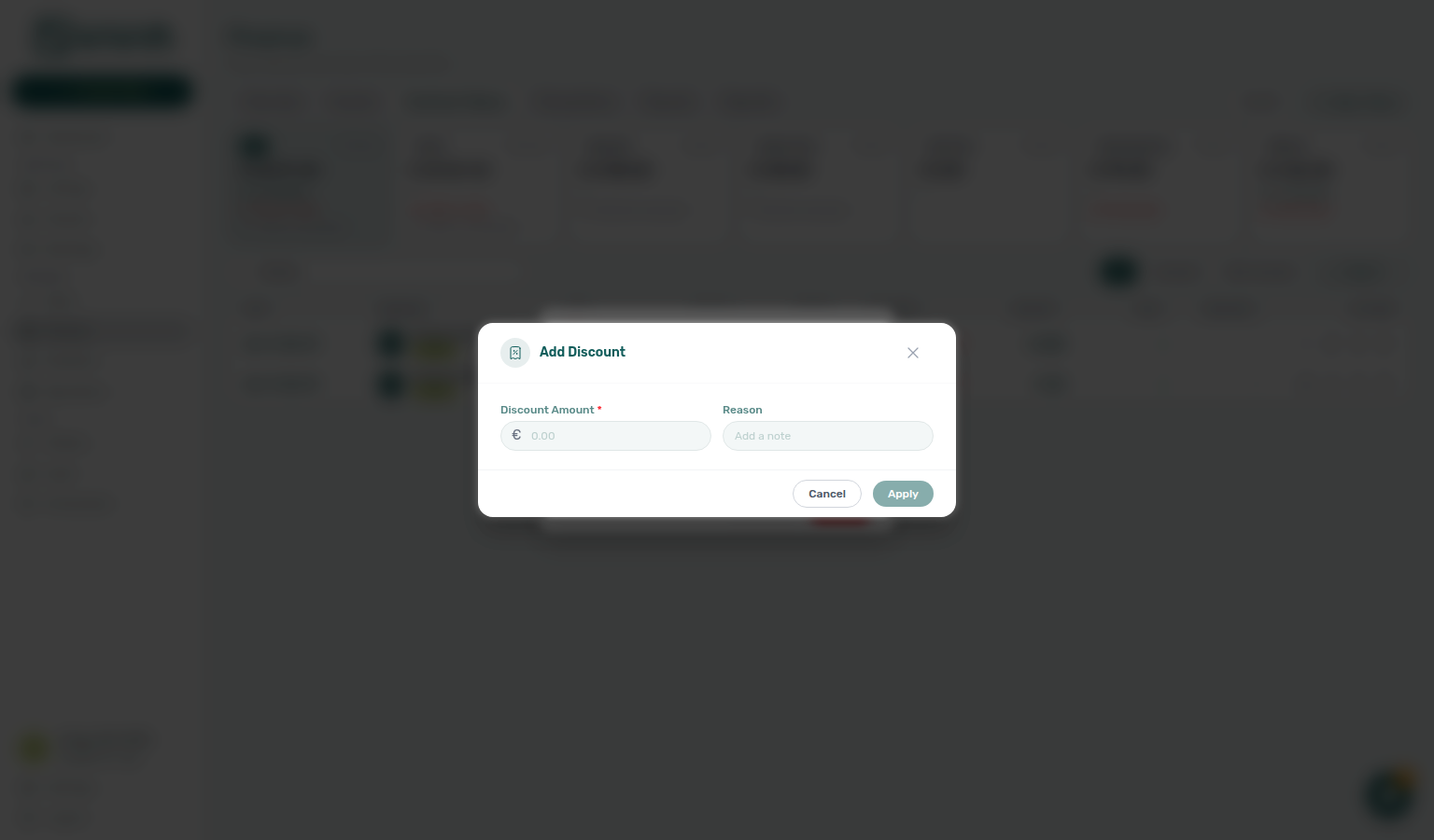
Vivin locks due dates on move-in requirement, booking confirmation requirement, and split rent lines — the calendar control is disabled with an explanatory tooltip. Extensions apply only to manually editable lines. See Bookings > Contract Values — system-managed due dates.
Document the agreed extension in Internal Notes or the Communication thread when the tenant confirms in writing. To correct a note you already sent, hover your bubble and use the pencil — Edit your own notes in place. If Communication messages do not appear, use Refresh in the sidebar header — other tabs stay available. See Glossary — Booking detail sidebar tab refresh.
Step 4 — Record the payment when received
Receipt recording pairs with Finance > Add Payment, Payment Allocation, and create-manual-payment-in on Landlord MCP — pending until Step 4b.
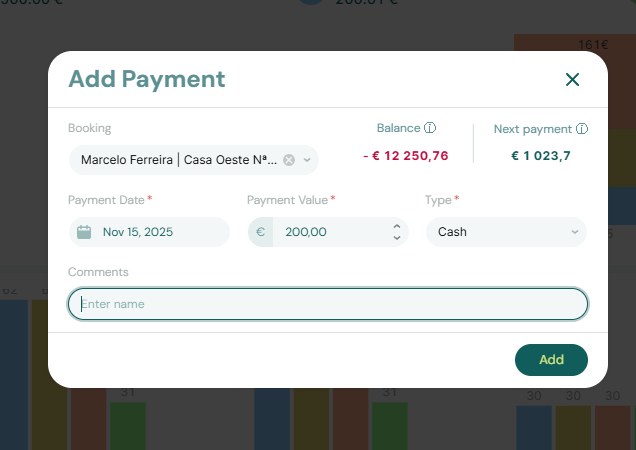
Go to Finance > Add Payment, select the booking, enter the amount and payment date, and save. The system allocates it to the oldest outstanding charge first based on your payment priorities. When the tenant paid on your card terminal, record it from the booking as Card (recorded manually) — not as Tenant Portal Credit Card.
Manual receipts often stay pending until someone with Approve payments confirms them on Finance → Transactions or the booking Transactions tab. Until approval, Total Debt and In debt contract lines may still show the old balance — triage Pending on the ledger and approve (or Reject selected for a mistaken entry) before you mark the tenant current. See Finance — Pending manual payments.
Account-scoped Landlord MCP create-manual-payment-in records the same bank-transfer rows you enter in Add Payment — the receipt may still show pending until Approve payments in Step 4b. External clients cannot approve from MCP; operators continue on Finance → Transactions or the booking Transactions tab.
Step 4b — Approve the receipt (when required)
Pending receipt approval pairs with Processing a New Booking — Step 5b (same habit), Finance — Pending manual payments, and Notification triage — Step 5 after balances settle. Upstream: Step 4.
When a Payment received from tenant … alert brought you here via Notification triage — Step 4, use this step before you mark the notification read in Step 5 — Total Debt and In debt lines may stay stale until approval completes. Follow the same approval habit as Processing a New Booking — Step 5b and Managing a Check-in — Step 3b. During month-end, the same Pending pill queue appears in Portfolio KPI review — Step 7 when Total Debt or Manual Payments disagree with Analytics:
After you save Add Payment, the row may still show pending until approval:
- Open Finance → Transactions (widen the date range if needed) or the booking Transactions tab and confirm Pending rows exist when you expect a manual approval queue.
- On the ledger, click the amber Pending chip on the All type-summary card (or use the Pending status filter) to isolate manual rows — see Finance — Pending manual payments (
finance-transactions-pending-pill.png). - Locate the manual row in the filtered table.
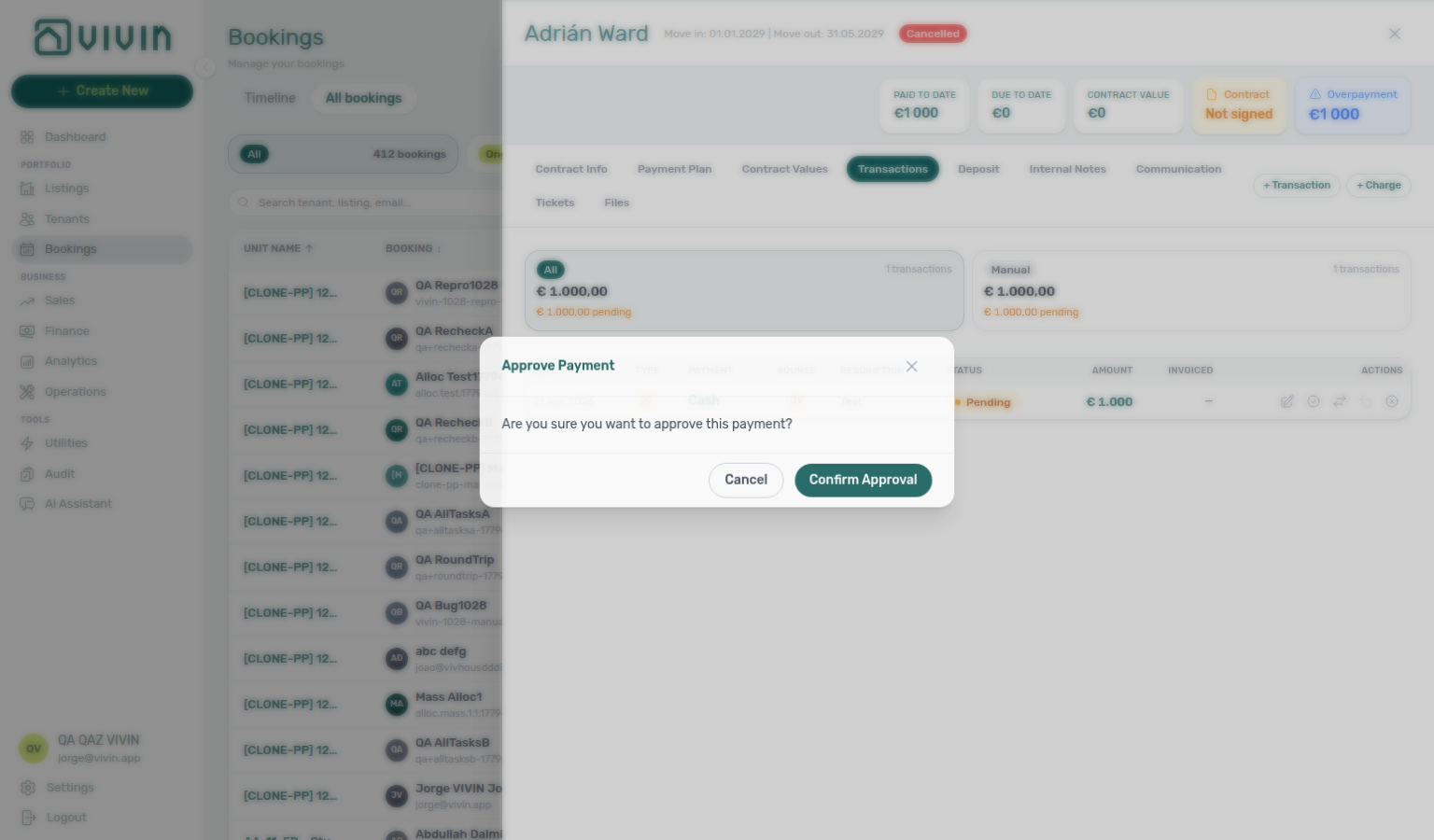
- Click Approve payment (per-row check icon) or tick several rows and use Approve selected from the floating bar. For a mistaken duplicate on the ledger, use Reject selected (bulk-only on Finance — no per-row reject icon there). Reject selected shows the same red credit note warning as booking Transactions when accounting may already have invoiced the charge — see Finance — Reject payment and Bookings — Transactions row actions.


Step 5 — Apply a late payment penalty (if applicable)
Penalty charges pair with Settings > Payments policy, Bookings — Adding Extra Charges, and Audit — Discounts tab when goodwill credits overlap penalties. Upstream: Step 4b when the base charge is still pending.
If your penalty policy in Settings > Payments requires it:
- Open the booking → Payment Plan (or Contract Values) and click + Charge (see Adding Extra Charges)
- Select Penalty Fee as the Category
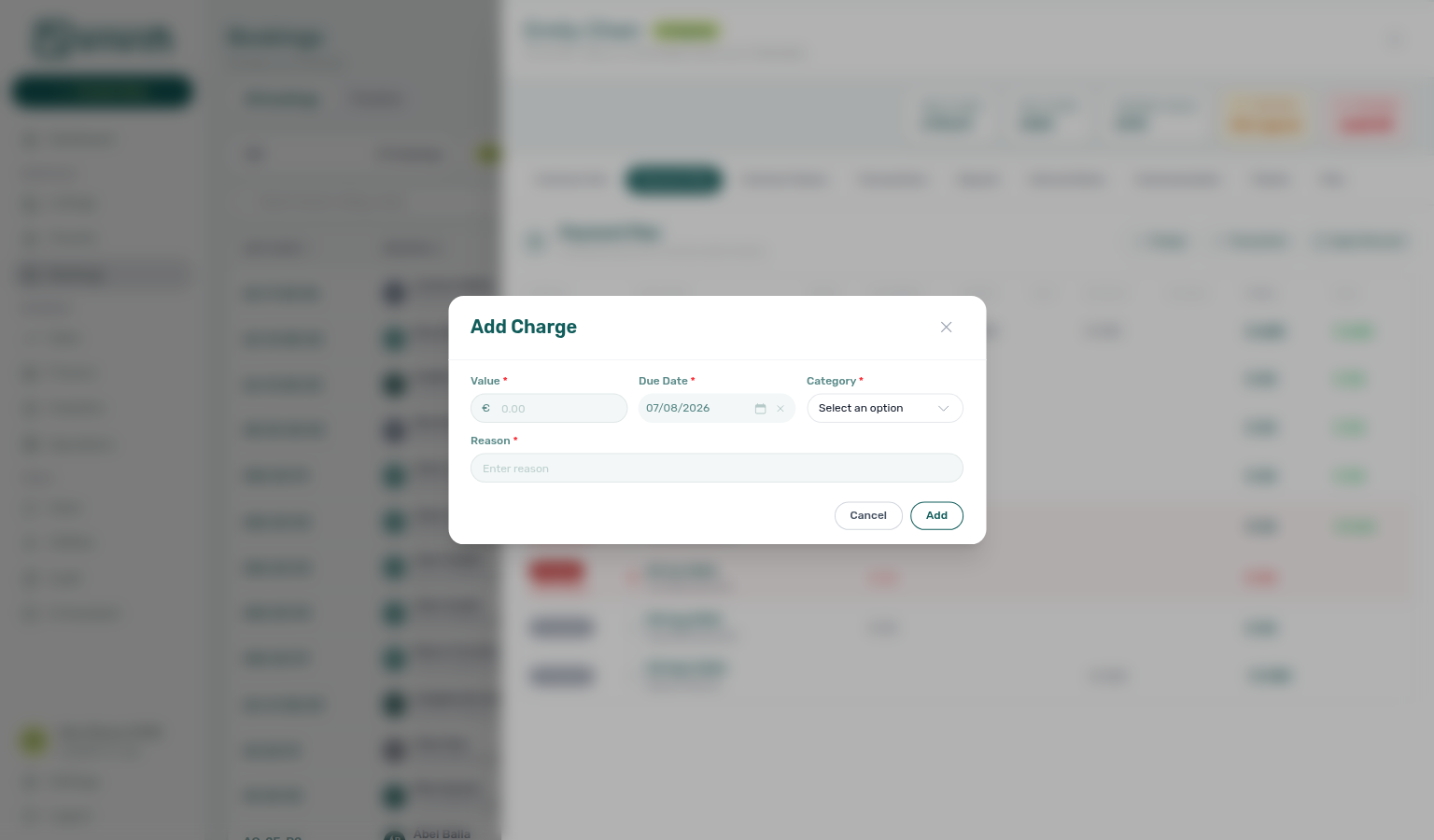
- Calculate and enter the penalty Value (e.g., 1% of the overdue amount per day late).
- Set the Due Date and a Reason, then Add.
Penalties are not automatically applied — they must be manually added as charges. The penalty configuration in Settings defines your terms, but you must create the charge yourself.
To skip account Payment Delay Penalties for one reservation, tick Exclude this booking from penalty fees on Contract Info → Method of payments. Marketplace imports cannot send that flag — Creating Bookings — Exclude from penalty fees.
Unpaid move-in requirements after check-in may trigger Auto-cancel unpaid move-in when the account enables it and the grace period elapses with no partial payment — distinct from chasing ongoing rent on Ongoing stays in the steps below. An Auto-cancellation Communication Rule can email the tenant the same day that backstop runs.
Step 6 — Escalate if unresolved
Segment-wide escalation pairs with Portfolio KPI review — Step 6, Settings > Emails — Communication Rules audience, Using in-app support (Vivin product defects), and notify-landlord on Tenant MCP (tenant-facing alert — contrast operator filters). Last resort: Cancelling a Booking — hub: Common Workflows — Cancellation collections before void (Step 2 settlement before Step 4; bookings-cancel-booking-modal-refund-types.png, workflows-cancel-booking-refund-modal-flow.mp4).
If multiple contact attempts fail, escalate through your standard collections process. Document all communication attempts in the booking's notes field for future reference. When arrears block a departure-week Ready To Refund toggle (Ready to Refund on depositStatus — see Glossary — Deposit lifecycle status), pair this step with Common Workflows — Check-out collections before refund and Managing a Check-out — Step 6 before finance queues the deposit return — when the tenant already passed check-out day but status still reads Ongoing with unpaid rows, continue Managing a Check-out — Step 7 after settlement rather than opening a duplicate collections case on an Ended stay. On Upcoming bookings with unpaid confirmation or move-in requirements, pair segment filters with Processing a New Booking — Step 6 before you change portal modules account-wide — portal mail and tenant-category gates may still block self-service Make payment in Step 3. On newly onboarded inventory, pair first-live-booking collections with Onboarding a New Property — Step 7 before you change tenant-category portal rules account-wide. When repeated collections fail, last-resort cancel still requires refund-type confirmation in the booking sidebar — see Cancelling a Booking — Step 4 and post-cancel cleanup in Cancelling a Booking — Step 6. When arrears cluster on one tenant category across several bookings, scope Finance → Other filters Tenant → Tenant category (and mirror on Bookings → Tenant categories or Tenants — Tenant category filter) before you change communication rules or portal modules account-wide — see Settings > Tenant categories and Portfolio KPI review — Step 6. When unpaid utility overage lines cluster on one segment, pair the same filters with Entering Monthly Utility Bills — Step 4 before you chase rent on unrelated bookings. At month-end, after you clear individual balances in Steps 4–4b, run Portfolio KPI review — Step 7 to confirm Total Debt, Manual Payments, and Debt Aging agree before you sign off portfolio KPIs — lingering Pending rows may still inflate KPIs until you finish the Step 6b mesh: arrival-week move-in transfers (Managing a Check-in — Step 6b), confirmation-week imports (Processing a New Booking — Step 6b), departure-week settlements (Managing a Check-out — Step 6b), cancellation settlements (Cancelling a Booking — Step 6b), and utility overage bank transfers (Entering Monthly Utility Bills — Step 4b). Clear stale payment overdue rows in Notification triage — Step 5 after segment escalation settles — file Notification triage — Step 6 when row-click or read-state fixes need Vivin support.
Account-scoped Landlord MCP get-booking-summary gives portfolio-level active/upcoming counts before you scope Finance → Other filters Tenant → Tenant category for segment-wide arrears — pair with list-bookings when several tenants in the same tenant category owe at once, then list-payments / get-payment after you resolve booking ids from Contract Values In Debt rows. When escalation paperwork lists a fiscal ID or tenant display name instead of a booking id, list-tenants, get-tenant, and get-tenant-bookings resolve the profile and linked reservations before you open Contract Values. get-booking returns reservation context when a payment overdue alert already supplied the id from Notification triage — Step 4. list-tickets / get-ticket / add-ticket-comment surface open Operations prep or damage jobs and document collections attempts on the ticket thread when maintenance disputes block payment — external clients cannot close-ticket or edit Cost allocation from MCP alone. cancel-booking is a write tool; operators still confirm refund type in the booking sidebar (Cancelling a Booking — Step 4). External clients cannot change Communication Rules from MCP; operators finish escalation in the management UI.
Booking-scoped Tenant MCP notify-landlord alerts your team when a tenant reports arrears through a chatbot or portal channel — it does not replace operator collections in Steps 1–5 or segment filters in this step. get-payment-info remains the right tenant-scoped read when the conversation is about one reservation's schedule, not portfolio-wide In Debt rows. list-bookings-by-email resolves the booking id when a WhatsApp or email thread only shows the guest address — pair with Notification triage — Step 4 when Inbox preceded the escalation. Surface-choice contrast: Automation & AI — Workflow pairing for surface choice.
Finish Steps 1–5 and segment filters in this step before you open a Vivin support ticket — payment overdue alerts, Finance → Contract Values In Debt rows, and Tenant Portal — Make payment self-service are operator workflows, not product defects. File Using in-app support when Vivin behaviour blocks collections despite correct operator steps:
- Approve payments or
bookings.change_payment_due_datepermission missing for your role — attach your user email and the booking id on the New Support Ticket modal (Finance or Bookings module). - Finance → Other filters Tenant → Tenant category omits a segment that Bookings and Tenants still list — attach the category name and a sample booking id; see FAQ — Finance tenant category filter parity before filing.
- Landlord MCP or Tenant MCP external clients return persistent 403 / auth errors after you refreshed the management JWT — see Using in-app support — When to use in-app support, Landlord MCP — Permissions and safety, and Resetting a Management User Password — Troubleshooting.
Use the Help & Support drawer from Finance or Bookings so screenshots stay in context; bookmark /bookings?support=<ticketId> when you need the drawer on the reservation you are chasing — Deep Links — Support. If a management lockout delayed segment-wide collections triage, recover access with Resetting a Management User Password (Step 3) before you rerun Step 1 and Steps 4–4b — refresh Landlord MCP Bearer JWT after Step 3 there; catch up unread payment overdue rows in Notification triage — Step 5; continue Portfolio KPI review — Step 7 when month-end Total Debt lagged during the lockout.
Step 6b — Approve lingering collections receipts (when required)
Month-end Pending mesh pairs with Portfolio KPI review — Step 7, Processing a New Booking — Step 6b, and Managing a Check-in — Step 6b on the same ledger queue. Upstream: Step 4b.
At month-end when collections-week bank transfers you recorded in Step 4 still show Pending on Finance → Transactions but Contract Values In Debt rows or Payment Plan due-date pills still list the charge as unpaid — follow Step 4b and the same approval habit in Portfolio KPI review — Step 7 before you treat segment-wide arrears in Step 6 as unresolved collections:
- Open Finance → Transactions (widen the date range if needed) or the booking Transactions tab.
- Click the amber Pending chip on the All type-summary card (or use the Pending status filter) — see Finance — Pending manual payments.
- Locate manual in-payment rows tied to Contract Values lines you cleared in Step 4.
- Click Approve payment (per-row check icon) or tick several rows and use Approve selected from the floating bar. For a mistaken duplicate, use Reject selected — see Payment Allocation — Correcting mistaken receipts.
When Total Debt, Manual Payments, or Debt Aging still disagree with Analytics after you approve collections receipts on individual bookings, finish the cross-workflow Pending mesh in Step 6 before you open a Vivin support ticket: arrival-week move-in transfers (Managing a Check-in — Step 6b), confirmation-week imports (Processing a New Booking — Step 6b), departure-week settlements (Managing a Check-out — Step 6b), cancellation settlements (Cancelling a Booking — Step 6b), and utility overage bank transfers (Entering Monthly Utility Bills — Step 4b). Clear stale payment overdue rows in Notification triage — Step 5 after the mesh settles.
Approve payments and ledger Reject selected are operator workflows — finish Step 4b and the mesh above before you file Using in-app support when Approve payment is missing for your role, Pending rows persist after approval, or Landlord MCP / Tenant MCP clients return persistent 403 after you refreshed the management JWT — see Resetting a Management User Password — Troubleshooting. If a management lockout delayed month-end collections approval, recover access with Resetting a Management User Password (Step 3) before you rerun this step — pair with Processing a New Booking — Step 6b and Portfolio KPI review — Step 7 on the same Pending queue.
Handling a Late Payment section cross-reference
Use the steps above for the main path. For related guides, open Related below, or return to Common Workflows.
Related
Related below links this workflow to modules, concepts, settings, and escalation paths.
Documentation map & escalation
- Common Workflows — Hub pairing matrix across all operator guides
- Glossary — Term definitions referenced in the steps above
- FAQ & Troubleshooting — Quick answers when collections steps do not match live product behaviour
- Get Help & Support — Escalate when permissions block due-date extensions or approvals
Upstream & downstream workflows
- Notification triage — Upstream when a payment overdue alert brought you here (Step 1); clear payment alerts after the balance is settled (Step 5)
- Notifications — Payment overdue alerts — Operator Payments category rows on
/notificationsand the Dashboard bell (Step 1) - Entering Monthly Utility Bills — Unpaid utility overage lines use the same collections path (Step 1); segment-wide overage triage in Step 4 (Step 6)
- Entering Monthly Utility Bills — Step 4b — Utility overage Pending receipts in the Step 6 / Step 6b month-end mesh
- Processing a New Booking — Step 6b — Confirmation-week Pending receipts that can inflate Total Debt during Step 6 month-end review
- Managing a Check-out — Step 6b — Departure-week Pending receipts before Ready To Refund during Step 6 month-end review
- Cancelling a Booking — Step 6b — Cancellation settlement receipts and stale alerts after last-resort cancel (Step 6)
- Notification triage — Step 6 — Vivin support when payment alert row-click or read-state is blocked after Step 6 settlement
- Managing a Check-in — Resolve move-in requirements before key handover
- Managing a Check-out — Step 6 — Clear arrears before Ready To Refund
- Managing a Check-out — Step 7 — Collections after check-out day vs Ended status (Step 6)
- Processing a New Booking — Step 6 — Portal gates on Upcoming unpaid confirmation/move-in rows (Step 6)
- Automation & AI — Landlord vs Tenant MCP surface choice during segment-wide escalation (Step 6)
- Portfolio KPI review — Step 7 — Month-end Pending pill triage when Total Debt or Manual Payments lag recorded collections receipts (Step 4b); segment-wide Total Debt sign-off after Step 6 escalation
- Managing a Check-in — Step 6b — Arrival-week Pending move-in receipts that can inflate Total Debt during Step 6 month-end review
- Processing a New Booking — Step 5b — Same approval habit for confirmation receipts (Step 4b)
- Managing a Check-in — Step 3b — Move-in receipt approval on arrival week (Step 4b)
- Cancelling a Booking — Last-resort path when auto-cancel or repeated collections fail (Step 6)
- Cancelling a Booking — Step 6 — Post-cancel ticket closure after last-resort cancel (Step 6)
- Onboarding a New Property — Step 7 — First-live-booking collections on newly onboarded inventory (Step 6)
- Notification triage — Step 5 — Clear payment alerts after escalation or settlement (Step 6)
- Using in-app support — Vivin product tickets when Step 6 permissions, Finance filter parity, or MCP auth block self-serve collections; Help & Support drawer from Finance or Bookings
- Resetting a Management User Password — Recover access when a lockout delayed segment-wide collections (Step 6, Step 6b) or payment overdue triage (Step 1)
Concepts & settings that shape this workflow
- Booking Lifecycle — Which list filters and status labels apply while chasing overdue charges
- Tenant Portal — Tenant self-service Make payment from the Home balance card when the payment module is enabled; Overdue days past due on Payments → Payment Timeline shows N days past due per late installment; Paid installment shows a green Paid Total on settled rows; Pending installment shows amber Pending Remaining on a due-window row; Discounted installment shows the original amount struck through under Total when that amount is lower; Scheduled Due in N days shows Due in N days on future unpaid rows; Upcoming shows Upcoming on a Scheduled row whose due date is today or already past (not Overdue); TODAY compact tick at the end sits after the last card when nothing is still ahead
- FAQ — Tenant contract signing blocked — No PDF yet, mandatory Your Details gates, category locks, or Lease purpose; portal signing vs paper upload on Contract Info
- Tenant MCP — Booking-scoped
get-payment-infoduring tenant-facing collections (Step 3);notify-landlordwhen tenants escalate through chatbot channels — contrast with operator Step 6 segment filters; file Using in-app support — When to use in-app support for Vivin product defects - Using in-app support — Help & Support drawer and New Support Ticket modal when Step 6 permissions, Finance filter parity, or MCP auth block self-serve collections
- Landlord MCP — Account-scoped
get-booking-summarybefore segment-wide escalation (Step 6);list-bookings,list-tenants,get-tenant,get-tenant-bookings,list-payments,get-payment,get-booking,list-tickets,get-ticket, andadd-ticket-commentduring collections and maintenance-blocked arrears (Steps 1, 4–4b, 6);create-manual-payment-in(Steps 4–4b);cancel-bookingwrite tool — operators still confirm refund type in UI (Cancelling a Booking — Step 4); hub - Payment Allocation — Two-layer receipts and credit note reject/revert warnings
- Integrations & Distribution — Collections on marketplace-imported bookings
- Services Marketplace — Portal service charges on Transactions when overdue balances include add-ons
- Settings > Emails — Due Date — one reminder per unpaid payment — Overdue reminder automation (Step 2); several schedule rows for one booking is expected
- Tenant MCP — Property, payments, and portal tools — Booking-scoped
get-payment-info,get-dates-and-schedule, andget-portal-linkswhen chatbot tenants ask about due dates after an overdue reminder (Step 2); contrast operator Communication Rules send history - Settings > Payments — Penalty policy configuration (Step 5)
- Settings > Preferences — Auto-cancel unpaid move-in — Unpaid move-in requirements after check-in
- Settings > Preferences — In-app notifications — Account-wide payment overdue categories
- Settings > Tenant categories — Segment portal rules and portfolio filters when Step 6 arrears cluster on one tenant category
Finance, bookings & tenant surfaces
- Finance module — Overview, Contract Values, Total debt drill-down, and pending manual payments
- Finance — Booking sidebar stays on the drill-down — Open a booking from Total Debt or a Debt Aging bucket without losing the queue (Step 1)
- Finance — Filter the debt list by category — Booking category / Tenant category inside Total Debt without re-running Overview (Step 1)
- Finance — Filter toolbar stays two bars — chips and € totals on the grey summary bar under the white pickers (Step 1)
- Bookings — Payment Plan tab — Due-date status pills and Add Payment
- Tenants module — Fiscal ID search and table expand
- Finance — Tenant category filter — Other filters → Tenant → Tenant category when arrears cluster on one segment (Step 6)
- Bookings — Tenant categories mirror when Finance Overview still shows the old segment (Step 6)
- Tenants — Tenant category filter — Profile-count cross-check before changing portal rules account-wide (Step 6)
- Finance > Transactions — Row actions — Approve and bulk Reject selected (Step 4b)
- Payment Allocation — Correcting mistaken receipts — Approve, reject, and revert on Transactions (Step 4b)
- Dashboard — Total Debt — Month-scoped KPI before Finance drill-downs (Step 1)
- Analytics module — Revenue tab — Longer-range Debt Aging context
- Inbox module — WhatsApp follow-up when tenants reply on overdue balances
- Audit — Discounts tab — Cross-portfolio discount review before goodwill reductions (Step 5)
- API Reference — Creating bookings — Partner imports with outstanding confirmation payment (Step 4)
- API Reference — Booking lifecycle validations — Background validation before Contract Values triage (Step 1)
- API Reference — Management session — Operator JWT routes for scripted reconciliation (Step 4b)
Deeper workflow reads
See Upstream & downstream workflows above for the same guides.
Deeper API reads
- Management session authentication — Operator JWT routes for scripted reconciliation (Step 4b)
- Booking Lifecycle & Validations — Background validation before Contract Values triage (Step 1)
- Webhooks & Notifications — Payment-related webhook events that surface as in-app alerts
- Error Handling — Retry policy when receipt approval or allocation returns recoverable errors
- AI usage API — Internal LLM token ledger (
GET /ai-usage/summary;landlord_chat) during Step 6 month-end escalation
Operator habit hubs
Day-to-day operator habits (lockout catch-up, pending receipts, payment triage, handoffs, and related playbooks) live on the Common Workflows habit hub.
Deep-link anchors for habit hubs
Check-out vs cancellation
Lockout catch-up after password recovery
Pending manual receipt approval
WhatsApp per-booking messaging
Bot reasoning (audit)
ChatBot settings
Notification row-click navigation
Payment notification (operator)
Payment alert to receivables triage
Finance debt receivables triage
Handling a Late Payment collections
Finance Income status drill-down
Cash flow forecast drill-down
Reject/revert mistaken receipts
Month-end invoicing (fixed date)
Bulk Hostkit invoicing
Utility overage collections
Check-out final utilities handoff
Check-in to check-out handoff
Check-out collections before refund
Check-out ledger cleanup before refund
Cancellation collections before void
Rent reduction after invoicing
Same-day turnover coordination
Occupancy KPI to block hygiene handoff
Deposit missing on Finance Deposits
Deposit lifecycle status
Partly collected security deposit
Wrong tenant on a booking
Cancel Booking vs Delete Booking
Portfolio retirement decisions
Provider platform Delete Booking guard
Archived booking ledger visibility
Archive property (building-level)
Confirmation to check-in handoff
Confirmation alert triage
Portfolio segmentation by tenant category
Dashboard Total Debt subtitle
Step 1 ranks Top debtors on Finance — use post-login Total Debt as a live-portfolio snapshot before outreach, not as the booking list.
- FAQ — Dashboard Total Debt subtitle — Headline vs >15 days subtitle (
dashboard-kpi-total-debt-tooltip.png) - Step 1 — Identify overdue payments — Debt Aging / Top debtors (
finance-overview-debt-aging-expanded-bucket.png) - Payment alert to receivables triage — Alert-driven entry before
/compare - Pending manual receipt approval — Clear Pending before collections (
finance-transactions-pending-pill.png) - Portfolio KPI review — Dashboard Total Debt subtitle — Month-end headline reconciliation
Uncovered Debt KPI
Step 1 ranks Top debtors — when Uncovered Debt ≈ Total Debt on the seven-card strip, deposit cushions are thin and collections risk is high.
- FAQ — Uncovered Debt KPI — Deposit coverage vs Total Debt (
finance-overview-kpi-cards.png) - Glossary — Uncovered Debt — Prioritize thin-offset debtors (Step 1)
- Step 1 — Identify overdue payments — Debt Aging / Top debtors
- Finance debt receivables triage — Hub mesh (
finance-overview-debt-aging-expanded-bucket.png) - Dashboard Total Debt subtitle — Ongoing-only
/vs Finance all-booking KPIs
Directory list refresh
When a directory such as Bookings, Notifications, or Listings needs a refresh during this workflow, use Retry on the alert, or reload the page. Zero rows after a successful load means your filters matched nothing — widen filters or clear search.
See FAQ — Directory list refresh and Common Workflows — Directory list refresh.
Booking sidebar tab refresh
Inside an open booking, Communication and Tickets load independently — use header Refresh (Communication) or banner Retry (Tickets). Other sidebar tabs stay usable. Whole-module list refresh is Directory list refresh.
See FAQ — Communication or Tickets won't open and Common Workflows — Booking sidebar tab refresh.
Key glossary terms
- Glossary — End-of-Booking cost split — Charge Time → End of Booking splits daily overage across every occupied unit; still-staying roommates stay in the denominator
- Glossary — Change history — Operator-initiated edits on Listings setup and Bookings Changelog; create-time defaults excluded
- Glossary — Archived booking ledger visibility — Delete Booking hides manual/provider_platform rows on Finance → Transactions; vIBAN and credit card stay visible
- Glossary — Finance tenant category cache refresh — Recategorizing a tenant updates
booking.tenantCategoryIdimmediately; ledger tabs reflect it on reload, while Overview can lag up to ~10 minutes - Glossary — SIMAR water contract ID — SIMAR (Loures e Odivelas) water bills use Cód. Local in Connections — not Nº de Contador; leading zeros stripped
- Glossary — Per-booking maintenance ticket opt-out — Add booking checkboxes skip automatic CI/CO tickets for one reservation only; property rule unchanged
- Glossary — Full term list
Module documentation hubs
- Utilities module — Bills Included ceiling model and tenant overage charges
- Operations module — Maintenance tickets and check-in/out coordination
- Listings module — Property wizard and unit management
- Sales module — Portfolio availability and channel connections
- Notifications module — Full
/notificationshistory; Payment overdue alerts when scheduled charges are overdue (Step 1) - Booking engine details — Rich marketplace payload editor
- Properties workspace — Legacy
/propertiesURL redirects - AI Chat module — AI Assistant
- Account Settings — Workspace-wide financial policies
- API Reference hub — Partner HTTP contracts